Hello, puzzle friends, and welcome down to the pantry.
The shelves are full of jam jars, there are sacks of flour in the corner, and a whole family of little grey mice has moved in for the day.
Your job today is very simple to explain and not at all simple to do: count the mice.
Be careful, because the number is not nine, whatever your first glance tells you.
Some of these mice are plump and easy to see, sitting right out in the open.
Others are much smaller and have tucked themselves beside the bigger ones, where they are easy to walk right past.
A friendly tip: count in rows, from the top shelf down to the floor, and do not hurry.
Write your number down before you read on, and let us see how close you get.
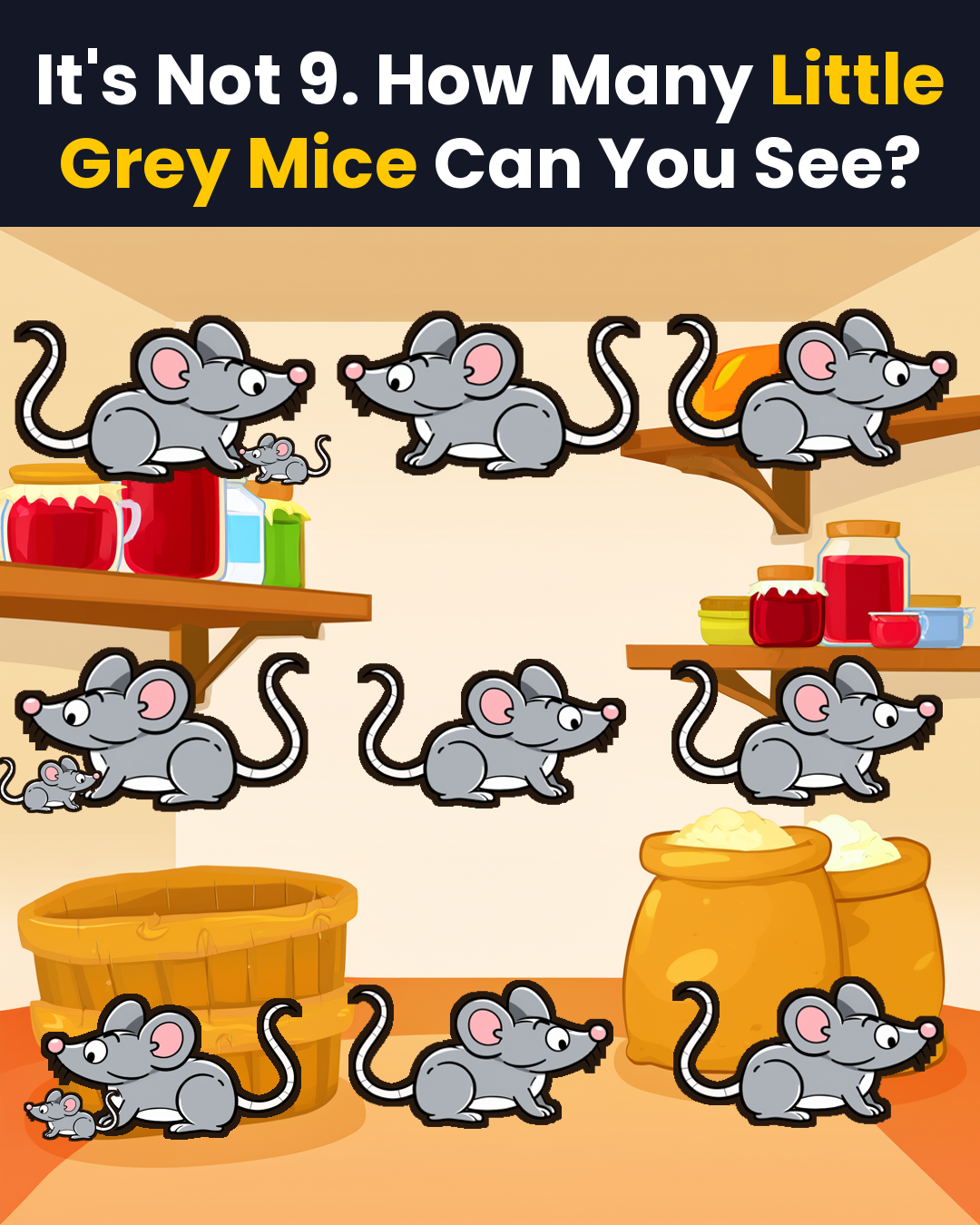
Take your time and look closely before you scroll down!
How To Count Without Losing Track
Counting looks like the easiest thing in the world until you try it on a picture like this one. Eyes wander, you lose your place, and suddenly you are not sure whether you already counted that mouse by the barrel.
The cure is a fixed route. Decide before you start that you will go left to right along the top, then left to right along the middle, then left to right along the bottom. Never jump back up. Use your finger on the screen if that helps, because touching each one makes it far harder to count the same mouse twice.
Then do a second pass just for small shapes. Ignore the big obvious mice entirely and search only for little ears, little tails and little pink noses near the edges and the corners.
Why Counting Fools Us
Human beings are surprisingly poor counters. Up to about four items we simply know the number at a glance, without counting at all. Beyond four, we must count one by one, and that is where mistakes creep in.
There is a second trap here. When several objects look alike, the brain treats them as a group and estimates instead of counting. Estimates are fast, comfortable and often wrong by two or three.
Size plays its part as well. We expect the members of one family of objects to be roughly the same size, so a mouse that is much smaller than its neighbors may be read as a shadow, a smudge or part of the furniture rather than as one more mouse to add to the total.
A Game As Old As The Market Square
Counting puzzles are among the oldest games there are. Long before magazines, people guessed the number of beans in a jar at the village fair or the number of apples on a cart, and the one who came closest took home a small prize.
The appeal has never changed. There is a right answer, anyone can take part, and no special training is needed. All you need is a pair of eyes and a little patience, which is a rare and pleasant thing in a game.
Your Challenge Today
Most people give their first answer in about twenty seconds, and most of those first answers are too low by two or three.
So do what the experts do and count twice. Count once from the top down, then count again from the bottom up. If both counts agree, you can be confident. Then show the pantry to a friend, let them give their number first, and keep yours to yourself until the end.
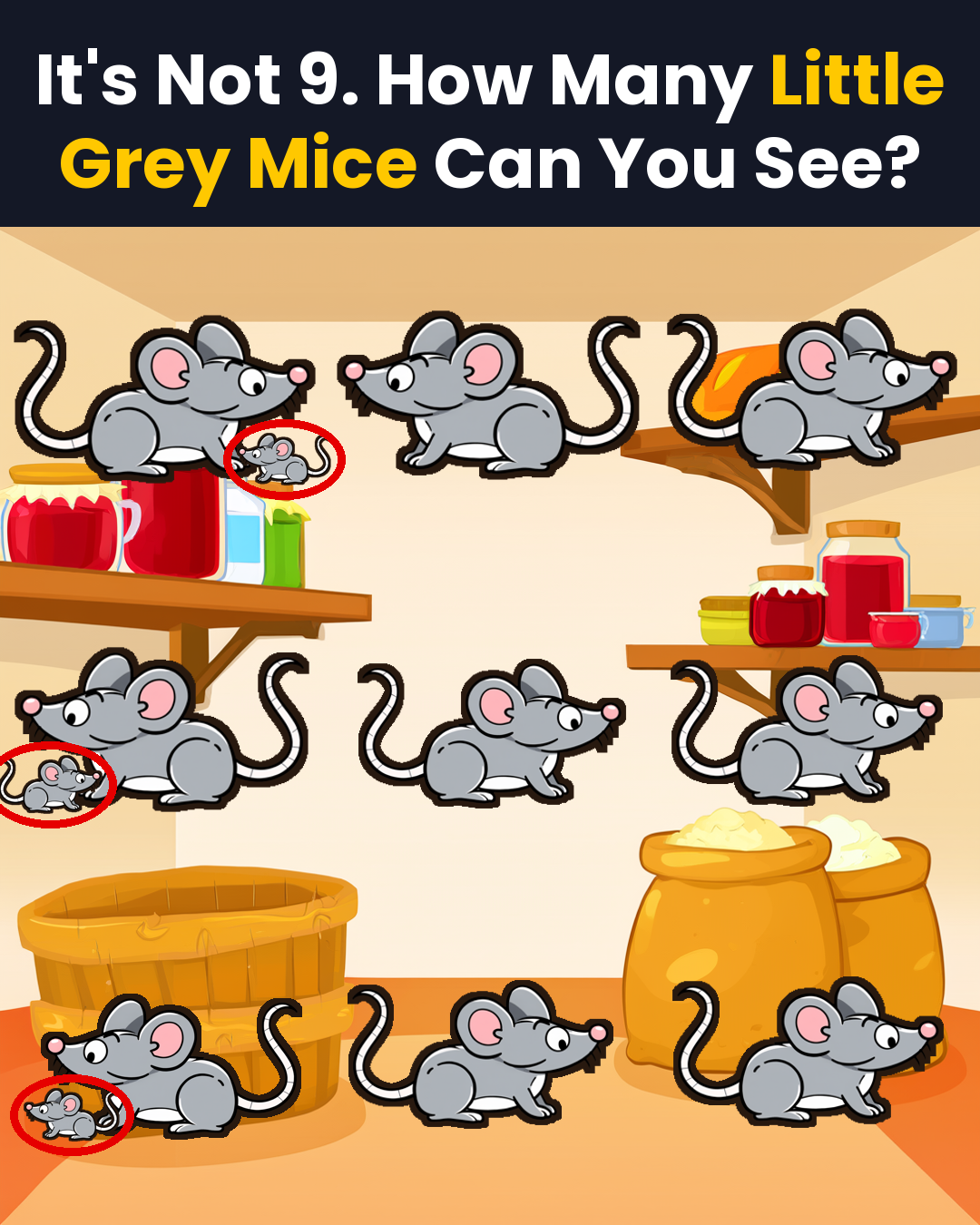
ANSWER: 12 mice – three tiny ones are hiding right next to the big ones.
Where The Hidden Mice Are
There are twelve mice in the pantry altogether. Nine of them are the large ones that almost everybody finds: three across the top of the picture, three in the middle band, and three along the floor by the barrel and the flour sacks.
The other three are the small ones, and they are the reason most answers come in at nine or ten. One tiny mouse sits on the jam shelf at the top left, right beside the tail of the big mouse there. Another is down at the far left of the middle row, almost touching the edge of the picture. The third is on the floor at the bottom left, nestled against the big mouse by the barrel.
Why They Are So Easy To Miss
Each small mouse was placed deliberately next to a large one. When two similar shapes touch, the brain reads them as a single object, so the pair is counted as one mouse instead of two.
Two of them also sit against the left edge, and the edges of a picture get the least attention of all. We look where the action is, and the action here is in the middle of the room.
So, How Did You Do?
If you said twelve on the first try, your eyes are genuinely sharp and your method is excellent. Eleven means you found two of the three little ones, which is a fine result. Ten or nine is the most common answer of all, so you are in the majority. Either way, the second look is always the one that finds the hidden ones.