Hello, puzzle friends, and welcome to the pond!
The sun is out, the reeds are swaying, and the lily pads are warm.
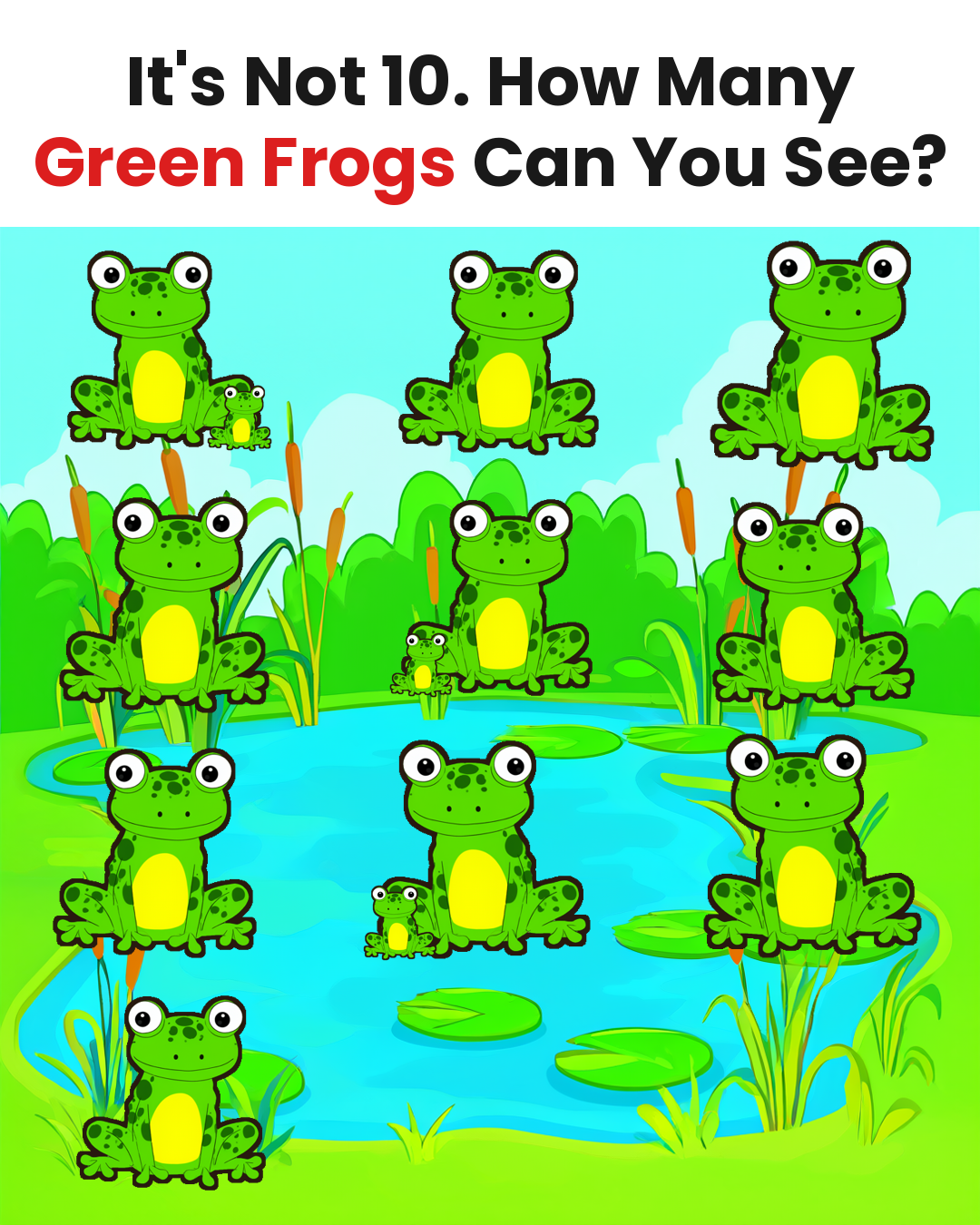
A whole family of bright green frogs has come out to enjoy the morning.
Some of them are sitting proudly in the open, easy to spot.
Others are much smaller and have tucked themselves in beside the big ones.
Your job is simple to say and harder to do: count every single frog in the picture.
Take your time, start on one side, and work your way across the pond.
Here is a gentle tip: the number is not the one in the title.
Take your time and look closely before you scroll down!
Count In Rows, Not In Circles
The biggest mistake people make with a counting picture is letting their eyes wander. They jump to the brightest frog, then to one on the other side, then back again, and after ten seconds they have no idea which ones they have already counted. The number they say out loud is usually a guess dressed up as an answer.
The cure is a method. Treat the picture like lines of text on a page. Start in the top left corner, move slowly to the right until you reach the edge, then drop down and come back the other way. Count out loud or tap your finger on the screen as you go. It feels slow, but it is far faster than starting over three times.
When you reach the bottom, do one more pass in the opposite direction. If both passes give you the same number, you can trust it. If they do not, the second pass will usually show you exactly where you lost your place.
Why Our Eyes Skip The Small Ones
Our vision is not a camera. Only a tiny part of the eye sees in sharp detail, and the brain fills in the rest with educated guesses. When it sees a large green frog, it quietly decides that the green shapes around it are part of the same frog, or part of the grass, and it moves on. That is efficient for walking through a garden, and terrible for counting.
Size makes it worse. A small object next to a large one of the same colour almost disappears, because the brain reads the pair as a single object with an odd outline. Painters have used this for centuries to keep a busy picture calm.
So when you count, deliberately look for the small and the partly hidden. Ask yourself, at every big frog: is anything sitting next to this one?
Frogs, Ponds And A Little History
Counting puzzles are among the oldest games we have. Long before screens, families played them with buttons on a table, with sheep in a field seen from a cart, or with the pictures in a weekly magazine. The appeal has never changed: the answer is simply there, in front of everyone, and anyone can win.
Frogs make a wonderful subject for one. In real ponds they are famously hard to count, because they sit so still and their green skin matches the weed almost perfectly. Wildlife surveyors often count frogs by their evening calls instead of by sight, for exactly that reason.
In other words, if this picture gives you trouble, you are in excellent company with the professionals.
How Fast Can You Do It?
Most people get a number within fifteen seconds. Most people are also wrong the first time, usually by two or three. That gap between confidence and accuracy is the whole fun of the puzzle.
Give yourself thirty seconds, do your two passes, and settle on a final number before you scroll down. Say it out loud so you cannot quietly change your mind later.
Then send the picture to a friend and ask for their number without telling them yours. Comparing two different answers to the same simple question is the best part of the whole game.
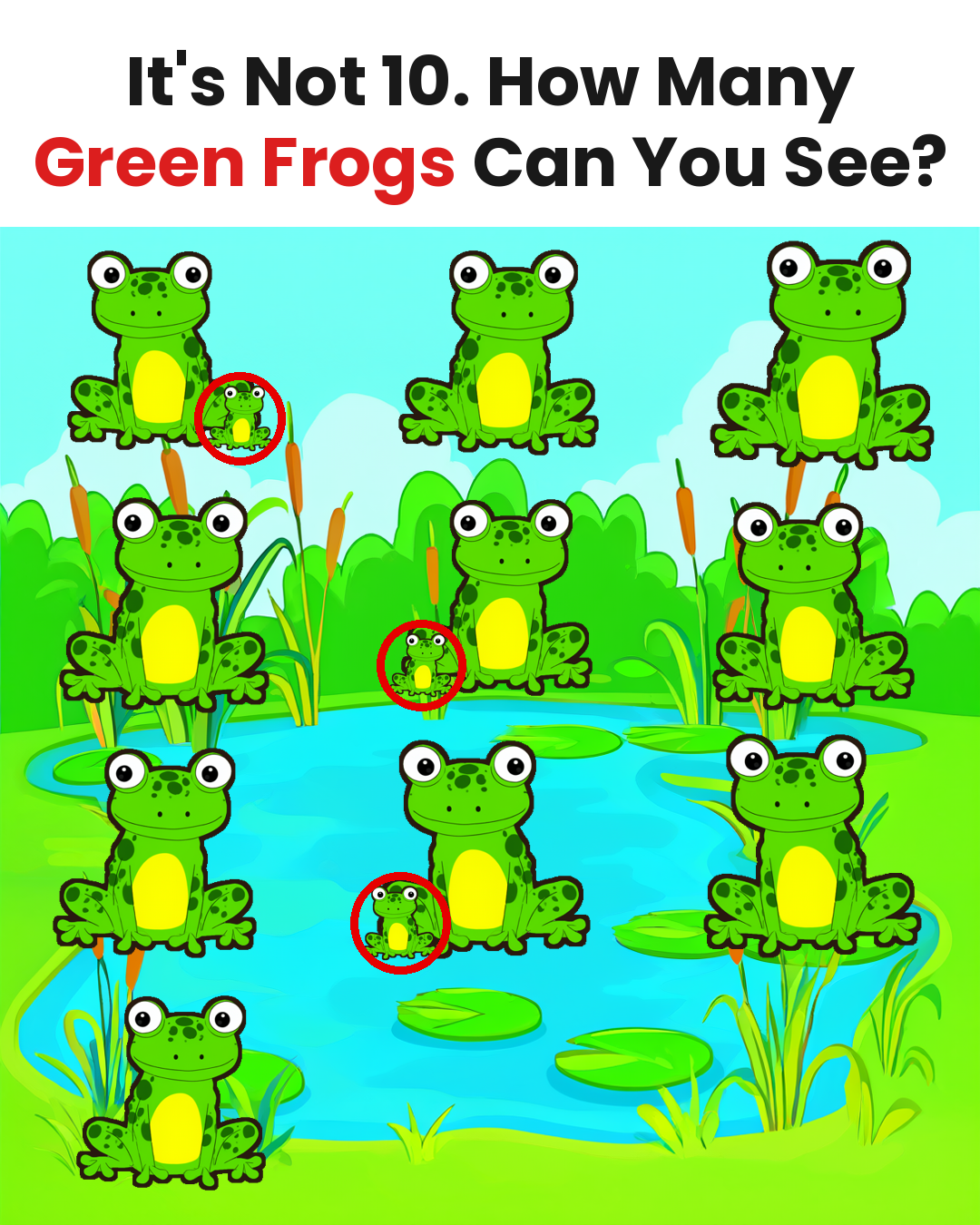
ANSWER: 13 frogs – ten big ones and three little ones sitting right beside them.
Where The Little Ones Are Hiding
There are thirteen frogs in the pond. Ten of them are the large ones, sitting in neat groups across the grass and the water, and almost everybody finds all ten without any trouble.
The other three are much smaller, and each one is tucked close beside a big frog. One sits at the right foot of the big frog in the top left corner. One is on the ground just below and to the left of the frog in the middle row. The last one leans against the large frog in the centre of the pond, low down near the water.
All three are the same shade of green as their big neighbours, which is exactly why the eye slides past them. They do not look like separate animals; they look like an extra leg or a shadow.
Why Most People Say Ten
Ten is the honest answer of a careful person who counted only what looked like a frog. The big ones are evenly spaced and clearly drawn, so the brain finds a comfortable pattern and stops looking. The moment a pattern feels complete, our attention relaxes.
The small frogs break that rule by sitting inside another frog’s outline instead of in their own space. To find them you have to look at the gaps between shapes rather than at the shapes themselves, and that is a very different way of seeing.
If you found even one of the three on your first pass, your eyes are sharper than most.
How Did You Do?
Under ten seconds with all thirteen: you have eagle eyes, and you clearly count things for a living or for fun.
Under thirty seconds: excellent work. You used a method instead of guessing, and it paid off.
Around a minute: perfectly normal, and you did the important thing by checking twice.
You said ten and stopped: do not worry at all. That is what nine out of ten people answer, and now you know exactly what to look for next time.