Hello, puzzle friends, and good morning from the pasture!
A friendly brown and white cow has wandered into the grass, and somebody left a real tangle behind her.
Four ropes run across the field, crossing each other again and again, and only one is tied to the cow.
The four wooden posts are numbered, and your job is simple: say which post is holding her.
The ropes are drawn so your eye slides from one to another at every crossing.
A small tip: start at the knot by the cow’s nose, not at the posts.
Take your time and decide on your number before you read on.
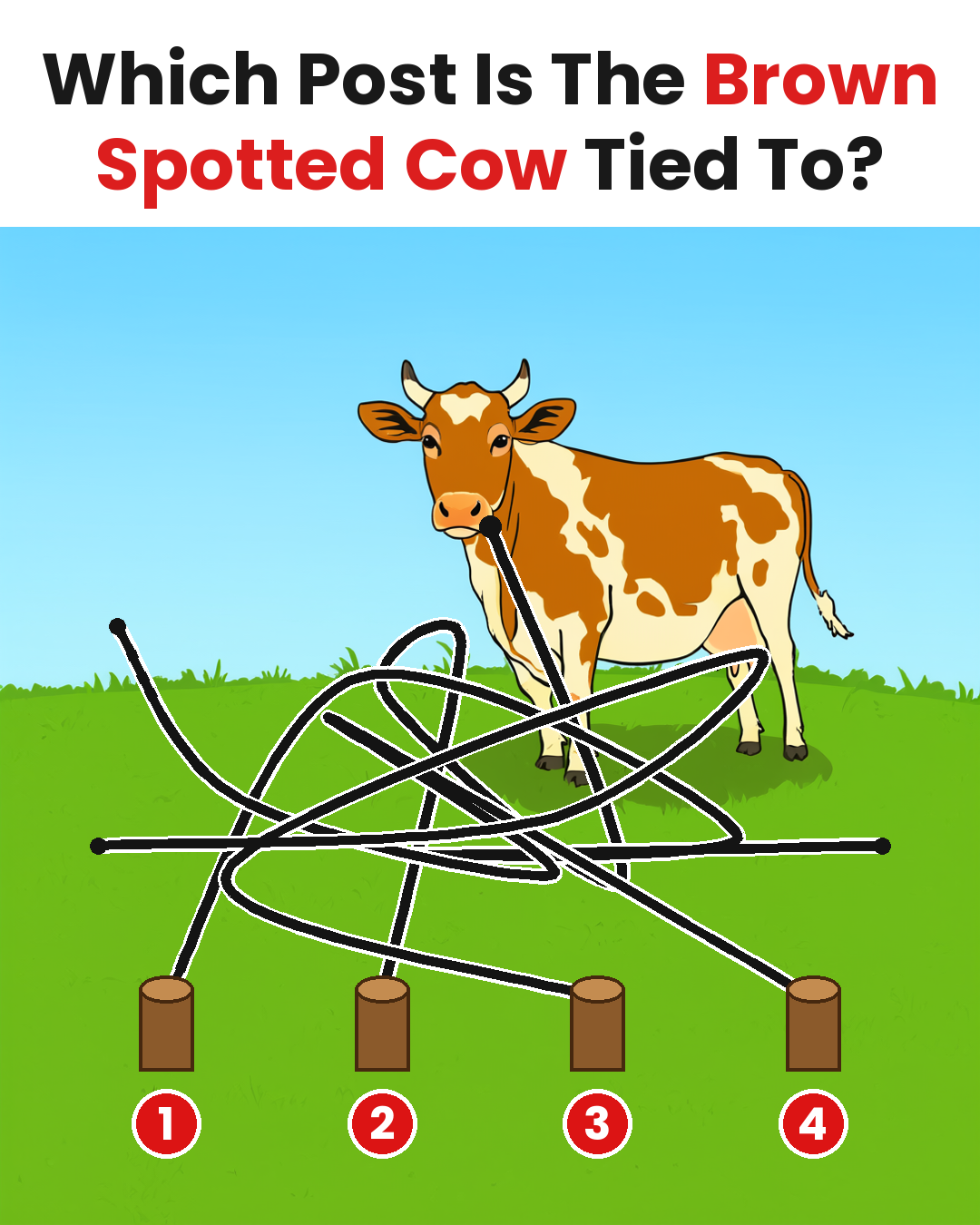
Take your time and look closely before you scroll down!
Start At The Cow, Not At The Posts
Almost everyone makes the same first move with a tangle puzzle. They look at post one, follow its rope up into the knot, lose it, and start again at post two. That is four journeys through the hardest part of the picture, and four chances to slip onto the wrong line.
There is a much better way. There is only one rope at the cow, so begin at the knot by her nose and follow that single line. You only have to make the trip once, and when it finally arrives at a post, you are finished.
Use something physical to help you. Put a fingertip on the rope at the cow and slide it along slowly, or hold a pencil against the screen. At every crossing, stop for a moment and ask yourself which line continues in the same direction. Ropes do not turn sharp corners in mid air. The curve carries on smoothly, and that smoothness is your best guide.
Why The Crossings Fool Us
Our visual system is wonderfully good at following a continuous edge. That skill is how we read the outline of a road, a branch or a path through a field. But it has a weakness, and tangle puzzles were made to find it.
When two lines cross, the brain has to decide which one continues. It makes that choice in a fraction of a second, mostly from the angle and from what it expects to happen. When the two lines cross at a shallow angle, the guess is often wrong, and the worst part is that you feel no doubt at all. You simply continue along a new rope believing it is the old one.
Colour adds nothing here to help you, because every rope is the same shade. That is the whole design. With no colour and no thickness to separate them, you are left with pure tracking, and tracking gets tired fast.
An Old Trick From The Puzzle Pages
Tangle puzzles have been printed in newspapers and children’s weeklies for well over a hundred years. In the old days it was a fisherman and four fishing lines, or a boy with four kite strings, and the reader was invited to say which one landed the fish.
The mathematics behind it is older still. Following a line through many crossings is a small version of a classic problem in the study of how things are connected.
The Friendly Challenge
Most people need about twenty five seconds to trace this one properly, and plenty answer in five seconds and get it wrong. Speed is the enemy here.
Try it once at normal speed and note your answer. Then trace it again slowly from the cow’s nose and see whether you still agree with yourself. If the two answers differ, the second one is usually right. Then show the picture to a friend and let them have a turn.
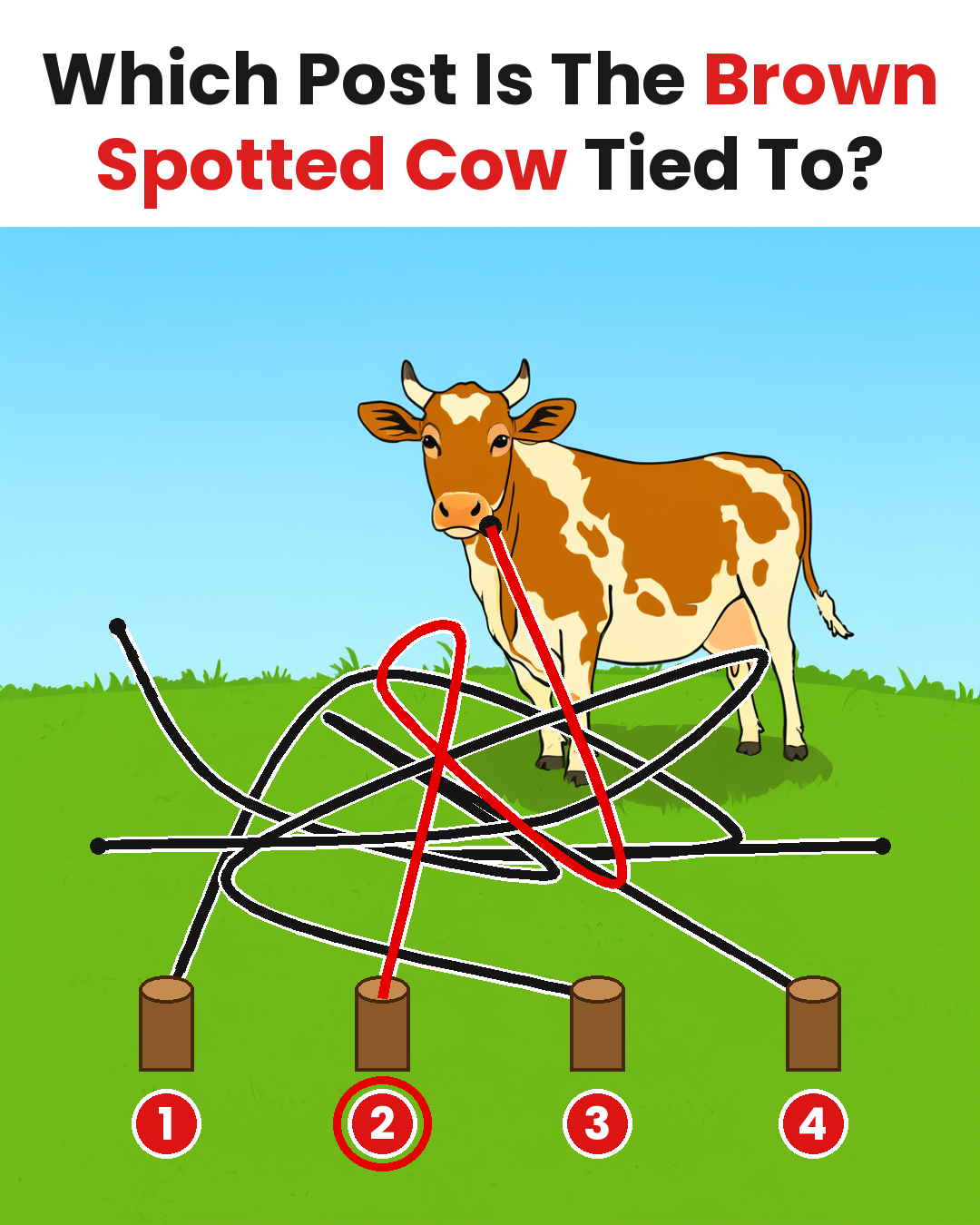
ANSWER: Post number 2
Where The Rope Really Goes
The rope begins at the knot right beside the cow’s muzzle and drops down into the middle of the field. From there it makes a long loop to the left, swings back toward the centre, and then runs down to the second post from the left.
The trouble is that it crosses the other three ropes several times on the way, and at least two of those crossings happen at a very shallow angle. That is where the eye quietly changes trains. A great many people arrive confidently at post three, because a decoy rope passes close to the cow’s line in the busiest part of the tangle and then heads that way.
There is also a useful clue that is easy to miss. The three decoy ropes do not start at the cow at all. Each one simply ends in a small black knot out in the grass. If you had checked those loose ends first, three of the four ropes could have been ruled out before you even started tracing.
How Did You Do?
Under ten seconds with post two means you have remarkable eyes and a very steady hand of attention.
Under thirty seconds is a strong result and the mark of someone who traced instead of guessed. Up to a minute is perfectly normal and usually means you checked twice, which is exactly the right instinct.
If you chose another post, you are in good company. Post three is the classic wrong answer, and almost half of all readers pick it. Try the trick with the loose ends next time and you will be much faster.