Hello, puzzle friends, and welcome to a warm summer meadow!
The grass is tall, the daisies are open, and the sky is a clear soft blue.
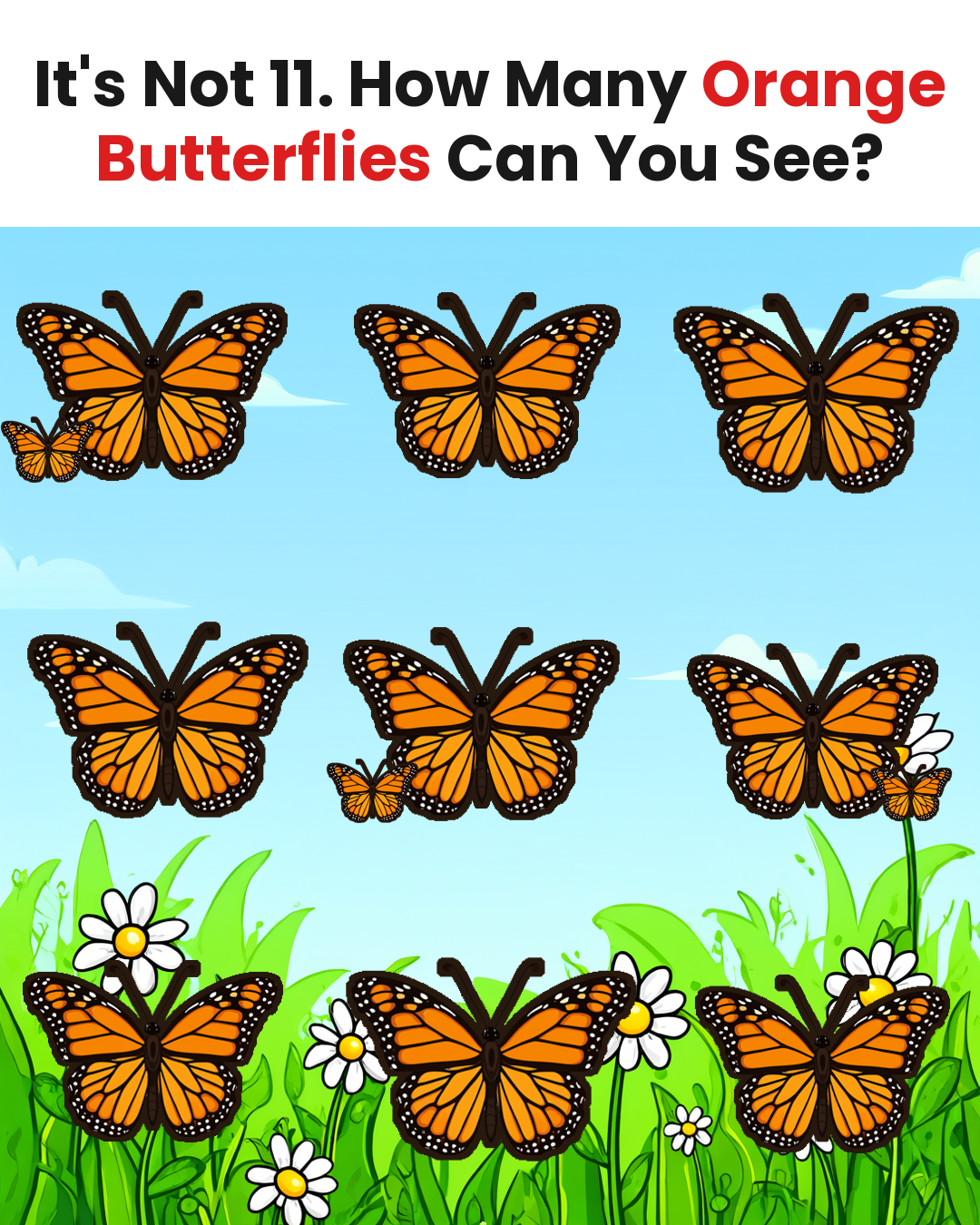
And the whole picture is full of orange butterflies with beautiful patterned wings.
Your task today is simple to say and surprisingly hard to do: count them all.
Nearly everybody gets a number that is too small on the first try.
Here is a gentle tip – the big ones are easy, so look for the little ones too.
Count slowly, row by row, and do not trust your first answer.
So, how many orange butterflies can you really see?
Take your time and look closely before you scroll down!
How To Count Without Losing Your Place
Counting looks like the easiest task in the world until the objects are scattered across a picture. Then our eyes wander, we count the same one twice, miss another, and end up with a different number each time.
The cure is to give yourself a path and stick to it. Go left to right along the top row, then left to right along the middle row, then the bottom row. Always the same direction, never jumping back.
Use your finger on the screen if that helps – there is no shame in it, and it is exactly what accountants and bird watchers do. A finger keeps your place when your eyes drift.
And when you reach your total, do one more pass in the opposite direction. If both passes agree, you can be confident. If they do not, something small is hiding.
Why Small Things Disappear
Your eyes have sharp vision in only a tiny circle at the centre of your gaze, about the size of your thumbnail at arm’s length. Everything else is softer than you think. Your brain fills in the rest with a very good guess.
This is why small objects vanish in a busy picture. If a tiny butterfly never falls inside that sharp little circle, your brain simply paints it as part of the background – grass, daisy, nothing to see.
There is also the size trap. Once you have decided what a butterfly looks like in this picture, your eyes start hunting for that size and ignore anything much smaller. Puzzle makers rely on this. The moment you deliberately widen your search to include the little ones, the picture changes completely.
A Few Words About Butterflies
Orange butterflies with black veins and white spots are known the world over, and the monarch is the most famous of them all. Every autumn, monarchs in North America travel thousands of miles to the same wintering forests, a journey no single butterfly completes alone – it takes several generations.
Their bright orange is not for show. It is a warning to birds that they taste unpleasant, a trick known as warning colouration. In nature, standing out can be safer than hiding.
Which makes this puzzle rather funny. In our picture, bright orange butterflies manage to hide very nicely indeed – not from birds, but from us.
The Counting Challenge
Most people say nine on their first attempt, and they say it with great confidence. A careful second look usually adds one or two more, and only the most patient counters reach the real number.
So here is your challenge. Count once quickly and remember the number. Then count again slowly, row by row, and include every butterfly however small.
If the two numbers are different, you have just learned something about your own eyes. Share the picture with a friend, ask for their number first, and enjoy the discussion that follows.
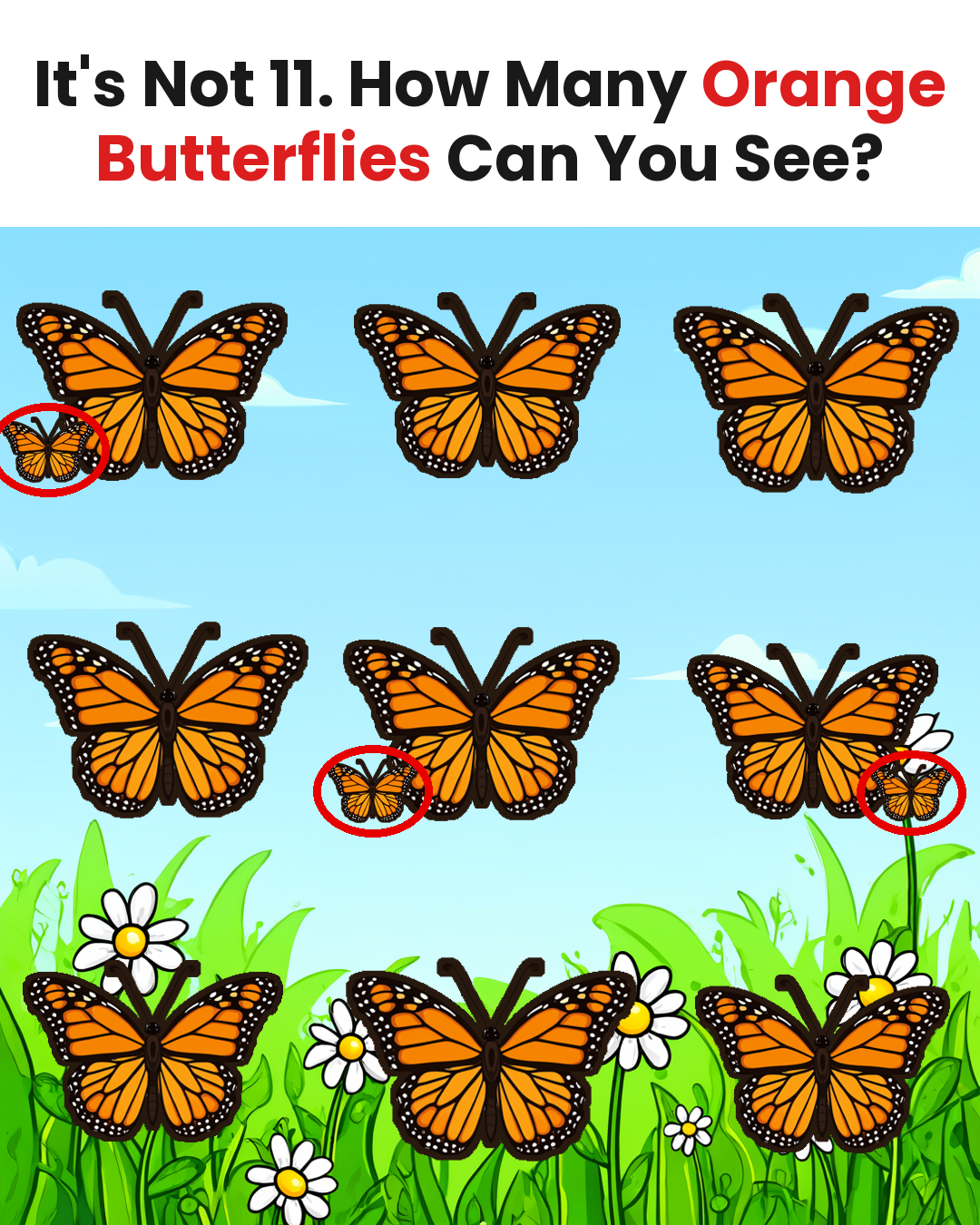
ANSWER: 12 butterflies – three tiny ones are resting beside the big ones.
Where The Hidden Ones Are
The true total is twelve. Nine large butterflies are easy to find: three across the top, three across the middle, and three down among the daisies at the bottom.
The other three are tiny, and they are resting right beside their big cousins. One sits at the far left of the top row, tucked against the wing of the first large butterfly. One is in the middle row, just below and left of the centre butterfly. And the third is on the right of the middle row, perched on a white daisy beside the big butterfly’s wing.
All three are perfectly visible. They are simply much smaller than the rest.
Why Almost Everyone Says Nine
The nine large butterflies are arranged in a neat pattern of three rows of three. That pattern is the problem. As soon as your brain recognises a tidy arrangement, it stops searching – the picture feels complete, finished, accounted for.
The small butterflies also sit touching the big ones. When two shapes overlap, our eyes tend to read them as a single object, so a little butterfly next to a big wing becomes part of that wing.
Add the daisies, which are white and busy and exactly the right size to hide a small orange visitor, and you have three butterflies that almost nobody counts the first time around.
How Did You Do?
You said 12 straight away: outstanding. You searched for different sizes from the very start, which very few people do.
You said 10 or 11: very good indeed. You spotted that something extra was there and went looking.
You said 9: welcome to the crowd – this is the most common answer of all, and a perfectly natural one.
Fewer than 9: slow down and try the row-by-row path. It will serve you well next time.