
Hello again, puzzle friends, and welcome to the prettiest corner of the street!
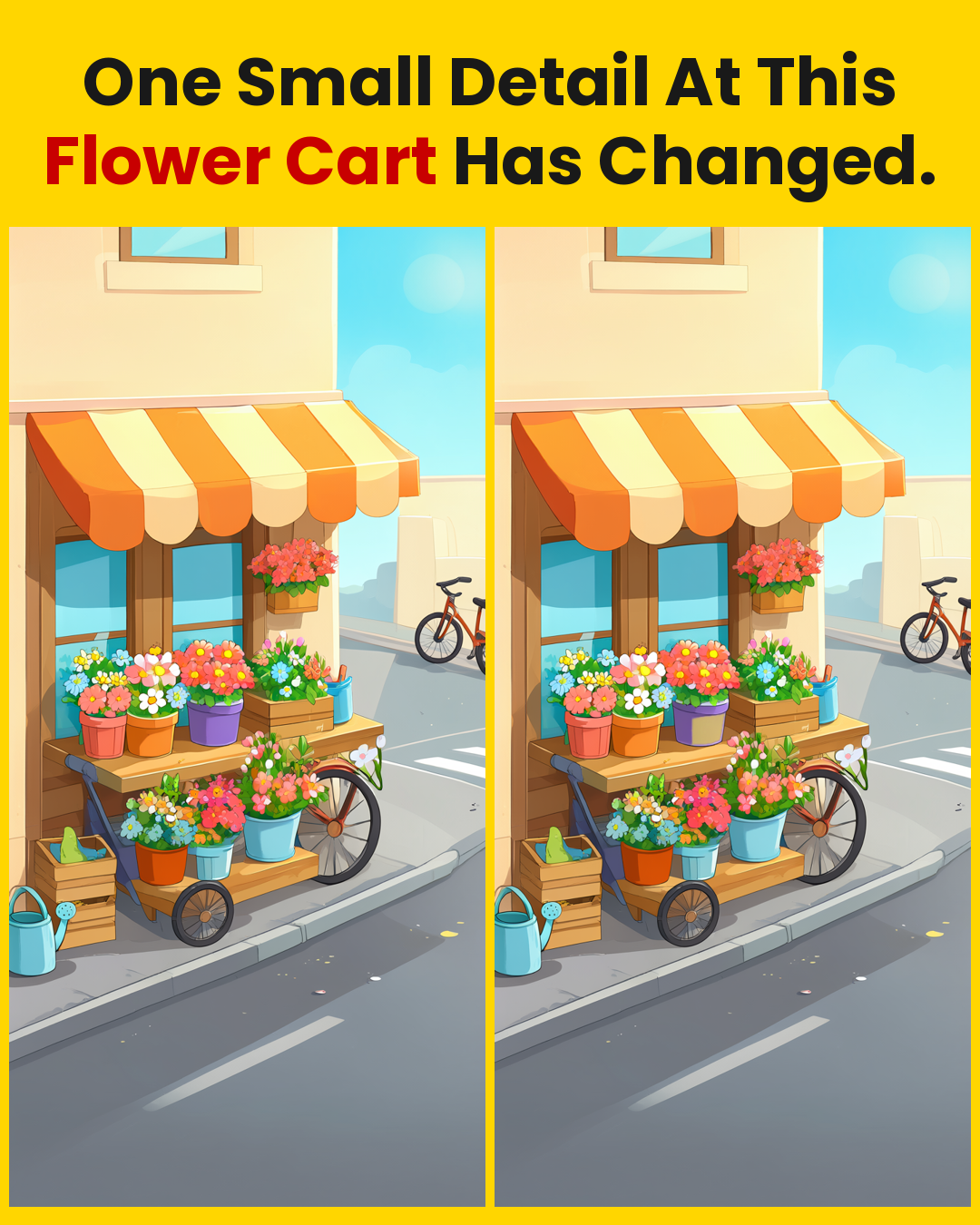
A little flower cart stands under a striped awning, loaded with blooms of every colour.
There are pots on the shelf, buckets below, a watering can on the pavement and a bicycle across the road.
Two pictures of this cheerful cart are waiting for you, and they look exactly alike.
They are not. One small detail has quietly changed from the first picture to the second.
A friendly tip: all those flowers are there to keep your eyes busy and happy.
Look past the petals and check the things that hold them instead.
Take a calm look, and see how quickly you can catch it.
Take your time and look closely before you scroll down!
Where To Start Looking
With a picture as colourful as this one, the worst thing you can do is look everywhere at once. Your eyes will bounce from flower to flower and come back with nothing. Pick a line and follow it instead.
Start with the top shelf and move slowly from left to right, checking one pot at a time. Then do the lower shelf. Then the wheels, the crates, the watering can, the awning and finally the background.
There is a second useful trick. Instead of hunting for the change, count things. Count the pots in the first picture, then in the second. Counting forces your eyes to stop on every single object, and a change you were looking straight past suddenly stands up and waves.
Why A Busy Picture Beats Us
Every extra object in a picture makes the puzzle harder, and not just a little harder. Your attention works like a narrow torch beam in a dark room: it can light up one small area at a time, and everything outside the beam is only a vague impression.
A flower cart is the perfect hiding place because it is full of repeated shapes. Round pots, round blooms, round wheels. When shapes repeat, your brain stops examining them one by one and treats them as a group – a bunch of flowers, a row of pots – and a single member of that group can change without anybody noticing.
Colour adds the final layer. In a picture that already holds pink, red, blue, orange and purple, one more colour simply does not look out of place.
A Note On Street Flower Stalls
Flower carts like this one have been part of city life for well over a hundred years. In London, Paris and New York, sellers pushed wooden carts to the busiest corners each morning and sold their blooms before the heat of the day.
Artists loved them. A flower cart gives a painter everything at once: bright colour, simple shapes and a cheerful human story. That is exactly why they still appear so often in cartoons and picture puzzles today.
If you have ever bought a bunch of flowers on your way home, you have taken part in one of the oldest street trades there is.
Can You Beat The Clock?
Most people need about forty-five seconds to find today’s difference. The fastest finders are usually those who checked the pots rather than the flowers.
So try this. Give yourself one minute, look only at the containers – the pots, the buckets, the crates, the can – and ignore every single petal.
If you find it, share the picture with a friend and keep the answer to yourself for a while. Watching somebody else search is half the pleasure of a good puzzle.
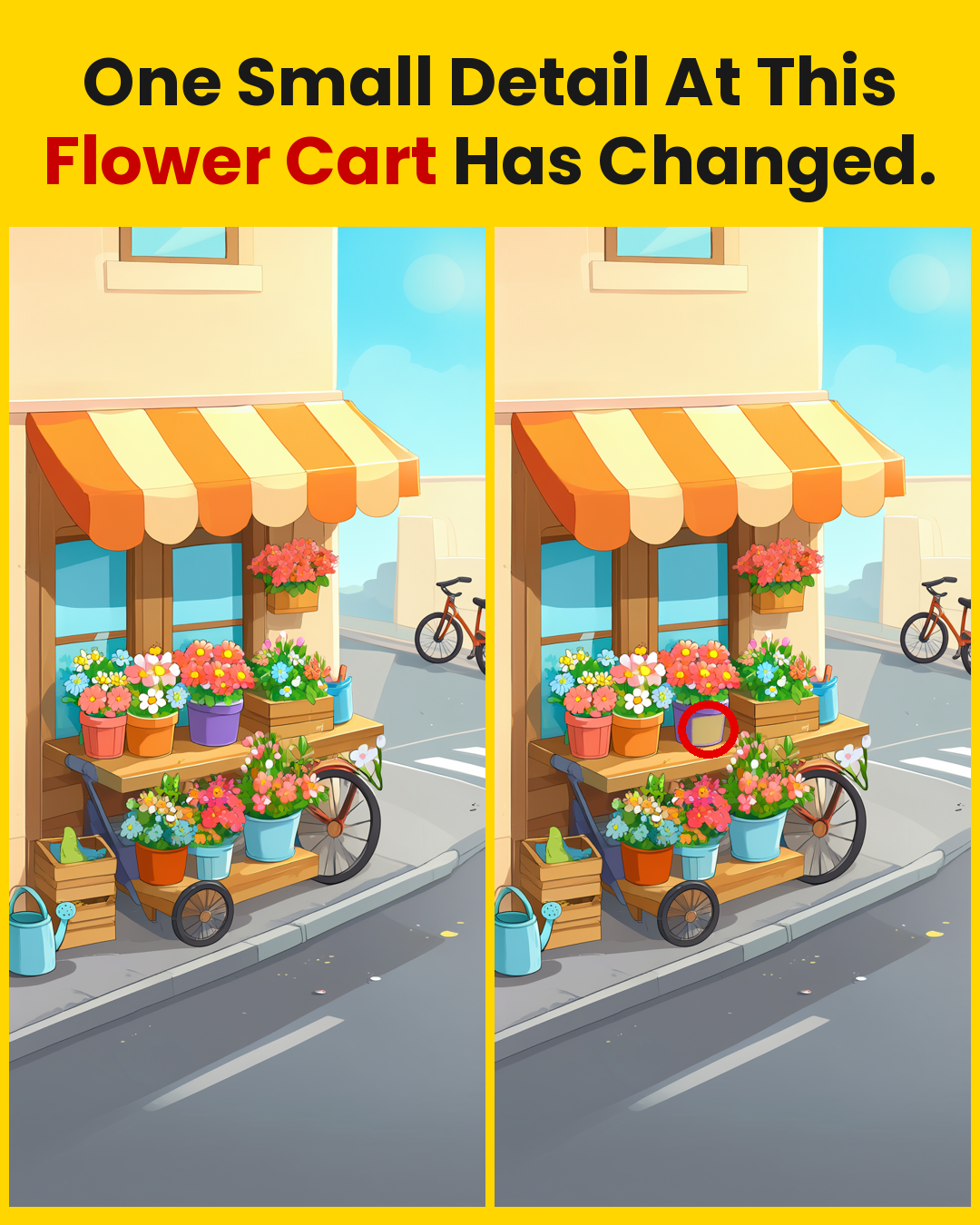
ANSWER: The purple flower pot on the top shelf changed colour – in the second picture it is cream.
The Pot On The Top Shelf
Look at the top shelf of the cart, at the row of flower pots standing in a line. In the first picture there are a pink pot, an orange pot and then a bright purple pot holding red flowers. In the second picture that purple pot has turned a soft cream colour.
Everything else is untouched. The same flowers, the same buckets below, the same watering can on the pavement, the same bicycle across the road. Only that one pot in the middle of the row has changed its colour.
Why It Slips Past Us
The pot is half hidden behind its own flowers, and that is the whole trick. Your eyes are drawn upward to the blooms, which are bigger, brighter and far more interesting than the container holding them. The pot is simply furniture.
There is also the matter of company. The pot sits in a row of other pots of different colours, so a new colour in that row looks completely at home. If the same pot had stood alone on an empty shelf, almost everybody would have spotted it at once.
And cream is a quiet colour. It does not shout. In a picture full of warm wood and pale stone, a cream pot blends into the background of your attention without a sound.
How Did You Do?
Under 10 seconds: truly eagle eyes. You looked at the pots before the flowers, which is the expert move.
10 to 45 seconds: a fine result. Your eyes are working methodically.
45 to 90 seconds: completely normal for a picture this busy.
Needed the answer: not a problem in the least. Next time, count the pots – it works every time.