Hello, puzzle friends, and welcome back to the farm!
Out in the meadow this morning stands a very patient white alpaca with a thick woolly coat.
Somebody has tied her to one of the four wooden posts along the bottom of the field.
The trouble is that the ropes have become a wonderful tangle, crossing over and under one another.
Four ropes, four posts, and only one of them is actually holding our fluffy friend.
Follow the rope that starts at the alpaca and trace it all the way down to its end.
Take your time, because the lines cross in all the wrong places on purpose.
The answer is waiting at the bottom of the page whenever you are ready to check.
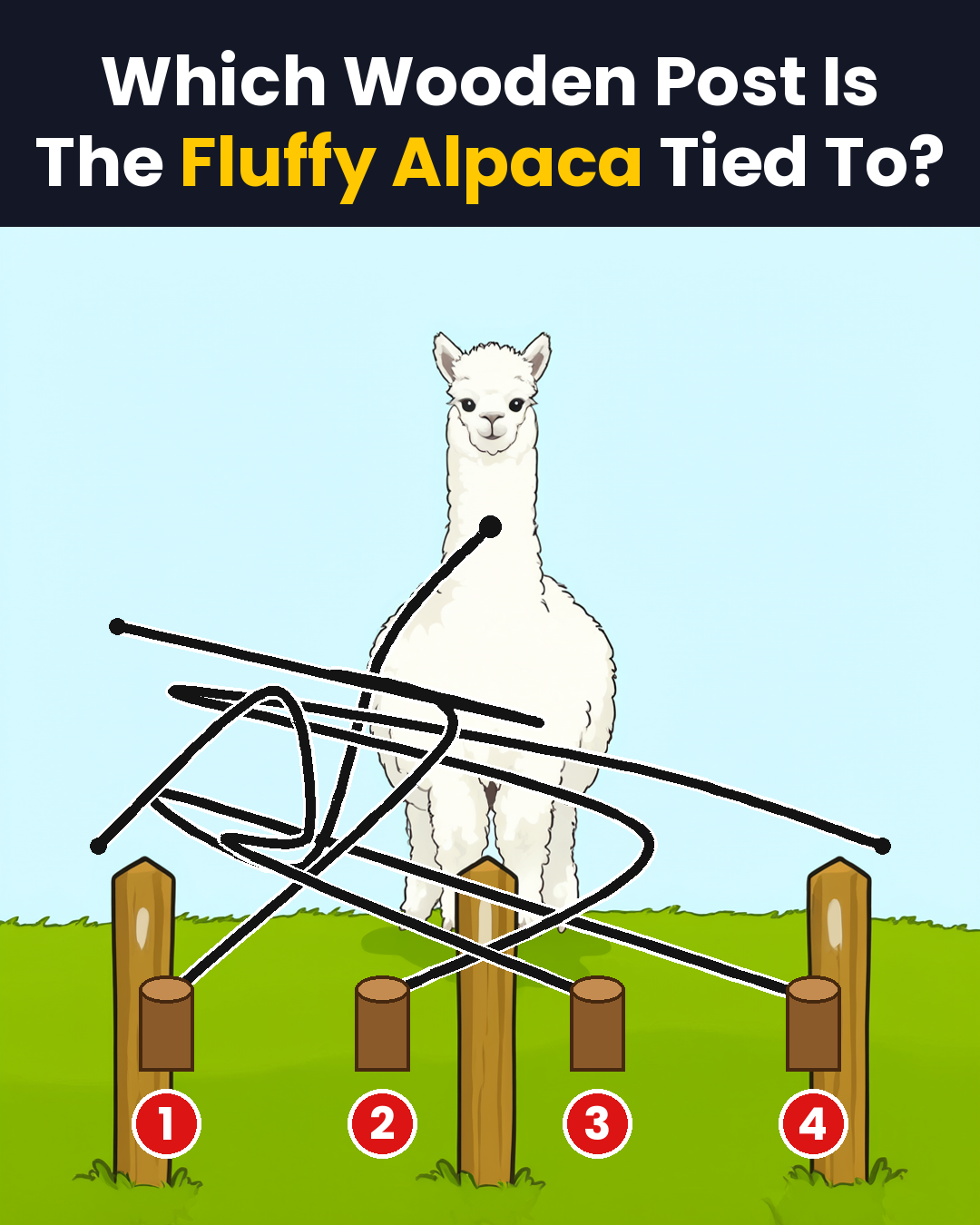
Take your time and look closely before you scroll down!
Start At The Animal, Never At The Post
Almost everyone begins this kind of puzzle the wrong way round. They look at the four posts, pick the one that feels most likely, and then try to work backwards. That approach fails, because three of the four ropes look perfectly convincing from the bottom.
The reliable method is to start where there is only one possible beginning: the alpaca herself. One rope, and only one, touches her. Put your finger on that spot and do not lift it. Slide along the line slowly, following every curve, and let your finger do the remembering so your eyes do not have to.
When the rope you are following passes under another line, pause for a moment before you continue. That crossing point is where almost every wrong answer is born, because the eye prefers to carry straight on along whichever line is easier to see.
Why Our Eyes Jump The Rails
Following a single line through a tangle is a surprisingly demanding task for the brain. Researchers who study vision call it tracing, and it happens slowly and deliberately, unlike the quick overall glance we use for most scenes.
The difficulty is that our visual system is built to join things up. It likes smooth continuous curves, and when two lines cross it quietly assumes that the smoother path is the same line carrying on. That assumption serves us beautifully when we look at a road, a river or a branch. Here it is exactly what the puzzle maker is counting on.
There is a second trap as well. The moment a rope loops back on itself, our sense of direction wobbles. We expect a rope to travel more or less downwards towards the posts, so a line that swings sideways or doubles back feels wrong, and we abandon it without realising we have done so.
A Puzzle With A Long History
Tangled line puzzles are older than most people think. Victorian puzzle books were full of them, usually drawn as a fisherman with several lines in the water, or a group of children holding the strings of kites that had blown together.
They became popular again in the early days of printed newspaper puzzle pages, where they sat beside the crossword and the word search. The appeal has never changed: the task needs no special knowledge, no vocabulary and no arithmetic. A child and a grandparent can attempt the same picture and both have a fair chance.
Today the same idea turns up in all sorts of places, from the wiring diagrams that electricians read to the maps of underground railways. Anyone who has traced a coloured line across a city transport map has solved a puzzle very much like this one without even noticing.
Ready To Beat The Clock?
Here is the challenge. Most people who answer quickly get it wrong, usually choosing the post that looks nearest to where the rope seems to be heading. Those who take about twenty to forty seconds and trace carefully almost always get it right.
Try it without touching the screen if you want the harder version. Keeping your place with your eyes alone is considerably more difficult, and it is a genuinely good little exercise in concentration.
When you have made your choice, show the picture to a friend before you reveal the answer. If the two of you pick different posts, you have the makings of a very enjoyable argument, and one of you is about to be delighted.
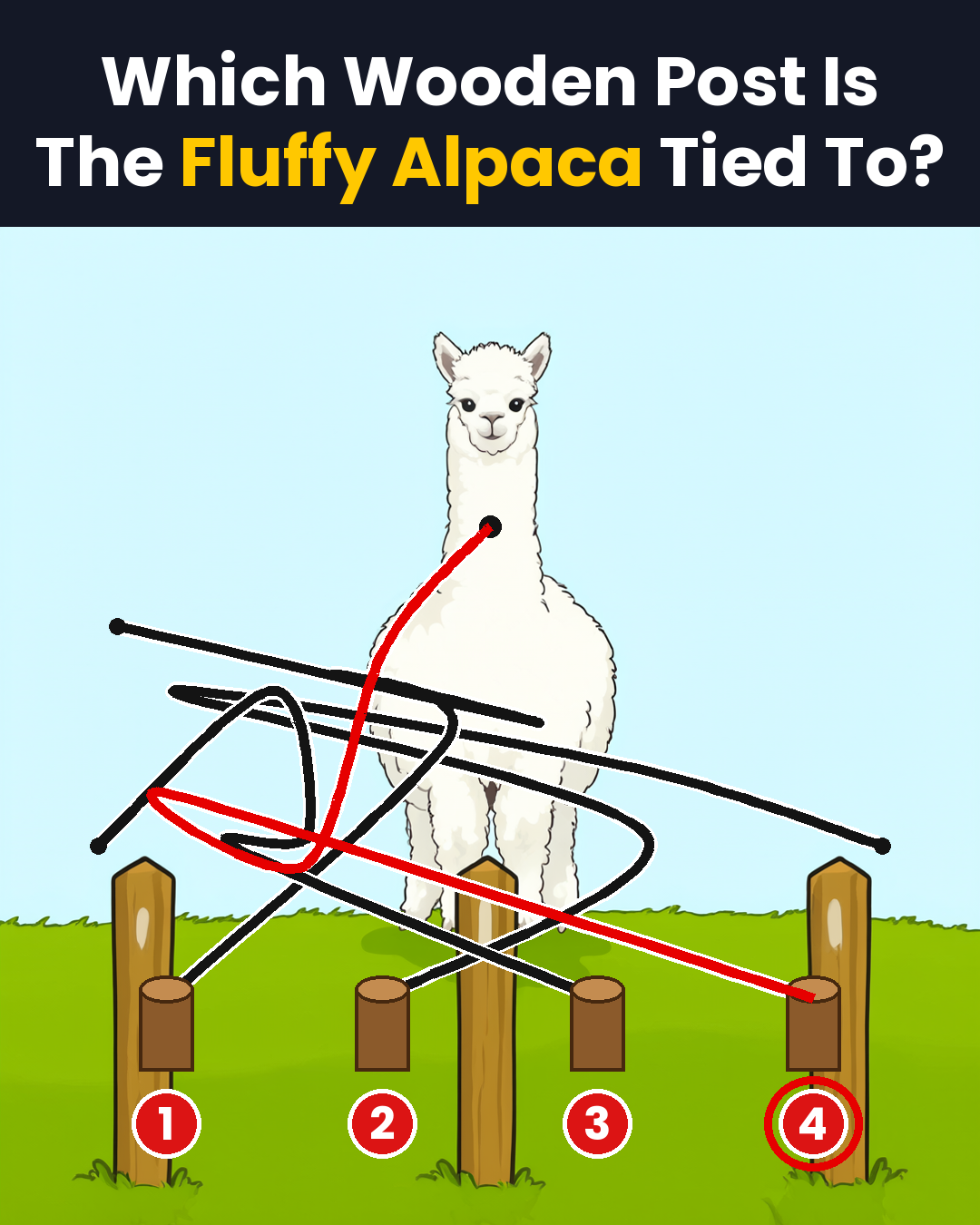
ANSWER: Post number 4 – the rope from the alpaca sweeps left, loops back and ends at the post on the far right.
Following The Right Rope
The rope that matters begins at the alpaca’s chest, right in the centre of the picture. From there it does not head sensibly downwards. Instead it curves away to the left, dips low across the middle of the meadow, and loops around in a wide bend.
That bend is the heart of the trick. Having drawn you left, the rope turns and travels all the way back across the picture to the right, passing over and under the other lines on the way. It finally comes down neatly onto the post on the far right, the one marked with the number 4.
In the answer picture that whole path is drawn in red so you can see the journey at a glance. The three black ropes are decoys, and each one is shaped to look like a perfectly reasonable answer from the bottom end.
Why Most People Choose The Wrong Post
The most common wrong answer is post 1. The rope leaves the alpaca heading left, and once the eye has committed to that direction it expects the line to finish on the left side of the field. Post 1 sits exactly where that expectation points.
The second most common mistake is post 2, chosen by people who lose the line at one of the crossing points in the middle of the tangle and pick up a neighbouring rope by accident. Both errors come from the same habit: guessing the destination before the journey is finished.
The answer is on the opposite side of the picture from where the rope first appears to be going, which is precisely why this one catches so many careful people.
How Did You Do?
Under fifteen seconds and you chose post 4: superb. You have the patience of a born line tracer.
Fifteen to forty seconds: a very good result, and the normal time for somebody who traced properly rather than guessed.
Over a minute but correct: well done indeed. Slow and right beats fast and wrong in this game every single time.
Chose post 1, 2 or 3: you are in the majority, so no harm done. Go back to the alpaca’s chest, follow the rope leftwards through the loop, and keep going even when it feels as though it is heading the wrong way.