Hello, puzzle friends, and welcome out to the meadow!
The sun is up, the grass is green, and a very woolly sheep is standing on the hill without a care in the world.
Somebody has tied her to one of the four wooden posts at the bottom of the field, but the rope has had a long and tangled morning.
Four ropes cross, loop and double back over the grass, and only one of them belongs to our sheep.
Your task is to follow her rope from where it leaves her side all the way down to the post that holds it.
Is it post one, two, three or four? Take a good look and decide.
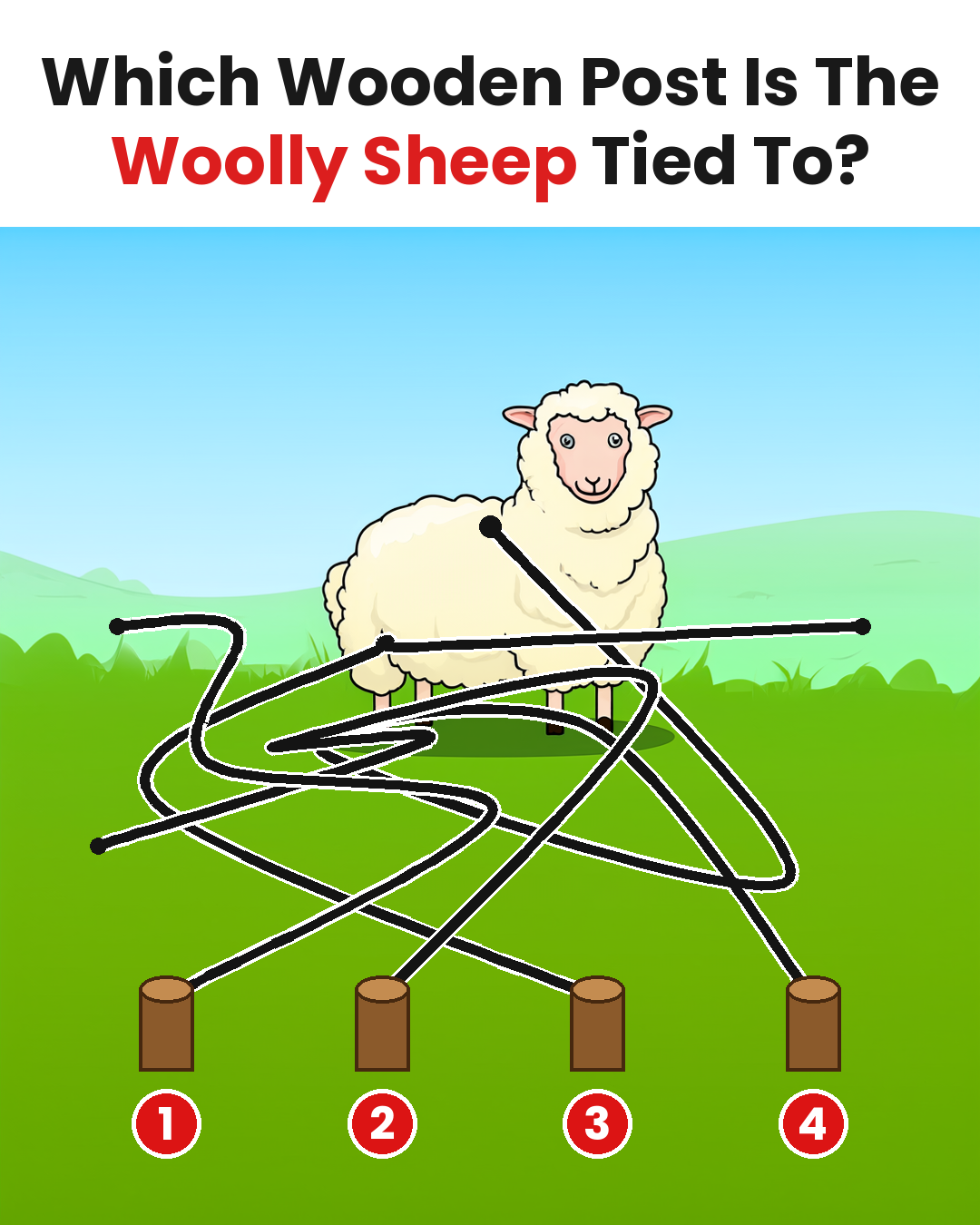
Take your time and look closely before you scroll down!
Start At The Sheep, Not At The Posts
Almost everybody begins this puzzle at the bottom of the picture. It feels natural: the posts are numbered, the numbers invite you in, and you start tracing upwards from post one. That is the slowest possible way to do it, because you may have to trace all four ropes before you find the right one.
The quick method runs the other way. Put your finger on the sheep, find the exact spot where the rope leaves her body, and set off from there. You only ever have one line to follow, so you can only ever arrive at one answer.
Move slowly and never let your finger lift off the line. The moment you lose contact is the moment your eye jumps to a neighbouring rope that happens to be heading in a friendlier direction, and from then on you are following somebody else’s rope with great confidence.
The Crossings Are Where It Goes Wrong
Every rope in this field crosses the others several times, and each crossing is a small invitation to make a mistake. At the junction the two lines look identical, and your brain has to decide which one carries on straight through and which one bends away.
There is a simple trick for this. When you reach a crossing, stop. Look at the direction your rope was travelling just before the junction, and carry that same direction a short way past it. Ropes do not take sharp corners at a crossing. The line that continues at the same gentle angle is yours.
If a rope seems to change its mind completely at a junction, you have almost certainly swapped on to the other one. Go back two crossings and start that stretch again. It costs a few seconds and it saves a wrong answer.
Why The Brain Finds Tangles So Hard
Following a single line through a tangle is a real skill, and researchers have a name for it: curve tracing. It is one of the few visual jobs the brain cannot do in a single glance. Instead, attention has to creep along the line a little at a time, almost like a torch beam moving through a dark corridor.
That is why these puzzles feel like work while a spot the difference feels like play. You are using the slow, deliberate part of your attention, and it can only hold one line at a time. Look away for a second and the beam goes out, and you have to find your place again.
It is also why children often beat adults at this game. They are quite happy to go slowly and use a finger, while grown ups try to solve it by eye alone out of pride.
Your Friendly Challenge
Most people need between twenty and forty seconds to trace this one properly, and a surprising number give up and simply guess. With four posts, a guess gives you a one in four chance, which is not a result to boast about.
So do it properly. Pick your post, commit to it out loud, and then read on to see whether your rope really did end where you thought.
Then hand the picture to somebody else and watch them squint at the grass. It is remarkably entertaining.
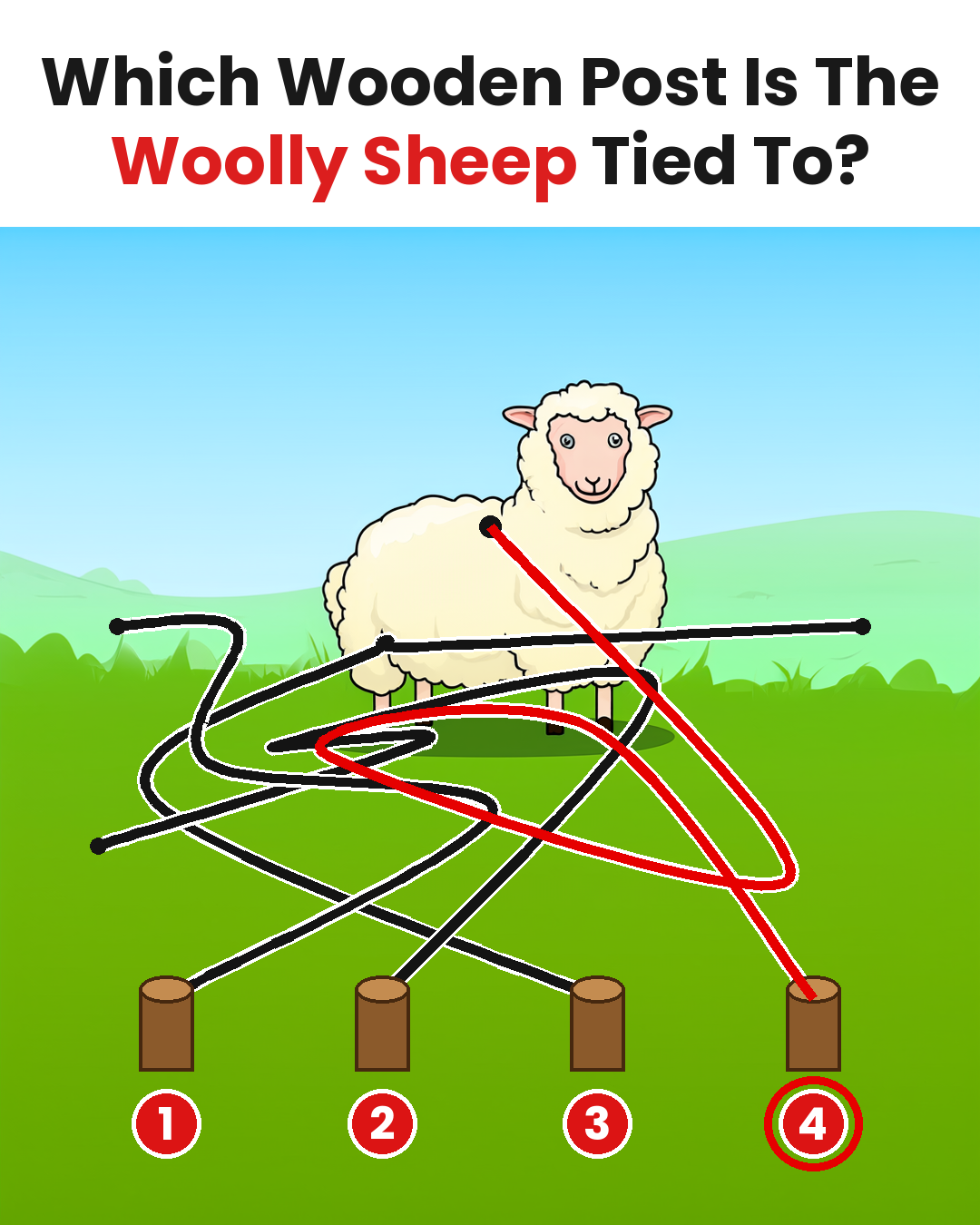
ANSWER: Post 4 – the sheep’s rope loops far to the right and ends at the post on the far right.
Follow It Once More, Slowly
The rope leaves the sheep high up on her woolly side and sets off down to the right at a steady angle. It carries on past the middle of the field, swings into a wide loop over on the right hand side, and curls back towards the centre as if it were about to head for one of the middle posts.
That is the moment most people lose it. Instead of continuing left, the rope turns once more and runs down to the right, ending neatly at the base of the post on the far right of the row.
The answer is post four.
Why So Many People Say Post Two
The rope starts off leaning to the right, and that is the direction most people expect it to keep. Then it curls back towards the middle of the picture, and right at that point it crosses two other ropes that are travelling towards posts two and three. Your eye, which is already a little tired of following curves, happily takes the easier line and glides away to a middle post.
There is another reason. We quietly expect the answer to a puzzle to sit somewhere near the centre, because the centre is where pictures usually put important things. The far right post looks like an afterthought, so the brain quietly rules it out before you have even finished tracing. Puzzle makers have known about that habit for a very long time.
How Did You Do?
Under ten seconds means you traced by eye alone and never wavered. That is genuinely sharp.
Ten to thirty seconds is a very good score and shows you took the crossings seriously.
Thirty to sixty seconds means you did it the thorough way, with a finger on the screen, which is the method we would recommend to anybody.
And if you guessed a middle post, you are in the largest group of all, and you have earned the right to pass this picture straight on to a friend.