Hello again, puzzle friends!
Today we are stepping into a small neighbourhood bookshop, the kind with a wooden counter, a lamp hanging low, and shelves packed from floor to ceiling.
There is a comfortable green armchair in the corner and a little round table set for a quiet cup of tea.
The two pictures look like the same photograph printed twice. Every book, every shelf, every leaf of the potted plant seems to match.
But one small detail is different, and it is only one.
Here is a friendly warning: the shelves full of colourful books are a trap. They pull the eye in and keep it busy, which is exactly what the puzzle wants.
So take a breath, look slowly, and enjoy the quiet of the shop.
Good luck!
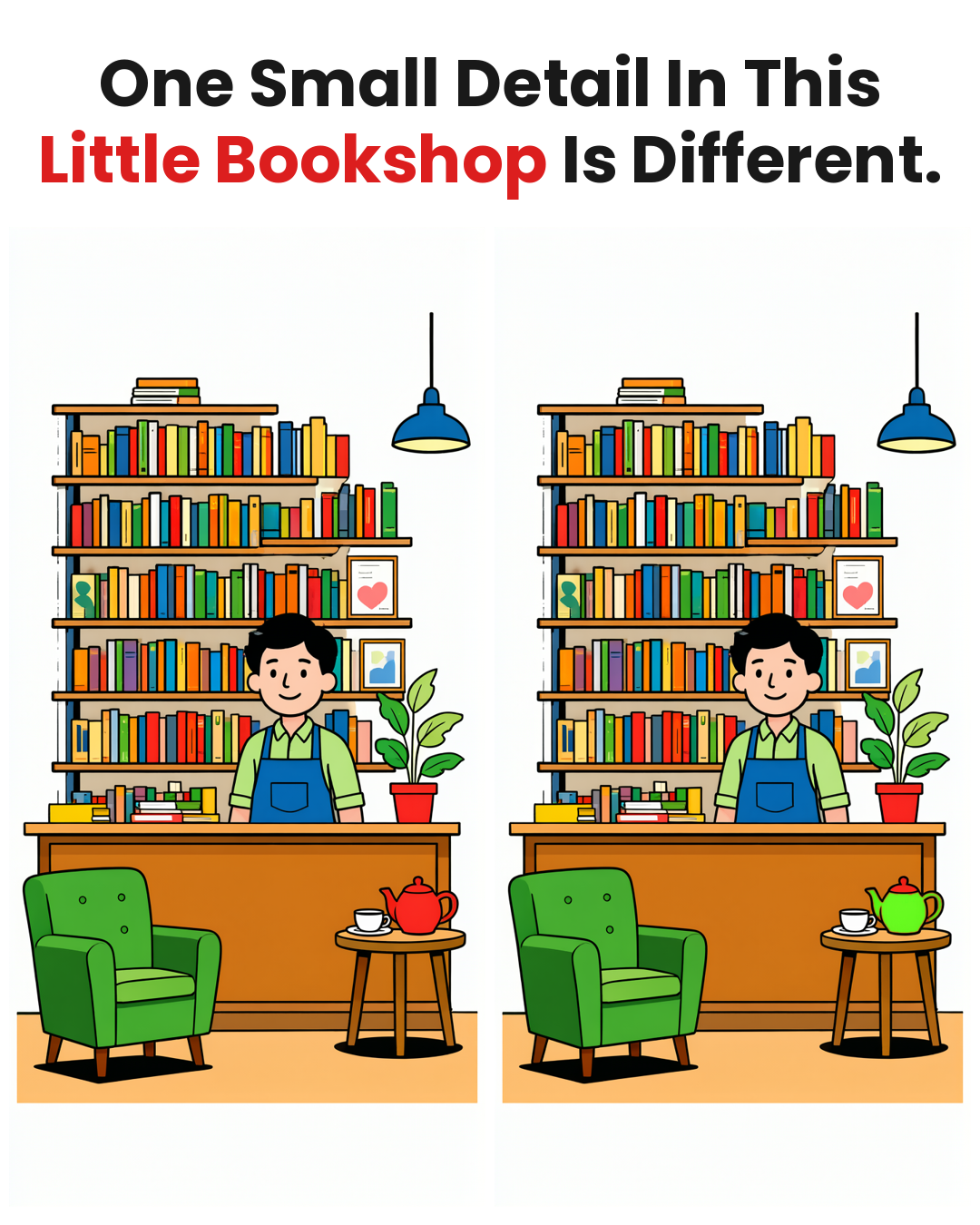
Take your time and look closely before you scroll down!
A Smarter Way To Search
An indoor scene full of shelves is one of the hardest kinds of spot-the-difference picture, because there is so much to look at. Hundreds of little book spines, all different colours, make a wonderful hiding place for a change, and your eye will happily wander among them for minutes at a time.
So do the opposite of what the picture invites. Check the big, simple objects first, the ones you can describe in a single word. The lamp. The chair. The counter. The plant. The table. The cup. The shopkeeper. Each of those takes two seconds to compare, and together they cover most of the picture.
Only if all of those match should you start on the shelves, and when you do, work shelf by shelf from the top down rather than letting your eyes roam.
Why Busy Pictures Fool Us
When a scene is crowded, the brain switches to a kind of summary mode. Instead of recording each book, it records a shelf full of colourful books. It is an efficient way to understand a room in a single glance, and it works beautifully in real life.
The trouble is that summaries have no fine detail in them. When you glance from one picture to the other, you are not comparing two scenes, you are comparing two summaries, and two summaries of the same shop will almost always agree.
Colour changes slip through this net most easily of all. Shape is part of our summary, but exact shade usually is not. We remember that there was a pot on the table. We rarely remember what colour the pot was.
Puzzles And A Cup Of Tea
There is a long and pleasant link between quiet puzzles and quiet rooms. Picture puzzles first became popular in family magazines in the late nineteenth century, printed next to the riddles and the crossword, and they were solved exactly where this scene is set: in armchairs, at kitchen tables, with something warm to drink close at hand.
That habit never really went away. Doctors today often recommend a few minutes of comparing, counting or searching as gentle daily exercise for attention. It is not about being clever. It is about the small effort of holding one image in mind while examining another, and that effort is good for us at any age.
So you are not wasting time with this picture. You are doing something rather sensible.
Your Challenge For Today
In a shop scene like this, most readers need forty seconds to a full minute. The shelves are simply too tempting, and nearly everybody spends their first twenty seconds there.
Give yourself forty-five seconds and try the big objects first. If you find it faster than that, you have an unusually disciplined eye.
Then pass it along. Send the picture to a friend who loves a challenge, or show it to someone sitting beside you, and see whether they can beat your time. Half the pleasure of a puzzle like this is the moment somebody says I have got it and the other person says where?
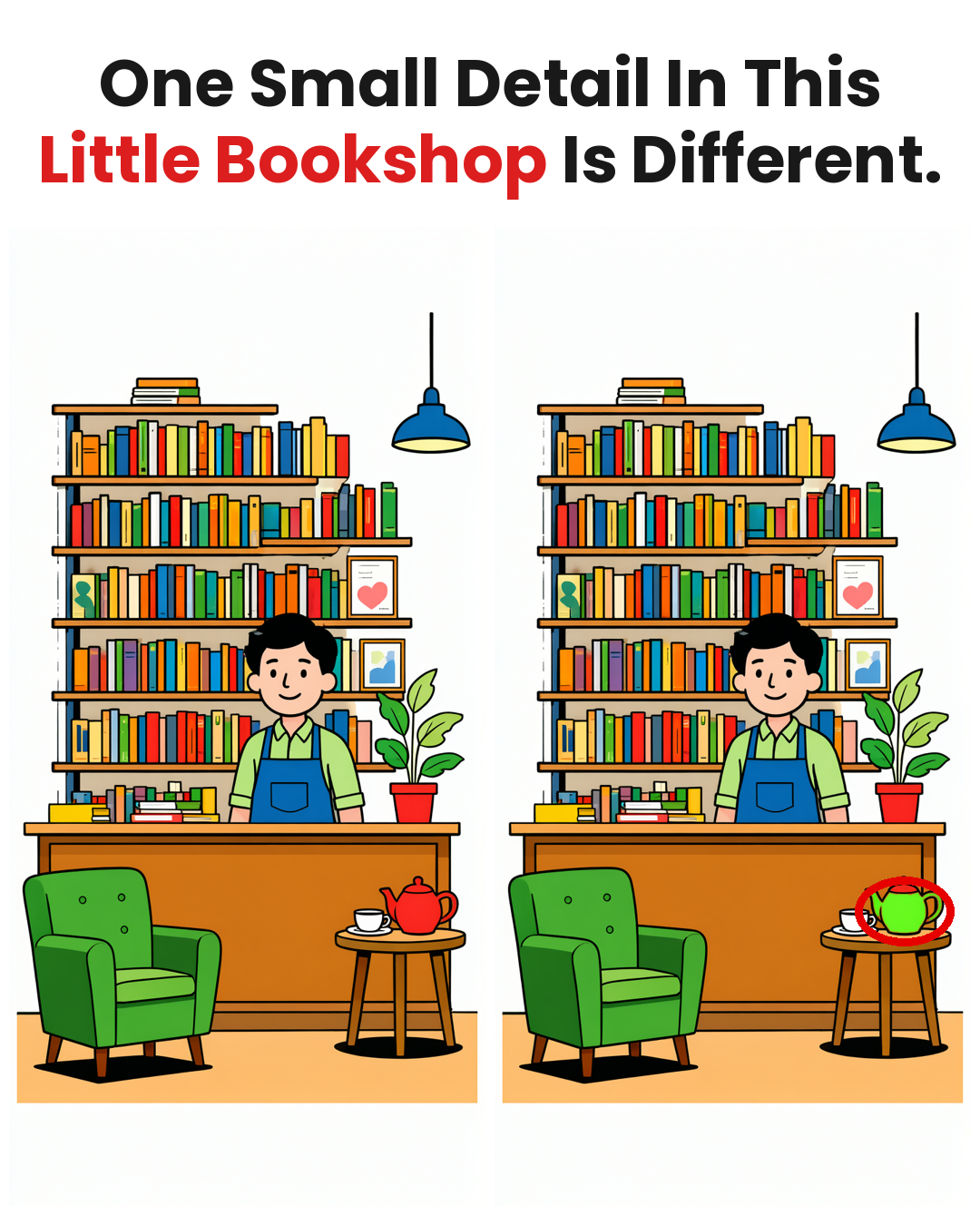
ANSWER: The teapot on the little round table changed colour – it is red in the first picture and green in the second.
Where The Change Is Hiding
Forget the shelves entirely. The answer is sitting on the small round table in the bottom right corner, next to the white cup and saucer.
In the first picture the teapot on that table is a bright cherry red, with a little round lid and a curved spout. In the second picture the very same teapot has turned a fresh leafy green. The shape is identical, the lid is identical, the handle and spout are identical. Only the colour has been swapped.
Everything else in the shop stays exactly as it was. The green armchair has the same two buttons on its back, the plant has the same number of leaves, the lamp hangs at the same height, the shopkeeper wears the same blue apron, and the picture frames on the wall are untouched.
Why So Many People Miss It
The green teapot has excellent camouflage, and it is not an accident. There is already a large green armchair on the same side of the picture, so a second green object further along the floor feels like it belongs. Your eye accepts it as part of the colour scheme and never stops to ask a question.
The second reason is simple competition. The shelves hold hundreds of coloured book spines, and every one of them is begging for your attention. By the time most people finish wandering through the books, they have forgotten the table completely.
This is the classic design of a good spot-the-difference picture: put the change in the calmest corner, and fill the rest of the frame with noise.
How Did You Do?
Under fifteen seconds: eagle eyes, and a very rare result in a scene this busy. You went straight for the simple objects.
Fifteen to forty seconds: sharp and well organised. You resisted the bookshelves, which most people cannot do.
Forty seconds to a minute and a half: perfectly normal, and where the great majority of readers finish.
Longer than that, or you came down for the answer: no reason at all to feel bad. This one was designed to be stubborn. Try the next puzzle with the big objects first and you will feel the difference straight away.