Hello, puzzle friends!
Today we are standing in a sunny meadow with a small spotted pony and a tangle of rope.
Four wooden posts are lined up at the bottom of the picture, numbered one to four.
Only one of them holds the pony’s rope, and the other three ropes simply lie in the grass.
Your task is to follow the rope from the pony’s halter all the way down and see where it ends.
No scrolling, no guessing and no counting posts from the left.
Use your eyes, take it slowly at the crossings, and give yourself an honest answer.
Which post do you say it is?
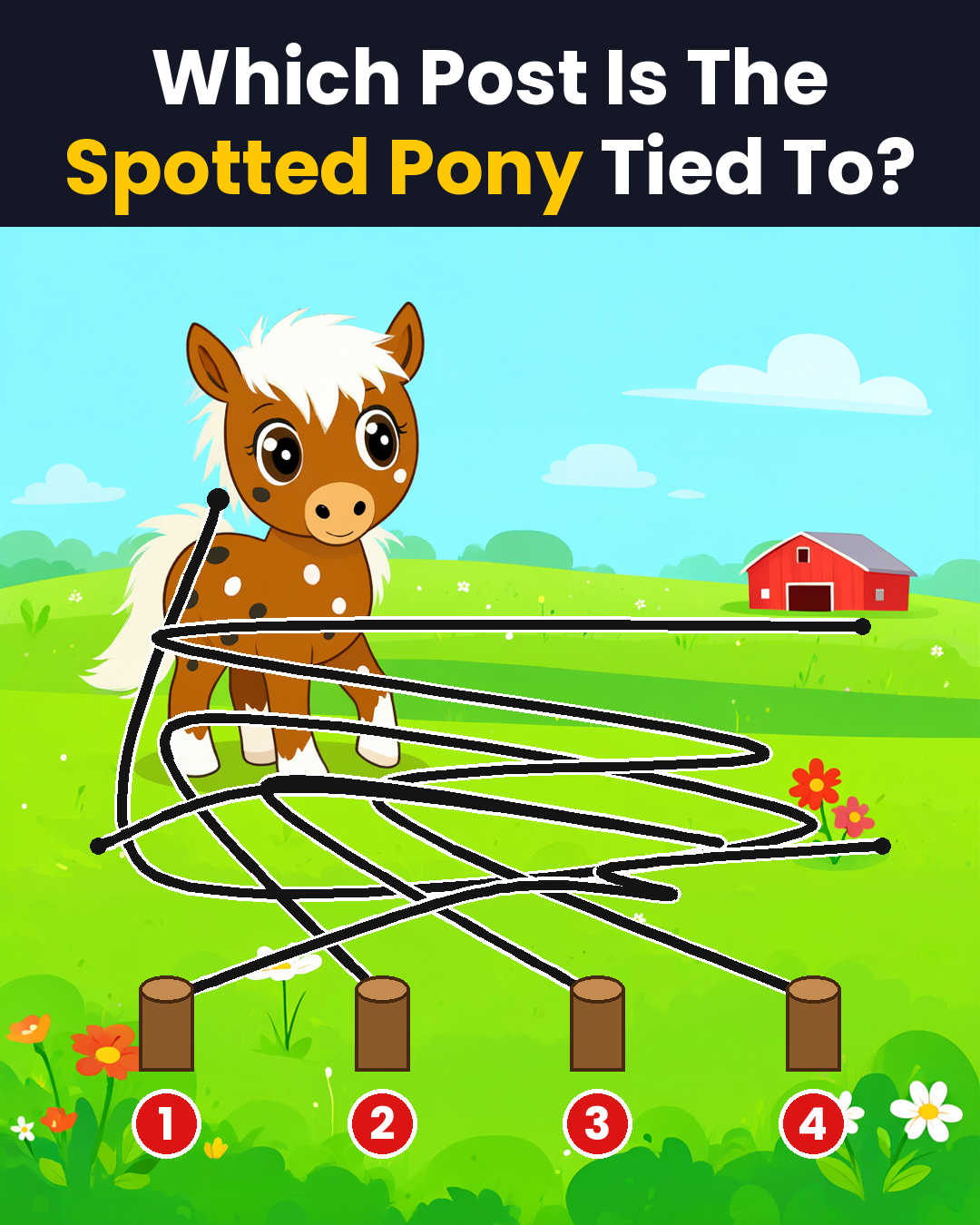
Take your time and look closely before you scroll down!
Follow The Rope, Do Not Jump Ahead
The honest way to solve a rope puzzle is also the slowest way, and that is the whole difficulty. Start at the knot by the pony’s neck, put the tip of your finger on it, and move along the rope a short stretch at a time. Never let your finger leave the picture, because the moment it does, your eye will land on the wrong line.
The dangerous places are the crossings. Where two ropes meet, your eye naturally follows the line that is easiest to see rather than the line you were actually tracing. The trick is to stop just before each crossing, notice the direction your rope is travelling, and look for that same direction on the other side.
If you lose your place, do not try to guess your way back. Return to the pony and start again. It feels like a defeat, but a second careful journey takes less time than untangling a mistake.
Why Our Eyes Get Lost So Easily
Our vision is wonderful at seeing shapes and rather poor at following thin lines. When a line disappears behind another one, the brain has to guess where it comes out, and it almost always guesses in favour of the smoothest, straightest continuation. Psychologists call this good continuation, and it is the reason a rope that bends sharply at a crossing is so easy to lose.
There is a second difficulty hiding in the picture. All four ropes are the same colour and the same thickness, so there is nothing to tell them apart except their path. If one of them were red, the puzzle would fall apart in a second. Sameness is the real camouflage here.
And then there is impatience. After a few seconds of careful tracing, part of your mind decides it already knows the answer and quietly starts looking for a reason to agree with itself. That is usually the moment the mistake happens.
A Puzzle With A Long History
Tangled line puzzles have been printed for well over a century. They appeared in Victorian magazines as fishing lines running into a pond, in wartime newspapers as telephone wires between poles, and in children’s annuals as kite strings in a windy sky. The drawing changes with the fashion of the day, but the task has never changed at all.
They have a quiet usefulness too. Tracing a line trains the smooth, controlled eye movement that we also use for reading, and it asks for the kind of patience that modern screens rarely encourage. A minute spent on a rope puzzle is a small, pleasant piece of exercise for the eyes.
Our Friendly Challenge
Most people need between twenty and forty seconds to follow this rope honestly, and roughly half of them still name the wrong post.
Decide on your number before you read any further, and say it out loud so you cannot quietly change it. Then pass the picture to a friend and let them try. It is very entertaining to watch somebody trace the rope with complete confidence and arrive at a post you already know is wrong.
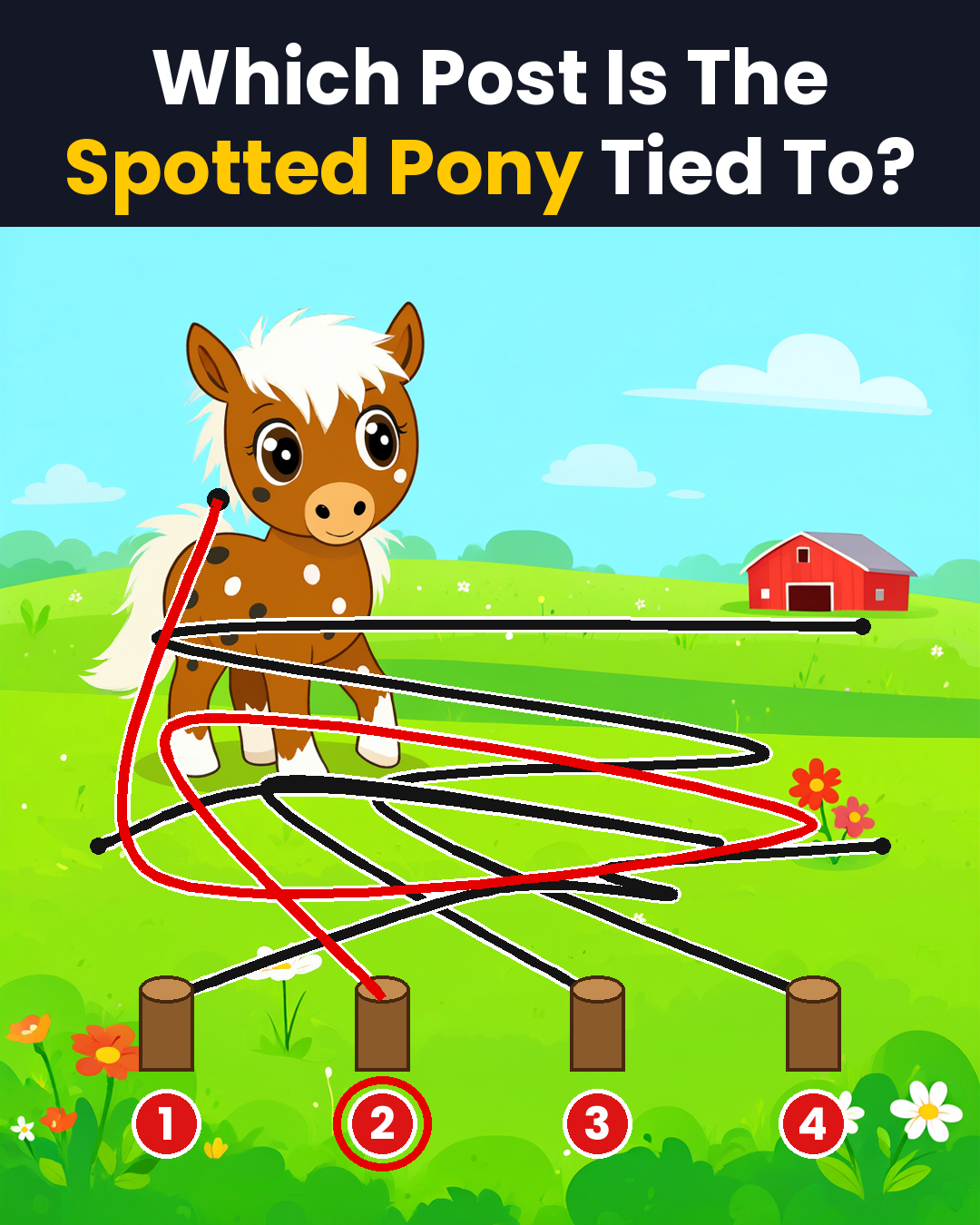
ANSWER: Post number 2 – the pony’s rope ends at the second post from the left.
Where The Rope Really Goes
The pony’s rope starts at the knot just below its mane, on the left of the picture. From there it drops down and swings far to the left, almost touching the edge, then turns back and makes a long loop across the middle of the meadow.
It crosses the other ropes three times on the way. After the last crossing it runs down to the left of centre and finishes neatly at the second post, the one with the red number two underneath it. In the answer picture that path is drawn in red so you can see the whole journey at a glance.
Post one looks tempting because the rope passes close to it twice, and post four catches the eye because a long straight rope seems to head that way. Both of those belong to loose ropes with knotted ends lying in the grass.
Why Most People Say Post One
The most common wrong answer is post one, and there is a simple reason. The pony stands on the left of the picture, so the nearest post feels like the natural owner of the rope. Our brain prefers short, tidy explanations and quietly offers that one before the eyes have finished their work.
The second trap is the big sweeping loop. It is the smoothest curve on the screen, so the eye slides along it happily and arrives at the wrong place with great confidence.
How Did You Do?
Under fifteen seconds and correct: superb concentration, and your eyes behaved themselves perfectly at every crossing.
Fifteen to forty seconds: a very good result, and almost certainly the result of tracing rather than guessing.
Over a minute: no shame at all, because careful is better than fast in this game.
Named post one, three or four: you are in excellent company. Go back to the knot at the pony’s neck and follow the rope once more, slowly, and you will see number two appear.