Hello again, puzzle friends!
Today we are taking a walk through a sunny autumn garden, and somebody has invited the owls.
They are perched everywhere: along the fence, in front of the golden trees and right down in the grass.
Your job today is a simple one. Count every little brown owl you can see in the picture.
It sounds easy, and that is exactly why so many people get it wrong on the first try.
A friendly tip before you start: the big owls are not the whole family.
Look low, look beside the wide ones, and do not rush your eyes past the grass.
Take your time, count carefully, and see whether you can beat the crowd.
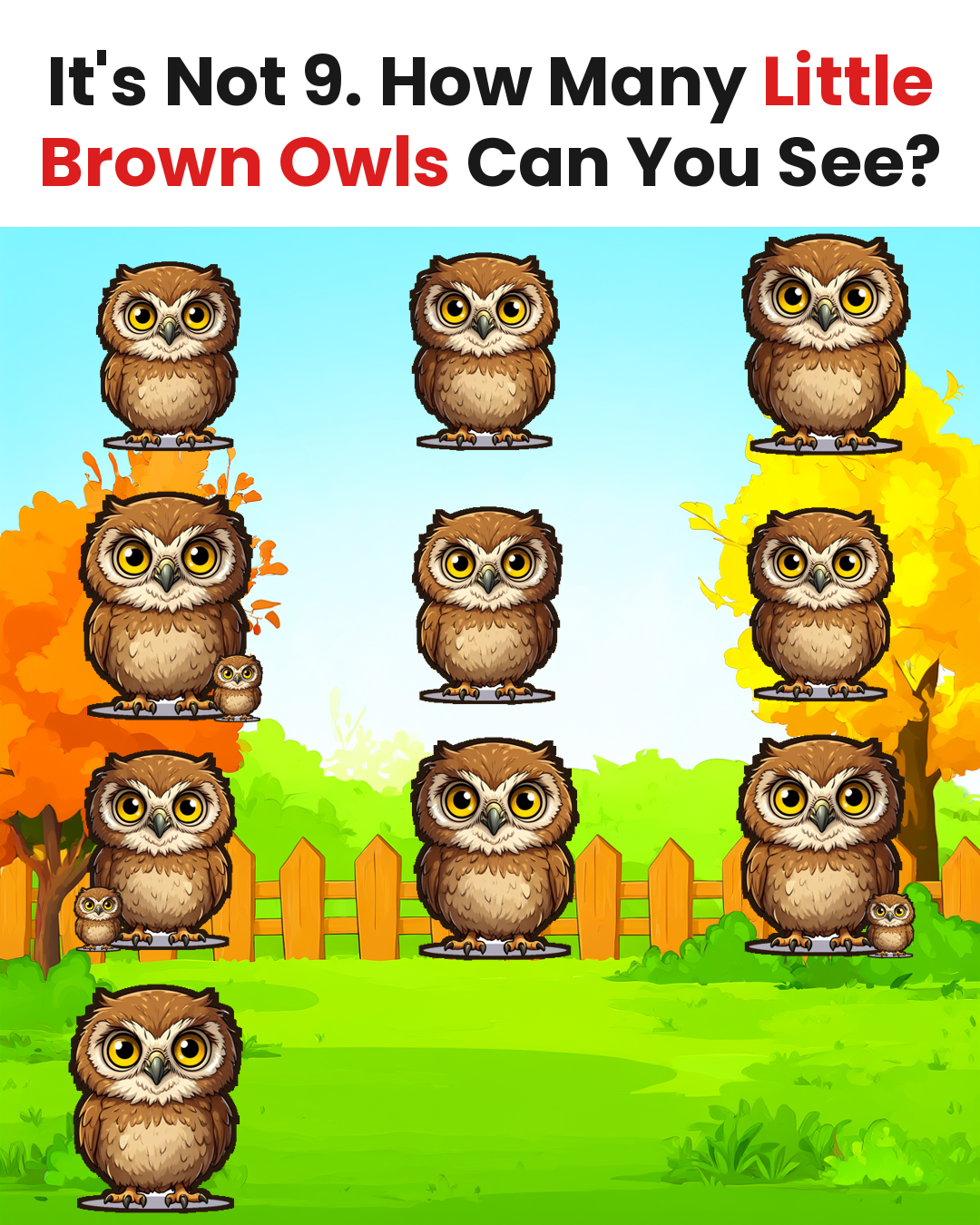
Take your time and look closely before you scroll down!
Give Your Eyes A Route To Follow
Counting seems like the easiest task in the world until a dozen similar shapes are looking back at you. The usual mistake is to let the eye wander wherever it likes, hopping from one owl to another in no particular order. After a few seconds you have counted one bird twice and skipped another one altogether, and the number you end up with is simply wrong.
The cure is to give yourself a route and refuse to leave it. Read the picture the way you read a page: the top row from left to right, then the middle, then the bottom. Whisper each number to yourself as you go, because saying a number out loud anchors it far better than thinking it.
When you reach the last owl, do not stop and do not celebrate. Go back to the beginning and count once more, this time from right to left. If both journeys give you the same number, you can trust it. If they do not, the second number is usually the honest one, because by then your eyes already know the picture.
Why Our Brain Loves To Count Too Few
There is a good reason this kind of puzzle catches almost everybody. Our vision is built to notice the big, bold and obvious first. Large shapes with strong outlines reach our attention in a fraction of a second, while small shapes sitting right next to them are treated as part of the same thing. Scientists call this grouping, and it saved our ancestors a great deal of time. It also makes us miss a tiny owl standing at the feet of a large one.
Colour plays its own quiet trick here. The browns and golds of the little owls sit comfortably against the autumn leaves and the warm grass. Nothing shouts for attention, so nothing gets noticed. Add the fence, the flowers and the blue sky, and your eye has plenty of pleasant places to rest instead of searching.
The moment you know what the trap is, you can step around it. Tell yourself before you start that some of the owls are small, and your attention will widen all by itself.
A Short History Of The Counting Puzzle
Counting puzzles are far older than the internet. Newspapers of the nineteen twenties printed drawings packed with rabbits, cats or faces hidden in the branches of a tree, and readers posted their answers in by letter. The prize was often nothing more than seeing your own name in print the following week, and people still queued at the newsstand for it.
Teachers borrowed the idea for classrooms, doctors borrowed it to test attention, and families borrowed it for rainy afternoons. The reason it has survived so well is that it needs nothing at all: no equipment, no instructions and no special knowledge. A picture and a little patience are enough.
So, How Did You Do?
Here is our friendly challenge for today. Most people need between twenty and forty seconds to count this garden properly, and nearly everyone gives too small a number the very first time.
Write down your answer before you scroll on, so you cannot change your mind later. Then share the picture with a friend or with somebody in the family and watch them fall into exactly the same trap. Half the fun of a puzzle like this is seeing somebody else count with great confidence and still land two short.
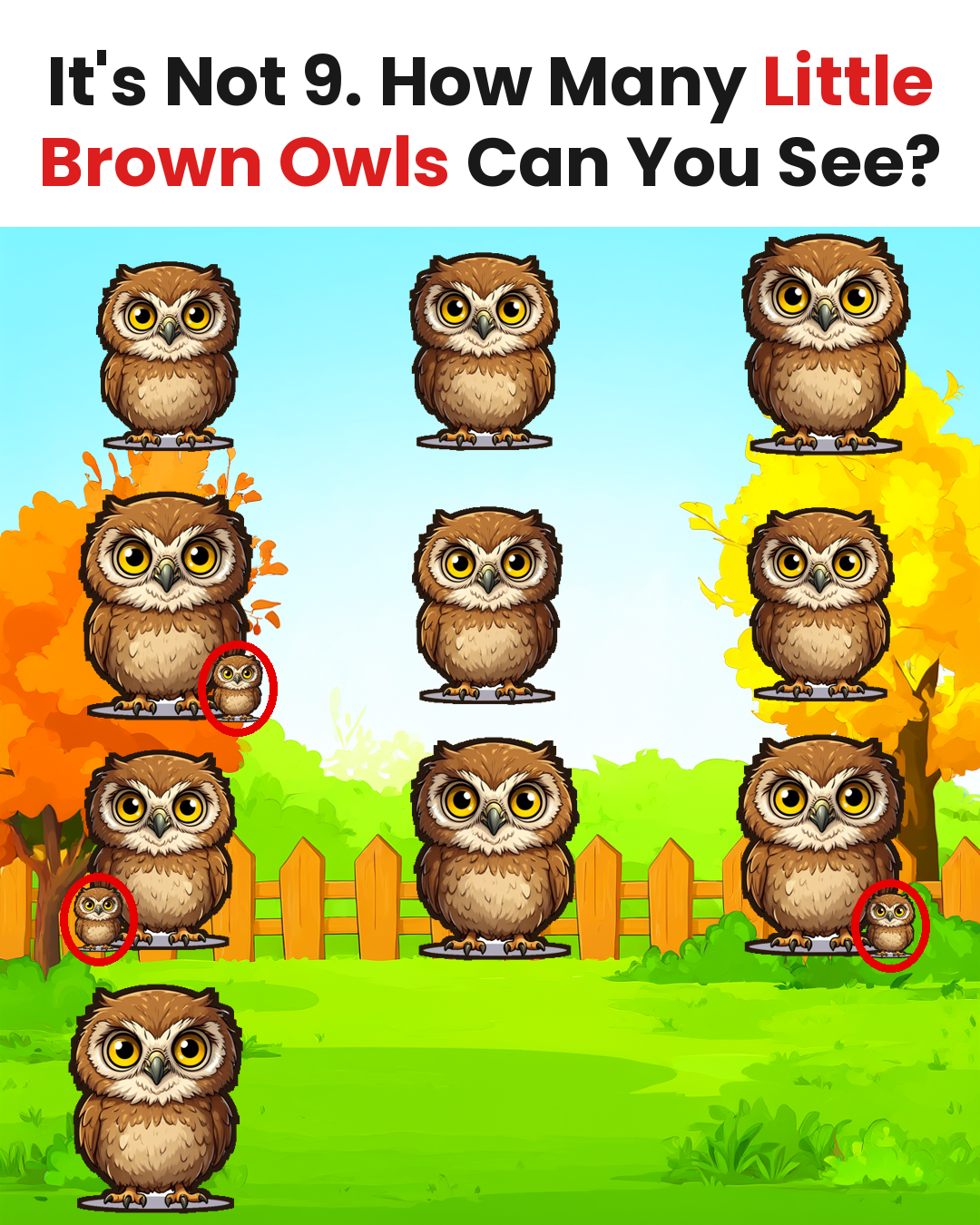
ANSWER: 13 owls – ten big ones and three tiny owls tucked in beside them.
Where The Missing Owls Were Hiding
The big owls are the easy part. There are ten of them, standing in neat rows across the garden, and almost everybody finds all ten without any trouble.
The three that decide the puzzle are much smaller. One little owl stands right beside the large owl on the left, halfway down the picture, almost touching its feathers. Another one is tucked down in the grass at the bottom left, next to the wide owl near the fence. The third sits on the right, close to the bush, beside the owl at the end of the row.
All three share the same soft brown colouring as their big neighbours, and all three stand so close that the eye reads each pair as a single bird. That is why so many people confidently answer ten and move on.
Why Almost Everyone Misses Them
When two objects touch, our brain treats them as one object. It is a shortcut that works beautifully in the real world and badly in a puzzle. The little owls were placed on purpose at the edge of a bigger shape, where that shortcut does the most damage.
There is a second reason as well. By the time your eyes reach the bottom of the picture you are already counting quickly, pleased with yourself and expecting to finish. Attention relaxes right at the moment the puzzle needs it most.
How Did You Score?
Under fifteen seconds with the right answer: you have eagle eyes, and very few people manage it.
Fifteen to thirty seconds: excellent work and a careful, steady method.
Thirty to sixty seconds: perfectly normal, and you almost certainly counted twice, which is exactly the right thing to do.
Counted ten or twelve: welcome to the club, because that is where most people land. Look again at the feet of the big owls and you will see the little ones smiling back at you.