Hello, puzzle friends!
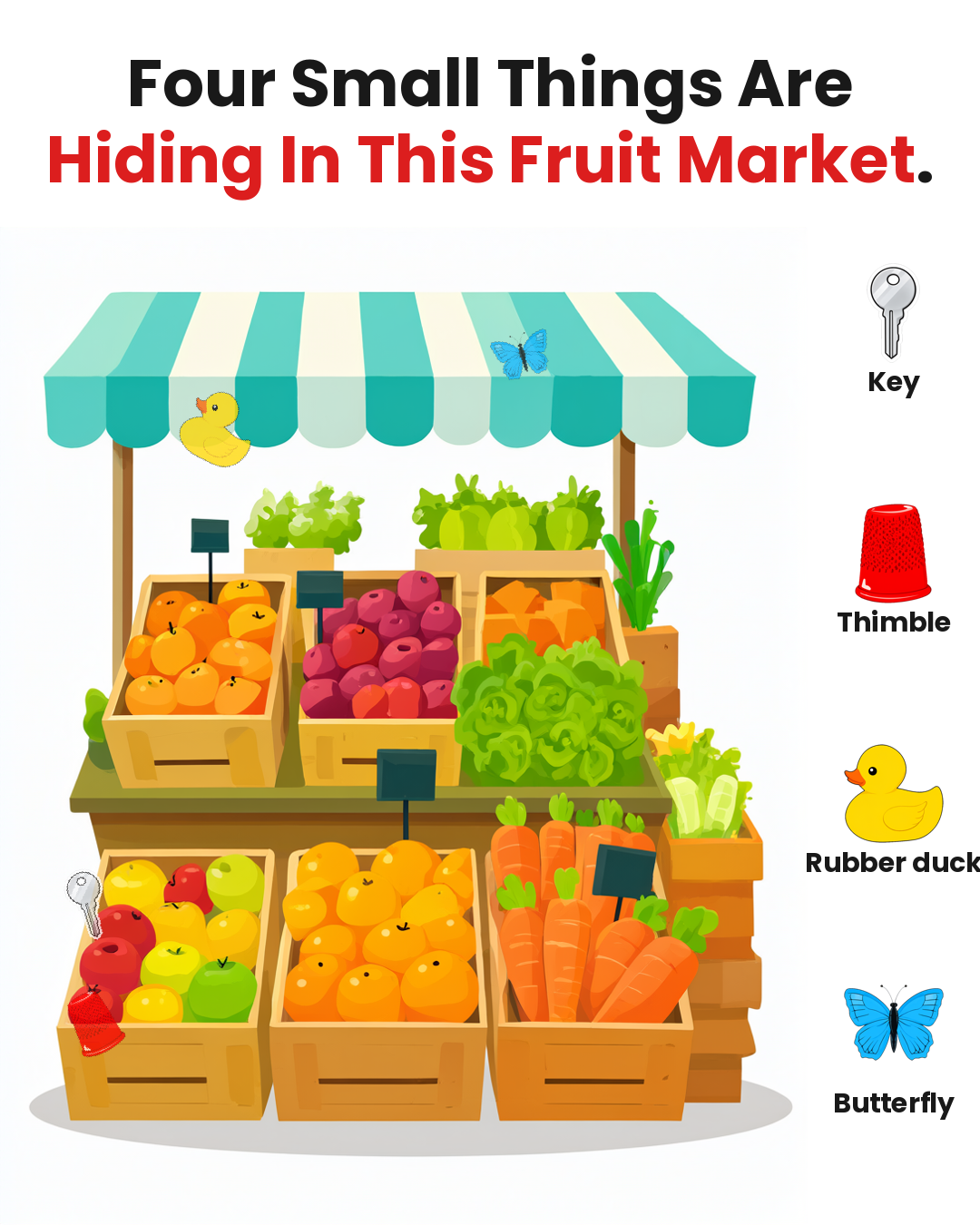
Today we are visiting a cheerful little fruit and vegetable market on a sunny morning.
There are crates of apples, oranges, carrots and fresh green lettuce under a striped awning.
But four small things have wandered in that do not belong on a market stall at all.
You will find them listed down the right side of the picture: a key, a thimble, a rubber duck and a butterfly.
They are all there, in plain sight, and not one of them is hidden behind anything.
A friendly tip: look above the fruit as well as inside the crates, and watch the edges.
Ready? Happy hunting!
Take your time and look closely before you scroll down!
Search In Bands, Not In Circles
The natural way to look for a small object is to let the eyes dart around the picture hoping to bump into it. It feels fast and it is remarkably poor. Without a plan the eyes keep returning to the same two or three interesting spots and never visit the quiet corners at all.
A far better method is to divide the picture into horizontal bands and search them one at a time. Take the awning first, then the upper shelf, then the lower crates, then the floor. Within each band move slowly from left to right, as if you were reading. It is slower for the first ten seconds and much faster after that.
One more habit helps enormously. Look at the list of objects before you start and picture each one in your mind: the shape of a key, the little dome of a thimble. An object you can already see in your imagination jumps out of the picture far more readily than one you are only half remembering.
Why Small Things Disappear In A Busy Picture
A market stall is wonderful camouflage because it is full of rounded, colourful, repeating shapes. Our vision takes a shortcut with scenes like this: instead of examining every single item, it builds a quick impression of apples, oranges, carrots and moves on. Anything that is roughly the right size and colour slips into that impression unnoticed.
This is why a red thimble sitting among red apples is so difficult. Colour is one of the first things our attention uses to sort a scene, and when the colour matches, the object is treated as part of the group. The silver key has the opposite problem. It is small, pale and thin, and against a busy crate it reads as a shadow or a highlight rather than an object.
The awning is a different kind of trap. Most people search downwards, because that is where the goods are. The top of a picture is scanned once, quickly, and then abandoned.
Where Hidden Object Puzzles Come From
Pictures with small things tucked into them have delighted people for a very long time. Artists hid faces in the leaves of trees in nineteenth century prints, magazines ran find the lost objects drawings for children, and whole books of them became family favourites in the last century.
The idea travelled well because it suits every age. A child can enjoy the same picture as a grandparent, and neither of them needs to know anything in advance. All that is required is patience and a pair of willing eyes.
A Friendly Challenge
Most people find three of the four objects within half a minute and then spend just as long again hunting for the last one. The thimble is usually the stubborn one.
Set yourself a limit of sixty seconds and see how many you can collect. Then hand the picture to somebody else without telling them which object is the difficult one, and enjoy watching them search the crates while the duck sits happily above their head.
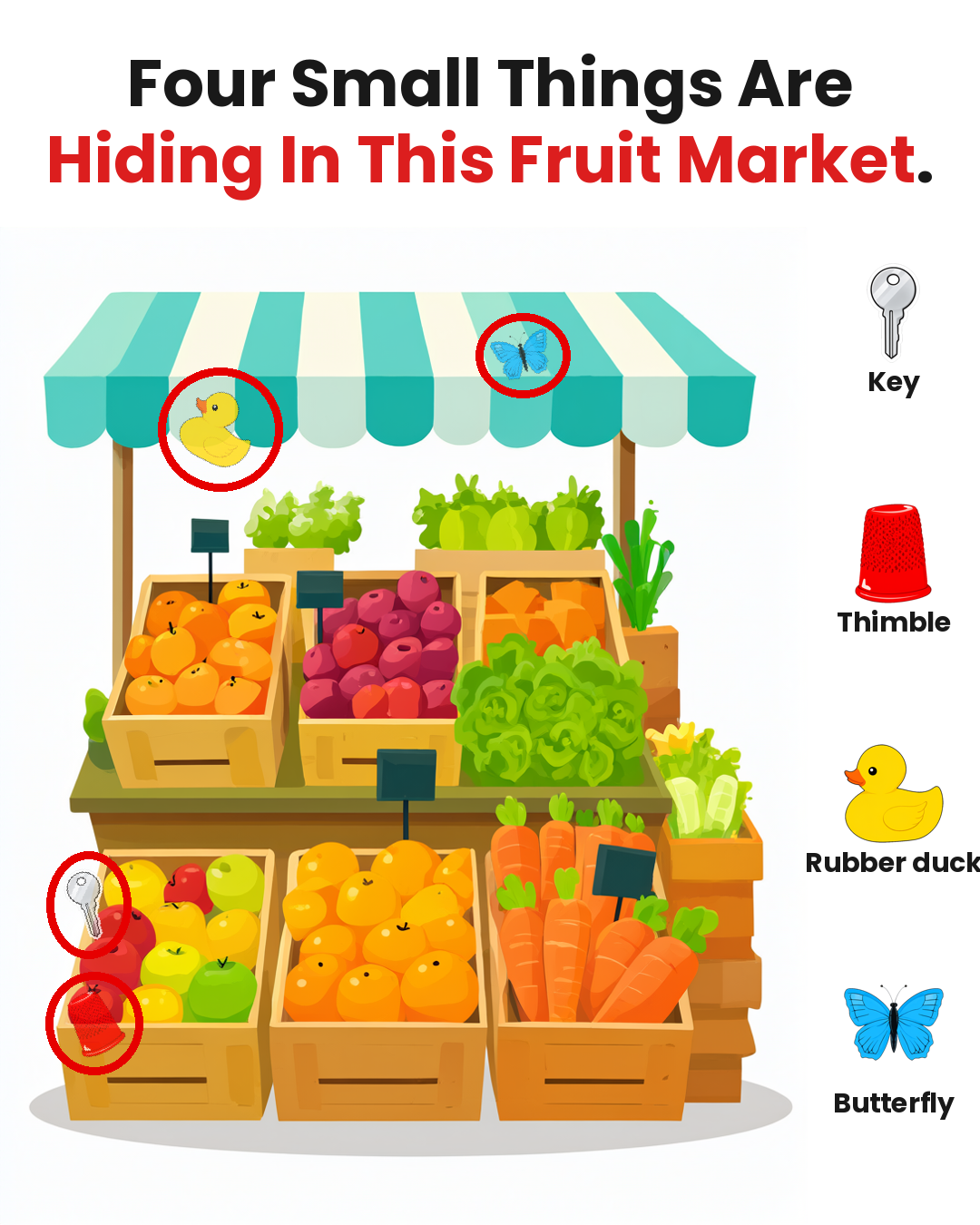
ANSWER: The key and the red thimble are at the bottom left in the apple crate, the rubber duck sits on the left of the striped awning and the blue butterfly rests near the middle of the awning.
All Four, One By One
The rubber duck is the cheekiest of the four. It is sitting on the left hand side of the green striped awning, right above the stall, in completely open view. Because it is yellow and the awning is bright, it looks like part of the decoration.
The blue butterfly is also on the awning, a little to the right of the middle, resting on one of the pale stripes. Its wings are the only blue in the whole picture, yet it is high up and small, so the eyes usually pass straight underneath it.
The silver key and the red thimble are both down in the bottom left corner, at the apple crate. The key leans against the front left edge of the crate and the thimble stands in the grass just below it, no more than a hand’s width apart. Both are circled in the answer picture.
Why They Are So Easy To Miss
Three separate tricks are at work. The thimble shares its colour with the apples beside it, so grouping swallows it. The key is thin and pale, and thin pale shapes are read as part of the background. The duck and the butterfly are simply in the wrong place: nobody searches the roof of a market stall for lost objects.
There is also a very human effect called satisfaction of search. Once you have found two or three things, your attention quietly relaxes and the last object can sit in front of you unseen for a surprisingly long time.
How Did You Do?
All four in under twenty seconds: outstanding, and genuinely rare.
All four in under a minute: excellent eyes and a sensible method.
Three out of four: the usual and perfectly respectable result, and the missing one was almost certainly the thimble.
Two or fewer: do not worry at all. Look once more at the awning first and then at the bottom left corner, and all four will be yours.