Hello, puzzle friends!
Today we are visiting a sunny little pond full of cheerful green frogs.
There are lily pads on the water, tall reeds along the bank and a great many smiling faces.
Your task is simple: count every frog you can see.
It sounds easy, but almost everybody gives the wrong number the first time.
A friendly tip: the big frogs are not the whole story, so look down low and close to the grass.
Count slowly, row by row, and do not let the big ones steal all your attention.
Ready? Off you hop!
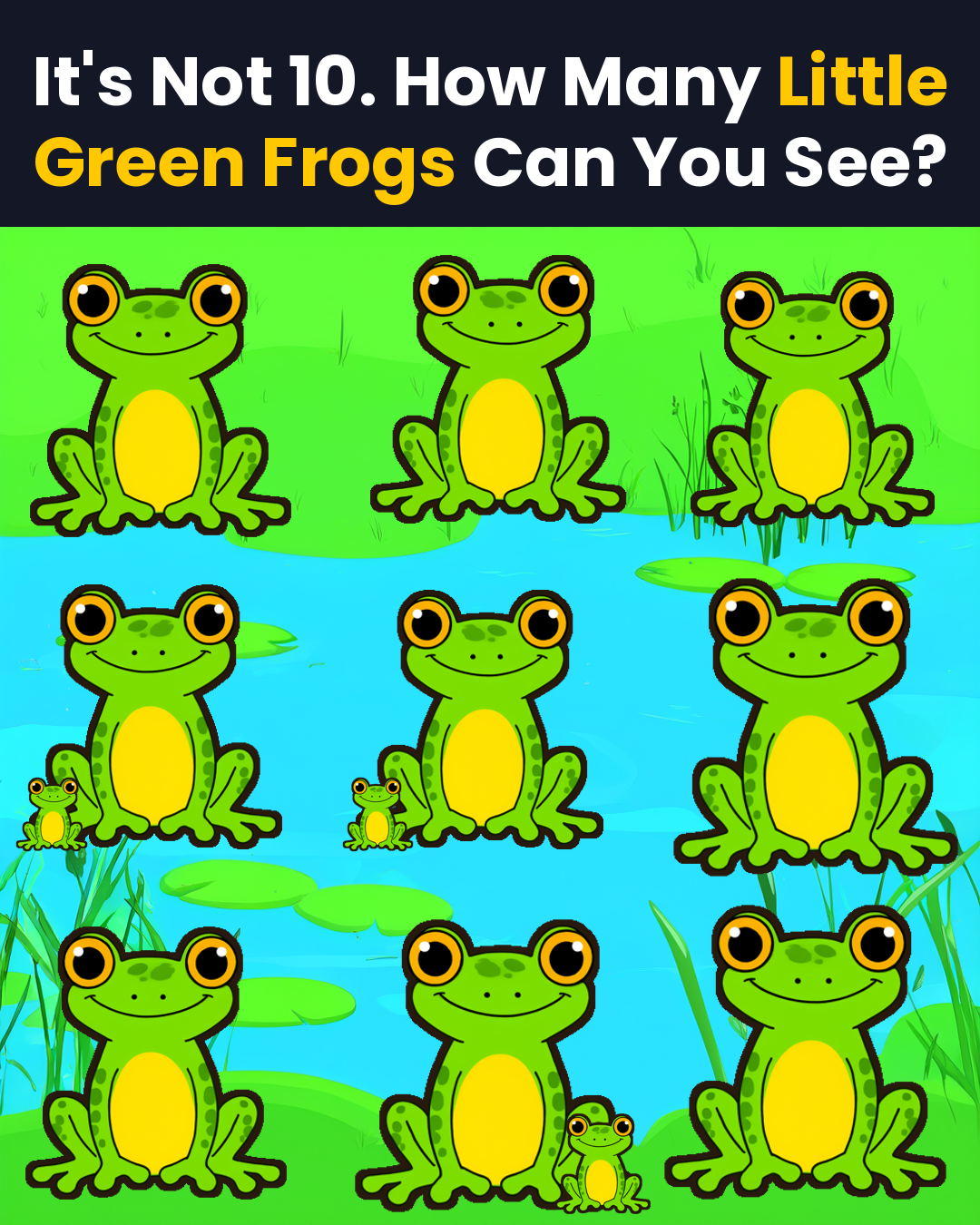
Take your time and look closely before you scroll down!
How To Count Without Losing Your Place
Counting looks like the simplest task in the world until there are a dozen similar shapes in front of you. The usual mistake is to count in a wandering line, jumping from one frog to another wherever the eye happens to land. Within a few seconds you have counted one frog twice and skipped another completely.
The cure is to give yourself a route and stick to it. Read the picture like a page: top row from left to right, then the middle row, then the bottom row. Say each number quietly to yourself as you go, because saying a number out loud keeps your place far better than thinking it.
When you reach the end, do not stop. Go back and sweep the picture a second time, looking only at the empty-looking spaces – the water, the grass and the gaps between the bigger shapes. That second sweep is where most people find the frogs they missed.
Why Counting Fools Us
Human beings can see a small number of things at a glance without counting at all. Up to about four, we simply know. Beyond that, we must count one by one, and that is where the trouble starts, because counting needs attention and attention wanders.
There is a second trap in a picture like this one. When objects look nearly identical, the brain treats them as a group rather than as individuals. It gives us a quick estimate instead of a true count, and estimates are usually a little low.
Size matters too. Big shapes grab the eye, and a small version of the very same shape sitting beside a big one is easy to overlook. Our attention goes to what is loudest, not to what is most important.
A Fun Fact About Counting Puzzles
Counting puzzles are among the oldest games we have. Market traders used them to sharpen their eyes, and teachers have used them in classrooms for generations.
Researchers still use the same idea today. When they want to study attention, they often show people a crowd of identical shapes and ask them to count. Almost everyone is confident. Almost everyone is wrong by one or two. It is one of the most reliable results in the whole field.
Your Challenge
Most people need about thirty seconds to count this pond properly, and most people get it wrong on the first attempt. Getting the right number in under twenty seconds is genuinely impressive.
Show the picture to a friend before you tell them anything, and ask for their number. If the two of you agree straight away, one of you is probably wrong. Count it together and see.
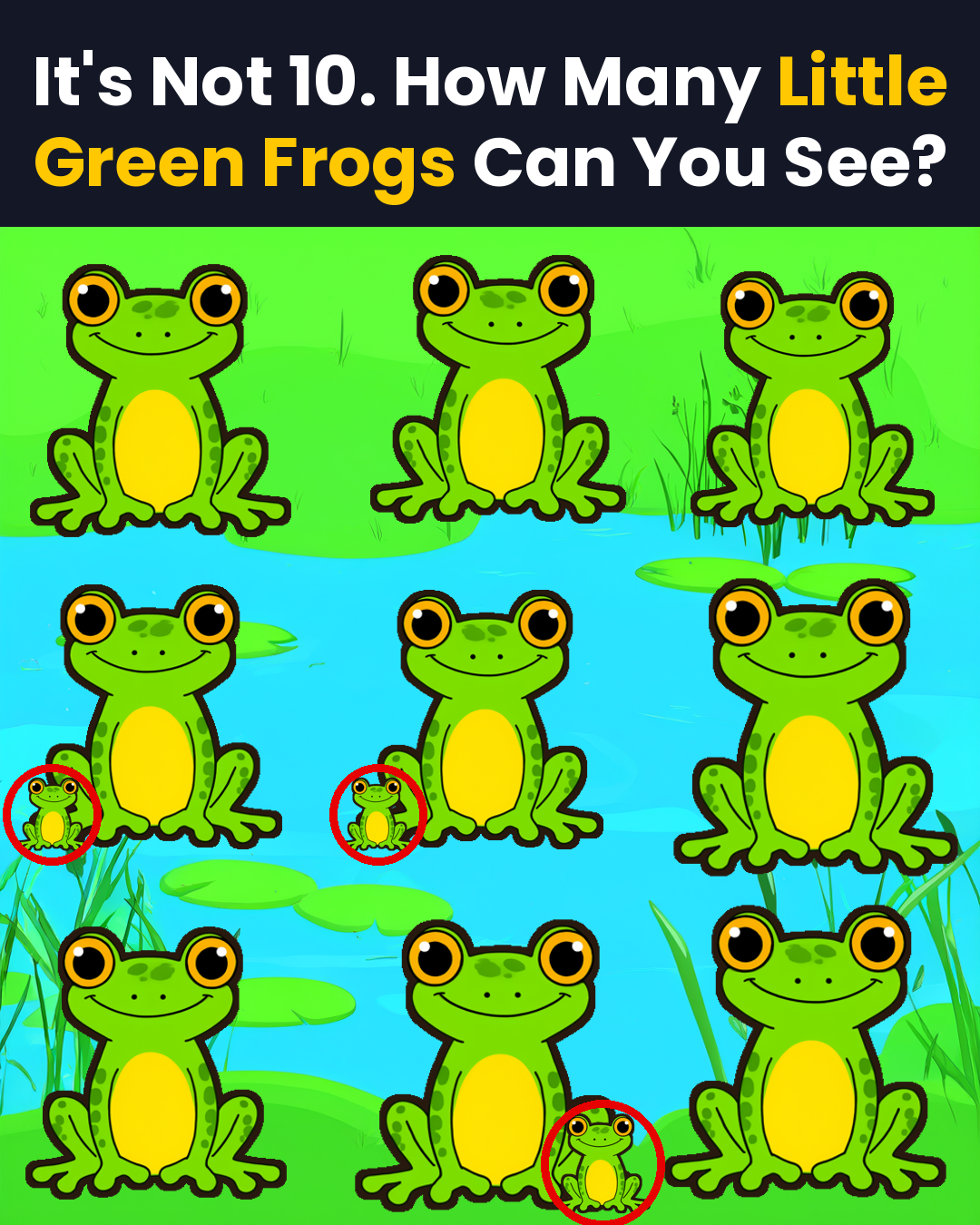
ANSWER: 12 frogs – nine big ones and three little ones hiding beside them.
Where The Missing Frogs Are
There are twelve frogs in the pond. Nine of them are the large ones, arranged in three tidy rows of three, and they are easy to find. The other three are much smaller, and they are the reason almost everybody says nine or ten.
The first little frog sits at the far left of the middle row, tucked beside the leg of a big frog among the reeds. The second little frog sits a short way to the right, in front of the middle frog of that row. The third one is at the bottom of the picture, in front of the frog in the middle of the bottom row, almost leaning against it.
Why They Are So Easy To Miss
All three little frogs are the same colour as the big ones, and they sit right next to a much larger shape. Our eye reads the big frog first, decides it has seen a frog, and skips over the smaller one as if it were part of the same animal.
It helps that they sit low, near the grass and the water line, where our attention naturally drops off. The middle of a picture gets most of our care; the bottom edge gets the least. Puzzle makers have known this for a very long time.
How Did You Do?
Twelve on the first count, in under 20 seconds – eagle eyes. You really did look at the whole picture.
Twelve after a careful second look – excellent work. The second sweep is what separates a good counter from a lucky one.
Ten or eleven – very close, and a very common answer. One of the little ones was simply too well placed.
Nine – do not be disheartened. Nine is what most people say, because nine is what the picture wants you to say.