Hello again, puzzle friends!
Step inside a small village post office, where a friendly postman is waiting behind the counter.
There are parcels on the shelves, a letter scale on the desk, a clock on the wall and a red mailbox by the door.
The two pictures look like twins, but one little thing has changed while nobody was watching.
It is not the postman, and it is not the clock.
A gentle tip: the shelves are a good place to begin, and the lower shelf is even better.
Compare one parcel at a time instead of looking at everything at once.
Take a deep breath and enjoy the search!
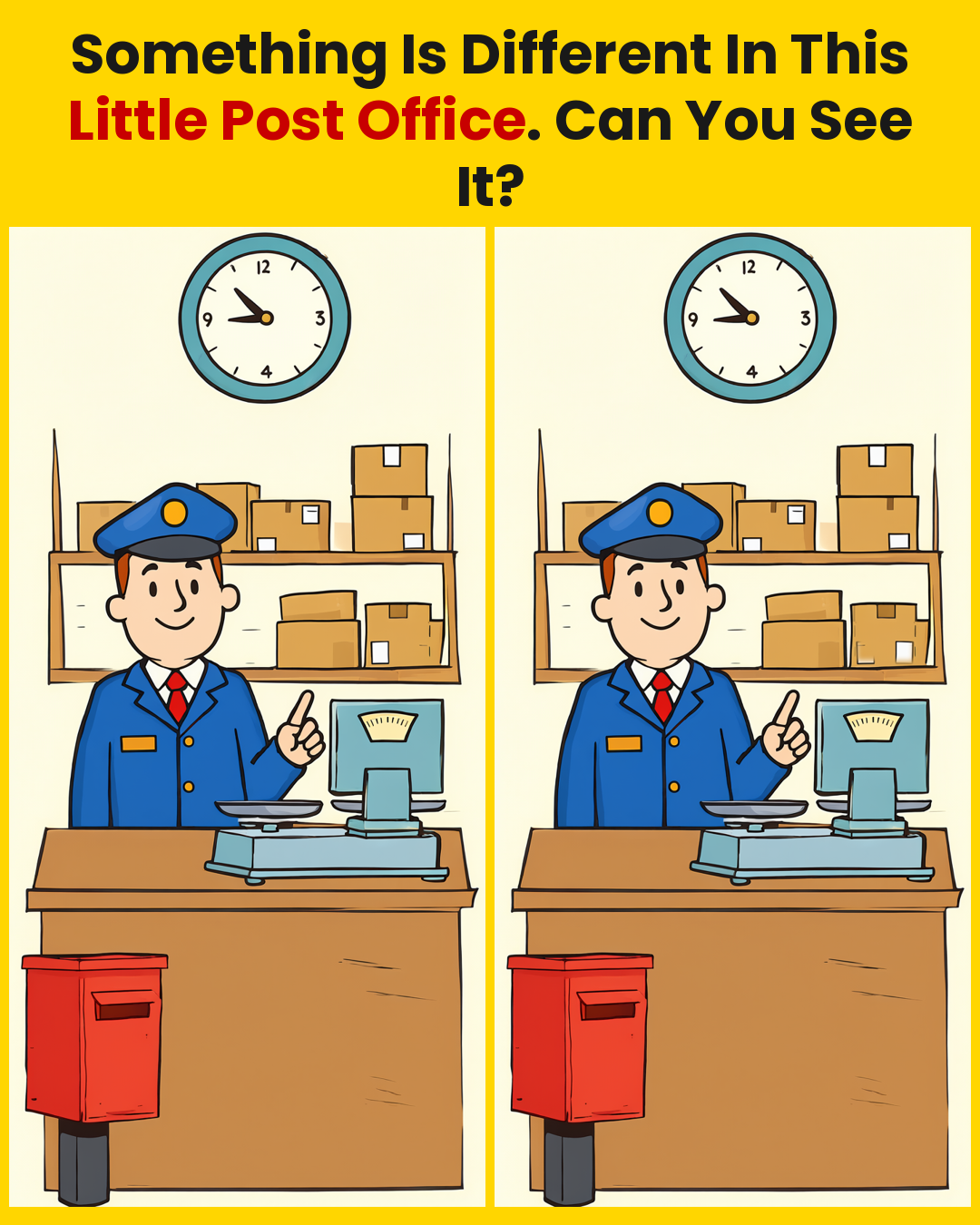
Take your time and look closely before you scroll down!
A Simple Method That Really Works
The best way to beat a picture like this is to be a little bit boring. Instead of letting your eyes jump around looking for something that shouts at you, work your way through the picture in a fixed order, top to bottom, like reading a page.
Start with the clock, then the top shelf, then the lower shelf, then the postman, then the counter, then the mailbox. Finish each part before you move to the next, and resist the temptation to skip ahead. Puzzle makers rely on us being impatient.
It also helps to look at shapes rather than things. A parcel is not really a parcel to your eye; it is a brown rectangle with a small white square on it. When you look at plain shapes, a detail that has moved becomes much easier to catch, because you are no longer thinking about what the object means.
Why Small Details Disappear
Our brain is a champion at sorting the world into groups. A shelf of brown parcels is filed away instantly as one single idea: parcels. Once that label is in place, the individual boxes stop being individual, and any small difference between them quietly disappears.
This is wonderfully useful in daily life. It is why you can find the milk in a full refrigerator without studying every shelf. But it is exactly what a puzzle is designed to catch out.
There is another reason this one is tricky. The change is not a colour and not a missing object. It is a position – something that has simply turned around. Our memory for colour is quite good, but our memory for which side a small thing sits on is surprisingly weak.
Puzzles In The Post
Picture puzzles and the post office have a long history together. For many years, newspapers and children’s magazines arrived by mail with a puzzle page inside, and whole families solved them together at the kitchen table on a Sunday.
Postcards with hidden pictures were popular too, sent from seaside towns with a cheerful note on the back. The puzzle was half the message. Today we send puzzles to each other on our telephones in a second, but the pleasure is exactly the same one our grandparents knew.
Ready For A Little Challenge?
Most people find this one in about thirty seconds. Under fifteen seconds is genuinely quick, and that means you are comparing in an orderly way instead of hoping for luck.
If you find it fast, give yourself a harder test: look away for a moment, then try to describe the whole post office from memory. Almost nobody can do it, and it is a fine way to see just how much our eyes leave out.
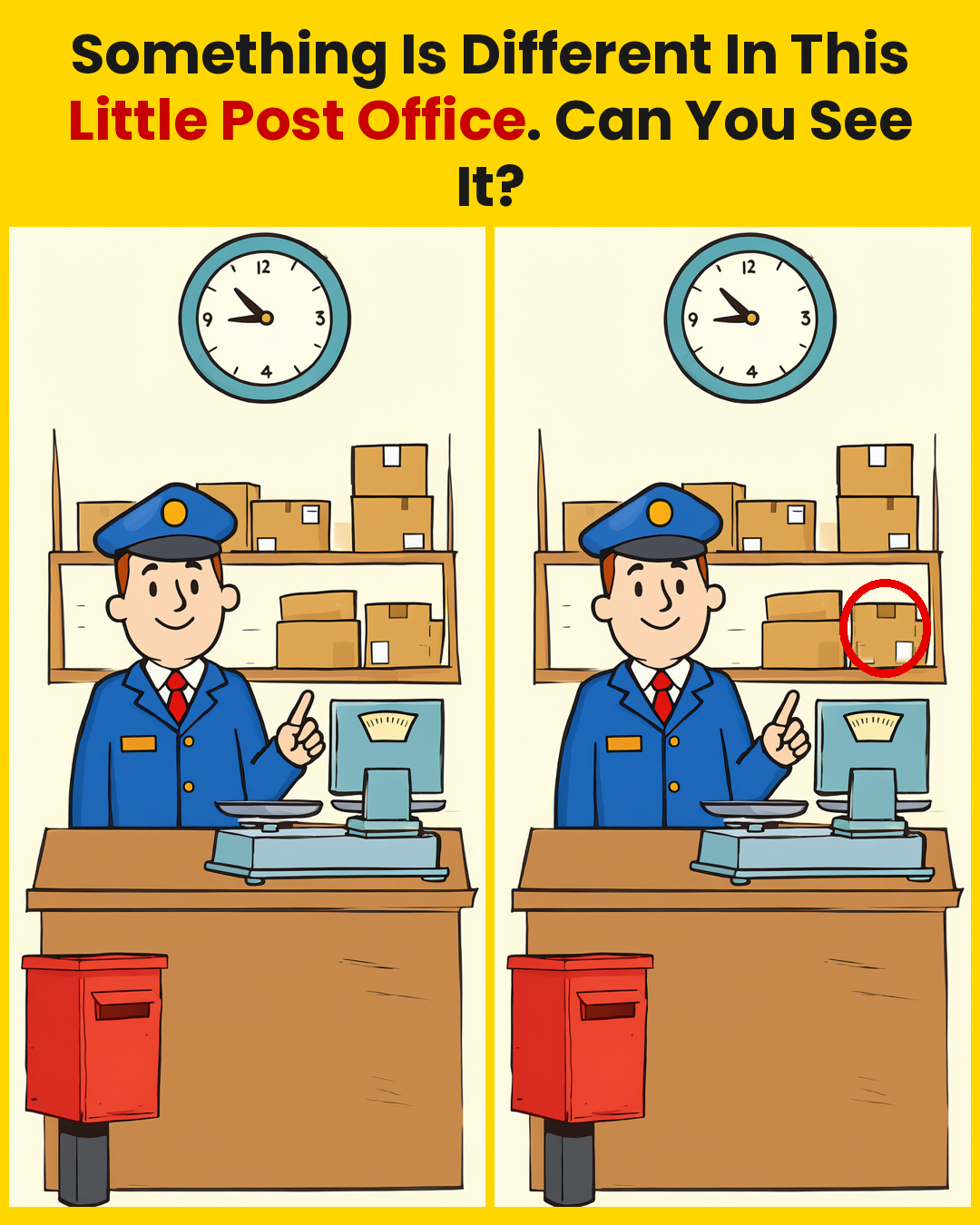
ANSWER: The parcel on the right of the lower shelf is turned around – its white address label has moved to the other side of the box.
The Parcel That Turned Around
Look at the lower shelf, at the parcel on the right-hand side. In the first picture, the small white address label sits on the left of that box. In the second picture, the very same parcel has been mirrored, and the label now sits on the right.
Nothing was added and nothing was taken away, which is what makes this change so quiet. The shelf still holds the same number of boxes, the colours are identical, and the shape of the pile looks unchanged. Only the little white rectangle has walked across the box.
Why Nearly Everyone Misses It
Two things work against us here. First, the postman stands right in the middle of the picture with a raised finger, and a raised finger is a natural magnet for attention. While we look at him, the shelves get only the corner of our eye.
Second, the label is small, white and plain, and it sits on a brown background among other small, white, plain labels. Our eye counts them, decides there are several labels on the shelf, and happily stops counting. To spot the change, you have to compare one single box with its twin – and that is the one thing a hurried brain refuses to do.
How Did You Do?
Under 10 seconds – eagle eyes. You look at details the rest of us walk straight past.
10 to 30 seconds – very sharp. A fine result for a change this quiet.
30 to 60 seconds – well done. You stayed patient, and patience is the real skill here.
More than a minute – do not worry at all. This kind of mirrored detail fools almost everybody the first time, and now you know exactly what to look for in the next one.