Hello again, puzzle friends!
Today we are spending a quiet morning down at the farm pond.
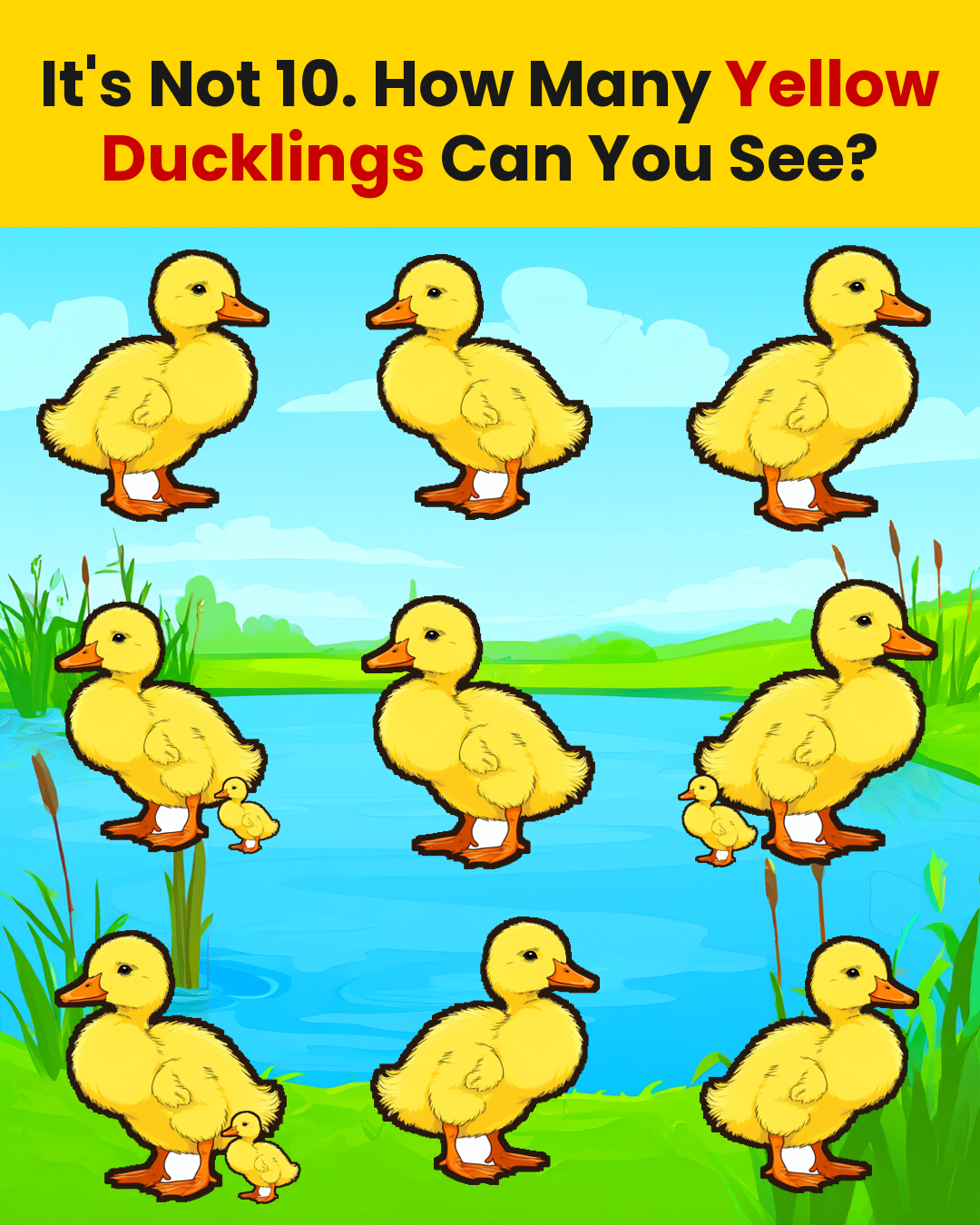
The sun is warm, the water is calm, and a whole family of fluffy yellow ducklings has come out to enjoy the day.
Your job is simple to say and not so simple to do: count every single duckling in the picture.
Most people take one quick look, say a number out loud, and feel very sure about it.
Then they look again and the number changes.
Here is a friendly tip before you start: the big ones are easy, so slow down and look at the ground around them.
Take your time, count carefully, and see if you can beat the clock.
Take your time and look closely before you scroll down!
Count In Rows, Not In Circles
The biggest mistake with a counting picture is letting your eyes wander wherever they please. You start in the middle, jump to the left, drift to the top, and by the time you reach the bottom you honestly cannot remember which birds you have already counted. That is how the same duckling gets counted twice while another one is never counted at all.
The cure is a simple method that works every time. Pretend the picture is divided into three horizontal bands: the top band above the water, the middle band along the pond, and the bottom band on the grass. Count one band completely, say the running total to yourself, then move down to the next band. Never jump back up.
When you have your total, do one more slow pass in the opposite direction, from the bottom band to the top. If both passes give you the same number, you can be fairly confident. If they do not match, something small is hiding somewhere, and that is your signal to look harder.
Why Our Brain Loves To Round Things Off
There is a reason puzzles like this one catch so many sharp people. Our brain is wonderful at seeing a group at a glance, but it is lazy about the exact number. Researchers call this subitizing: we can instantly recognise one, two, three or four of something without counting, but beyond that we start to estimate instead.
So when we see a pond full of ducklings, the mind quietly whispers a tidy number, something like nine or ten, and then our eyes go looking for proof. Once we have a number in our head, we tend to stop searching. Psychologists call this confirmation bias, and it works just as well on ducklings as it does on anything else.
Size plays a part too. Something small sitting right next to something large almost disappears, because the brain treats the pair as one shape. That is why the little ones in this picture are so easy to walk straight past.
A Puzzle Older Than You Think
Counting pictures are far older than the internet. Long before anyone shared a puzzle on a phone, children’s magazines and Sunday newspapers printed drawings full of hidden animals, and whole families sat around the kitchen table arguing about the right number.
Illustrators learned quickly that the best place to hide something is not in a dark corner. It is right out in the open, close to a bigger version of the same thing, where the eye slides past without stopping. The trick has not changed in a hundred years, and it still works beautifully.
That is part of the charm of these puzzles. They do not need education, speed or special knowledge. They only need patience, and patience is something that often improves with age.
Can You Beat The Average?
Most people land on the wrong number in the first eight seconds and then need another thirty or forty seconds to find everything. A careful counter usually gets there in under a minute.
So give yourself a gentle challenge. Look away from the screen, take a breath, then look back and count once more using the three-band method. Write your number down before you scroll.
And when you are sure, send this picture to a friend or to someone in the family who always claims to have perfect eyesight. It is a lovely, harmless way to start a friendly argument over a cup of coffee.
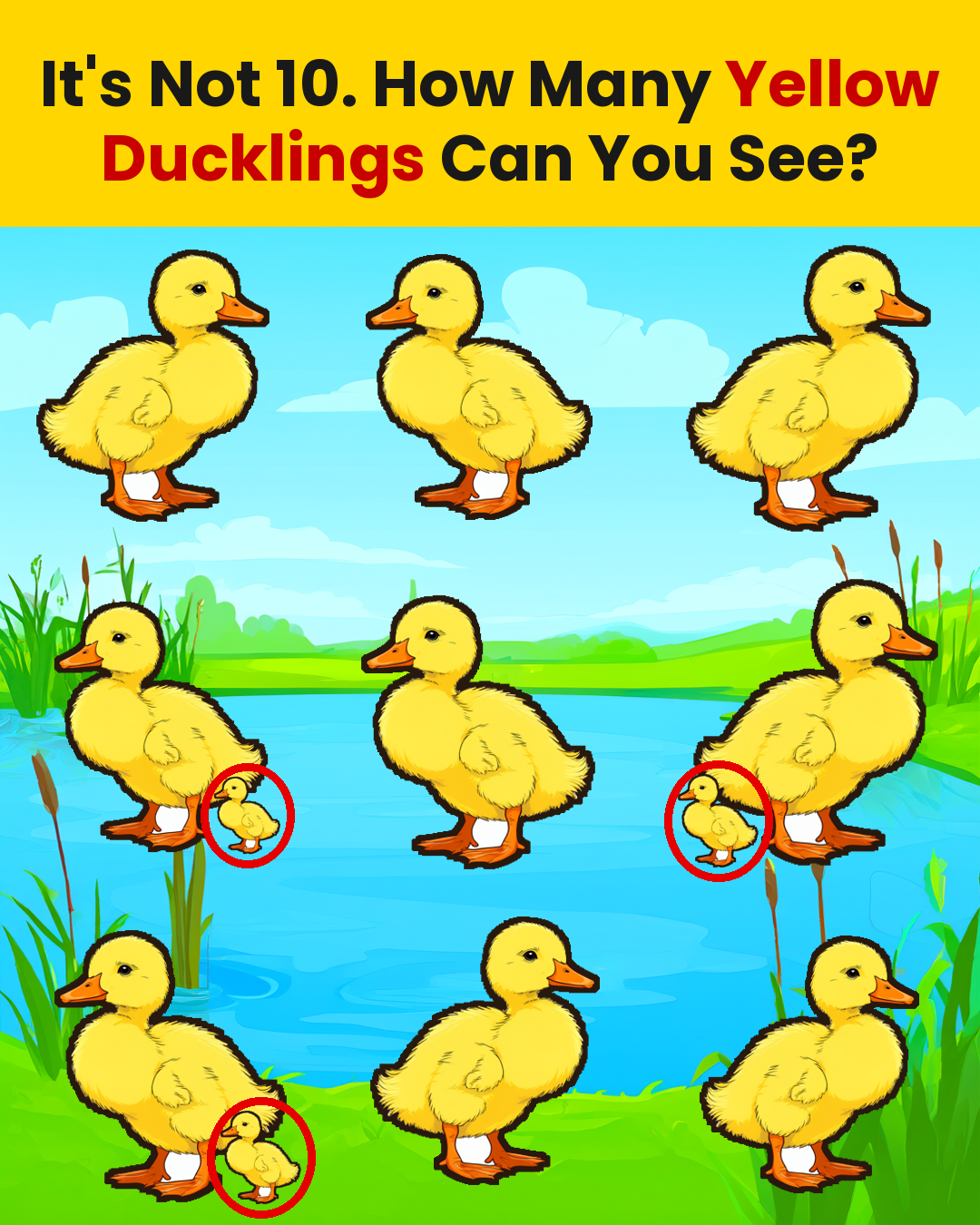
ANSWER: 12 ducklings – 9 big ones plus 3 tiny ducklings standing close beside the bigger birds
Where The Missing Ducklings Were Hiding
The nine large ducklings are the easy part. They are spread out across the grass and the water in three neat groups of three, and almost everybody finds all nine on the first pass.
The three extra ducklings are much smaller, and each of them is standing right beside a bigger bird. One is tucked beside the duckling on the middle left, close to the reeds. One is standing in front of the duckling on the middle right, almost touching its leg. The third is down in the bottom left corner, nestled against the grass beside the large duckling there.
Because each little one shares an outline with a big one, the eye reads the pair as a single fluffy shape and moves on. That is exactly why the true total is twelve and not the nine or ten that most people confidently announce.
Why Most People Miss Them
Two things work against us here. First, everything in the picture is the same cheerful yellow, so there is no colour change to catch the eye. Second, the little ducklings sit low on the ground, below the line where we naturally look.
Our attention is drawn to faces, and the big ducklings have large, clear eyes that hold our gaze. While we are busy looking at those faces, the small bodies down near the grass never get a proper inspection.
The fix is to ignore the faces completely on your second pass and run your eye along the ground line instead. Suddenly the three little ones appear as if someone had switched on a light.
How Did You Do?
Under 15 seconds for all twelve: truly eagle eyes, and you almost certainly used a method rather than a guess.
Under 40 seconds: excellent work, right in the top group of readers.
Under a minute and a half: a solid, careful result and better than most people manage.
Still counting after that, or sure the answer was ten? Do not worry for a moment. This puzzle was built to fool exactly that first confident glance, and the fact that you kept looking is the part that keeps the mind sharp.