Hello, puzzle friends!
Out in the meadow this morning there is one very calm little grey goat with a red collar and a bell.
Somebody has tied his rope to one of the four wooden posts at the bottom of the picture, and then, as always happens on a busy farm, three more ropes were left lying across the grass.
Now the ropes cross over and under one another, and the goat is far too comfortable to explain anything.
Your job is to follow his rope from the knot at his collar all the way down to the right post.
Do not guess by the direction it sets off in – that is exactly how this puzzle catches people.
Post 1, 2, 3 or 4? Take a good look and make your choice.
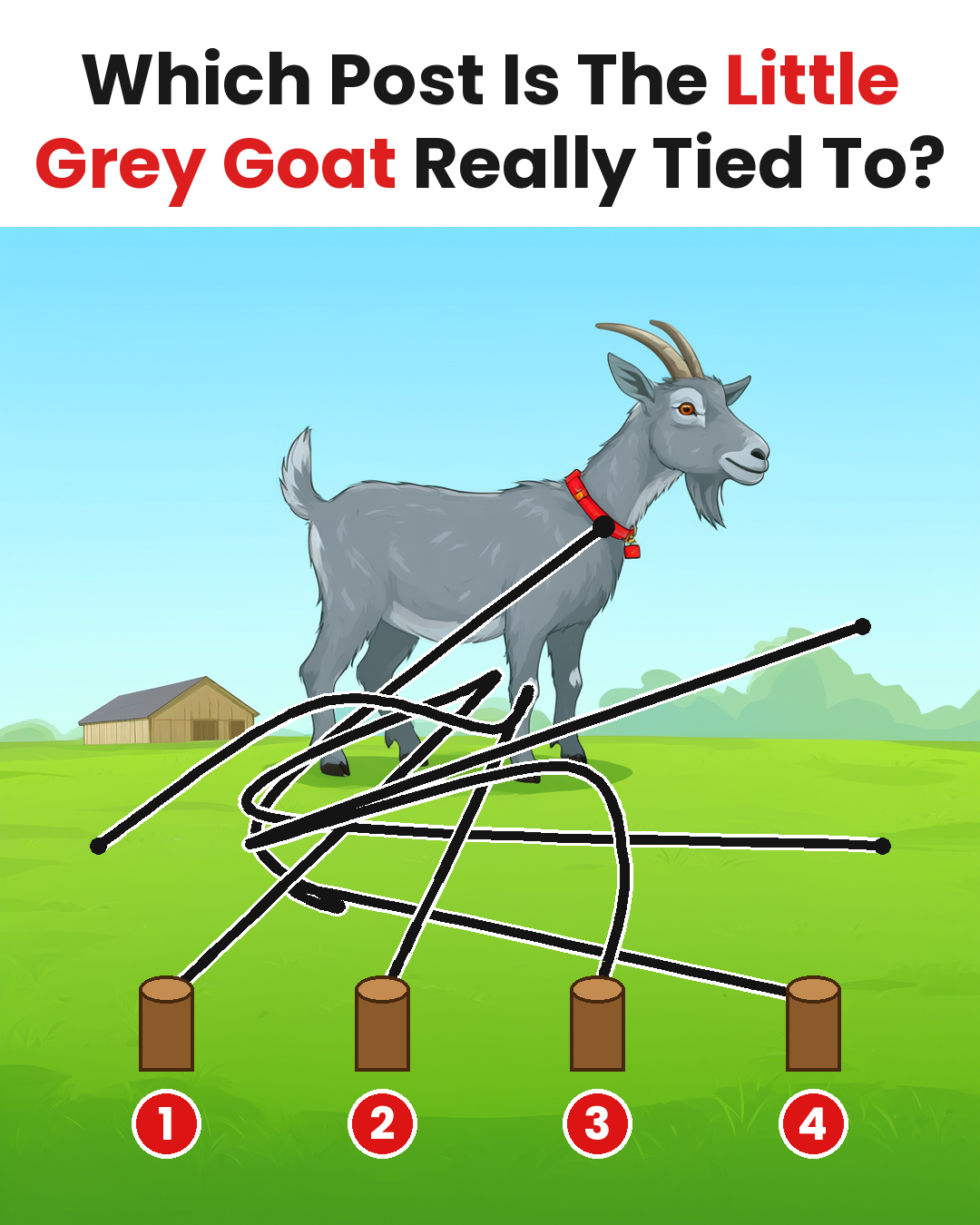
Take your time and look closely before you scroll down!
Start At The Goat, Never At The Posts
Almost everybody begins this puzzle at the bottom. They pick a post that looks promising, run their eye upwards and hope to arrive at the goat. It feels efficient, and it is the slowest way there is, because there are four posts to try and only one rope that matters.
Work the other way round. Put your finger on the black knot at the goat’s collar and follow that single line, one short piece at a time. Wherever your rope passes under or over another, stop for a moment, note which side it comes out on, and only then carry on.
If you lose the thread, go back to the knot and start again rather than picking up whichever line looks closest. A fresh start costs five seconds. A wrong guess costs the whole puzzle.
Why Our Brain Slips At Every Crossing
Following a line sounds like the simplest task in the world, and yet the eye does not move smoothly along it. It jumps in small hops, and after each hop the brain has to decide which line it landed on. At a crossing there are two candidates, and the brain often picks the one that continues the direction it was already travelling in.
That is why the ropes here curve. A straight rope would be easy. A rope that bends just before a crossing tempts your eye into carrying straight on, onto the wrong line altogether, and you will feel perfectly confident the whole way down.
There is also a sense of urgency that works against us. Puzzles feel like a race, and speed is the one thing that guarantees a mistake at a crossing.
An Old Puzzle With A Long Rope
Tangle puzzles of this kind were a favourite in children’s annuals and puzzle books long before anyone saw one on a telephone. The classic version showed three fishermen with tangled lines, or a group of children holding balloon strings, and readers traced them with a pencil on paper.
The idea is even older than the printed page. Mazes and knot patterns have appeared on pottery, mosaics and church floors for centuries, because the human eye has always enjoyed the particular pleasure of following one path through a muddle and arriving safely at the end.
Your Friendly Challenge
Most people need about twenty seconds for this one, and roughly half of them still name the wrong post on their first attempt. See whether you can do it in fifteen, using nothing but your eyes – no finger on the screen, no pencil.
Then pass it to a friend and ask for their answer before you say a word about yours. If the two of you disagree, trace it together slowly, crossing by crossing. That conversation is usually more fun than the puzzle itself.
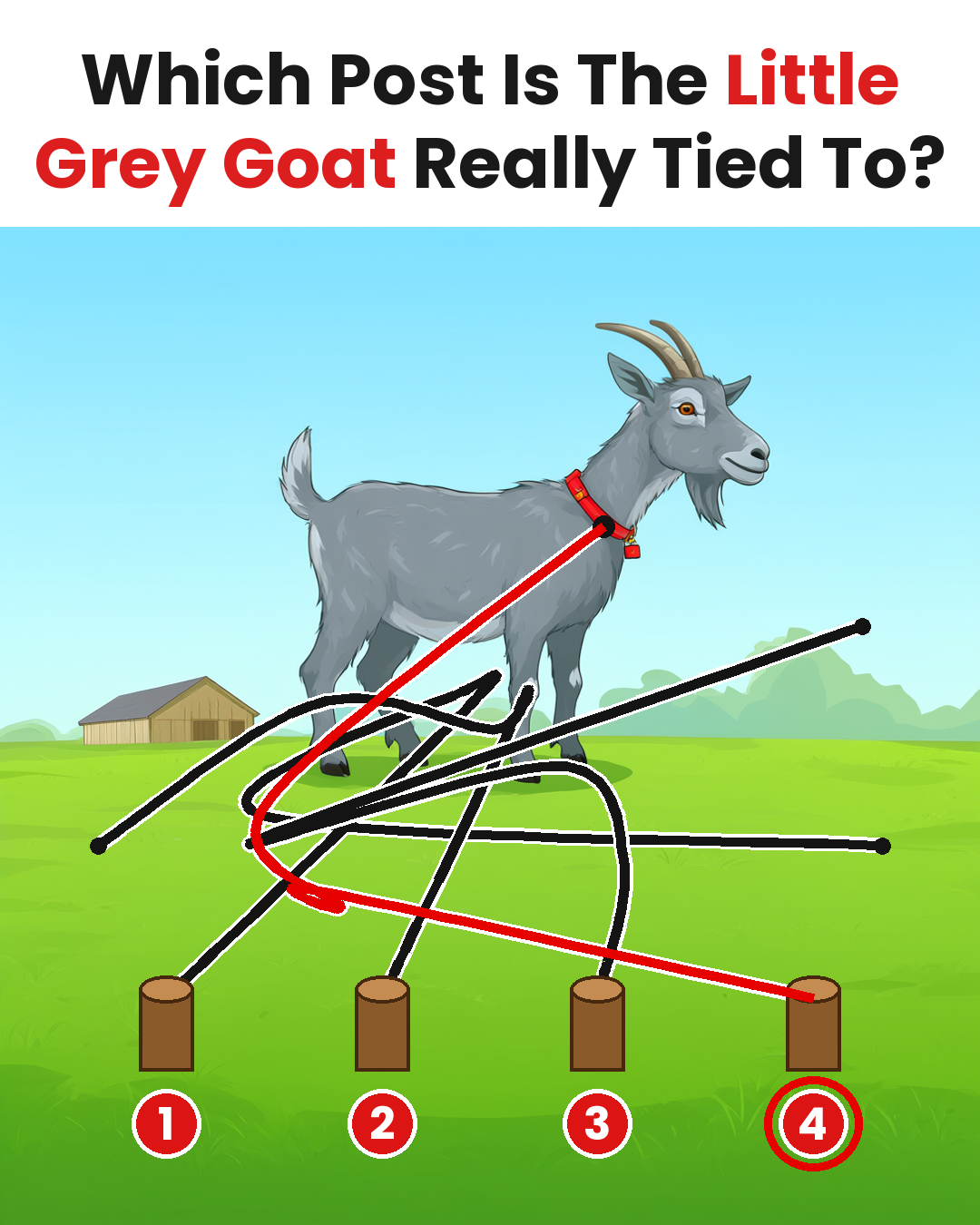
ANSWER: Post 4 – the goat’s rope starts at his red collar and ends at the post on the far right.
The Rope In Red
In the answer picture the goat’s rope is drawn in red so you can see the whole journey at once. It leaves the knot at his red collar on the right side of his neck, drops down and to the left across the meadow, dips low near the middle of the picture, then turns and runs steadily to the right, under two of the other ropes, and finishes neatly at post number 4.
The three black ropes have no goat at all. Each one begins at a small knot lying loose in the grass, which is a detail most people never stop to notice, and they end at posts 1, 2 and 3 purely to keep you busy.
Why Post 2 Fools So Many People
The goat’s rope sets off downwards and to the left, and post 2 sits almost exactly where that first stretch is pointing. The eye finishes the line in its imagination before it has finished reading it, and the answer feels settled before any real tracing has happened.
The turn back towards the right happens low in the picture, behind a tangle of crossings, which is the one place where most people stop concentrating. Slow down exactly there and the puzzle falls apart in your favour.
How Did You Do?
Under ten seconds and you said post 4: outstanding – that is a very steady pair of eyes.
Ten to thirty seconds: a strong result, and the way most careful solvers get there.
Up to a minute: perfectly good, and you almost certainly traced every crossing properly.
And if you went for post 2, do not worry at all. It is the most popular wrong answer in the whole meadow.