Hello, puzzle friends, and welcome to the pond!
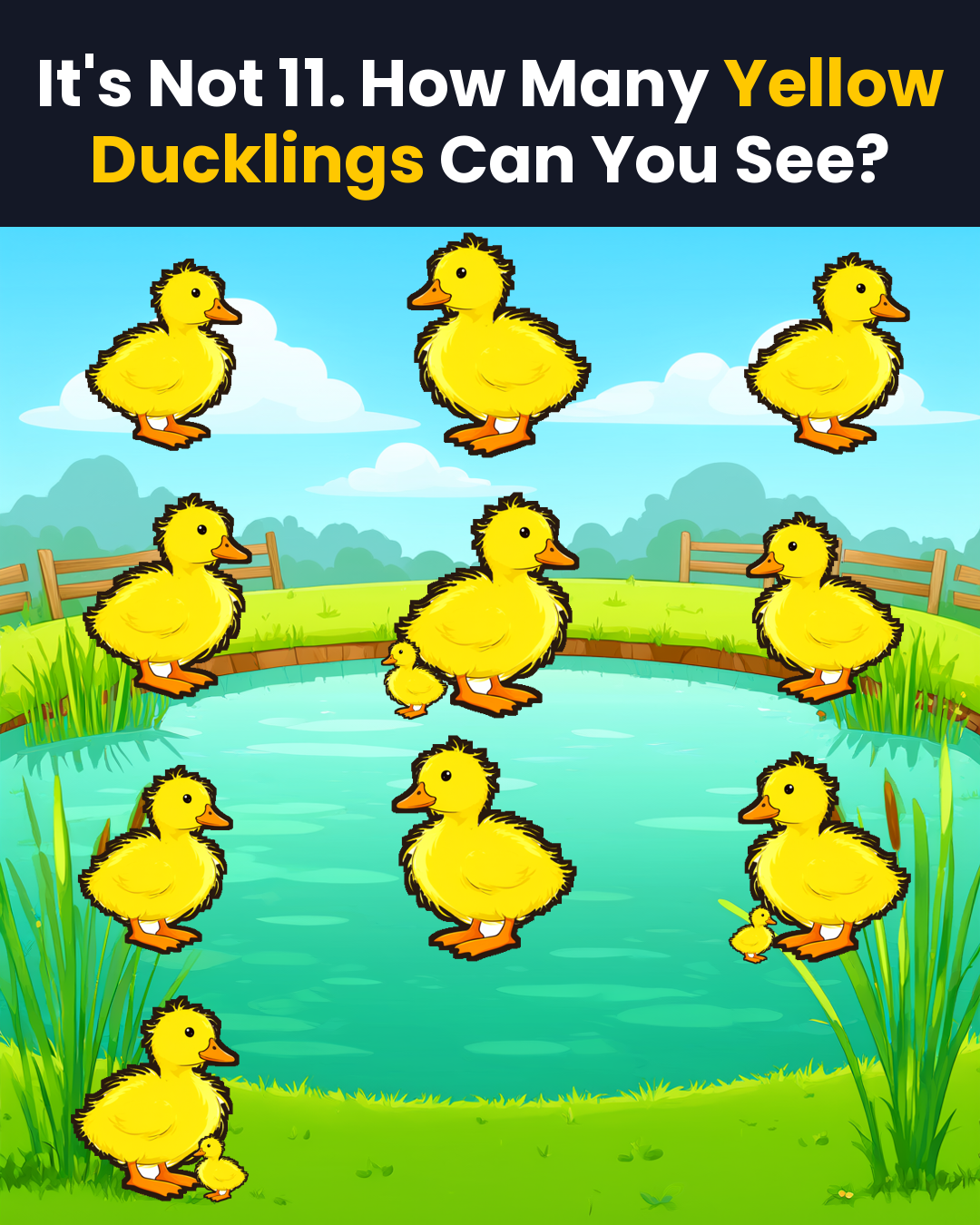
The sun is out, the water is calm, and a whole little family of yellow ducklings has come out for the afternoon.
They are standing on the grass, along the bank and right by the water, and all they want is to be counted properly.
It looks like an easy job, and that is exactly where most people slip.
Some of these ducklings are big and bold, and a few are so small that they almost disappear beside the others.
Take your time, go row by row, and look closely at the feet and the tall grass.
So tell us honestly: how many yellow ducklings are at this pond today?
Take your time and look closely before you scroll down!
Give Your Eyes A Route And Stick To It
The most common mistake in a counting picture is not bad eyesight. It is a wandering route. Our eyes love to hop to whatever is brightest or biggest, and after a few hops we have already lost track of what we have counted and what we have not.
The cure is simple. Start in the top left corner, move straight across to the right, then drop down one row and come back the other way, exactly as you would read a page in a book. Finish one row completely before you allow yourself to move on.
It also helps enormously to count out loud, or to move a finger along the screen. Speaking and pointing slow your eyes down to the speed of your voice, and that steady pace is usually the difference between a right answer and a confident wrong one.
Why Our Brain Finds This So Hard
When a picture is full of one shape in one colour, the brain stops looking at each item and starts treating the whole group as a texture. That is a clever shortcut for everyday life, where we rarely need to know exactly how many birds are in a field, but it is a poor tool for a puzzle.
There is a second trap here, and it has a name: size blindness. We expect all the members of a family to be roughly the same size, so anything much smaller is quietly filed away as part of the background, or as a bit of grass or a shadow. The small ducklings in this picture are not hidden behind anything at all. They are simply not the size your brain is hunting for.
Colour makes it harder still. Yellow on green, with sunlight on the water, gives the eye very little contrast to work with at the edges.
A Little History Of Counting Puzzles
Counting pictures are far older than the internet. Victorian magazines printed crowded farmyard scenes and asked readers to count the sheep or the chickens, and newspapers in the nineteen twenties ran weekly puzzles of exactly this kind, with the answer printed upside down at the bottom of the page.
They have lasted this long for a good reason. A counting puzzle needs no special knowledge, no language and no training. A grandmother and a grandchild can sit with the same picture and have an equally fair chance, which is something very few games can say.
The Friendly Challenge
Most people give their first answer in about eight seconds, and most of those first answers are wrong by two or three. If you want to do well, allow yourself a full thirty seconds and make two passes: one quick pass for the obvious ducklings, and one slow pass hunting only for small ones.
When you have your number, show the picture to somebody else in the house and see whether they agree with you. Half the fun of this puzzle is discovering that two careful people can look at the same pond and come away with different numbers.
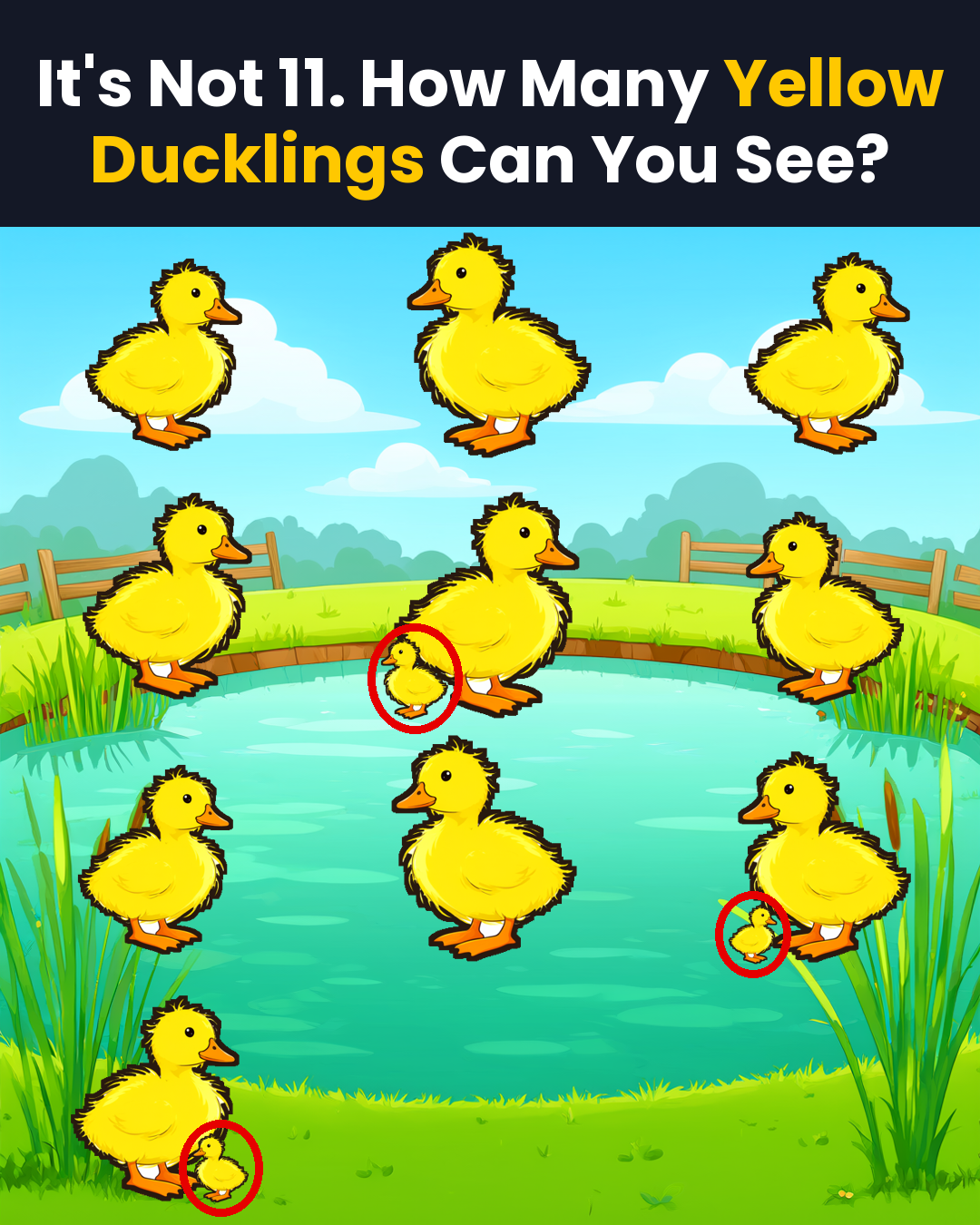
ANSWER: 13 ducklings – three tiny ones are standing right beside the bigger ducklings.
Where The Missing Ducklings Were Standing
There are thirteen ducklings at this pond, not eleven and not twelve. Ten of them are the big, obvious ones spread across the grass and the water in neat rows, and those are the ones almost everybody finds.
The other three are tiny, and each one is tucked right up against a bigger duckling. One stands at the chest of the large duckling in the middle row, one is beside the duckling on the right near the tall reeds, and one is down in the bottom left corner, pressed against its big brother in the grass.
They are not covered by anything. They are simply small, and they share the same bright yellow as the duckling they are standing next to, so the eye reads the pair as a single bird with a slightly odd outline.
Why Almost Everybody Misses Them
Your brain builds a quick template of what it is looking for – a yellow shape of a certain size – and then it sweeps the picture for matches. Anything well below that size is treated as noise and thrown away before you are even aware of it.
There is a simple trick to beat it next time. Instead of looking for ducklings, look at the empty spaces between them. Gaps are easy to check, and a small duckling fills a gap in a way that grass never does.
So, How Did You Do?
Under ten seconds and you got thirteen: you have genuine eagle eyes, and you should be very pleased with yourself.
Ten to thirty seconds: excellent work, and better than most people manage on their first try.
Up to a minute: a fine, careful result – you found the little ones because you refused to rush.
If you said eleven or twelve, you are in very good company. That is the most popular wrong answer of all, and now you know exactly where to look.