Hello again, puzzle friends!
Today we are leaving the house behind and walking into a quiet pine forest.
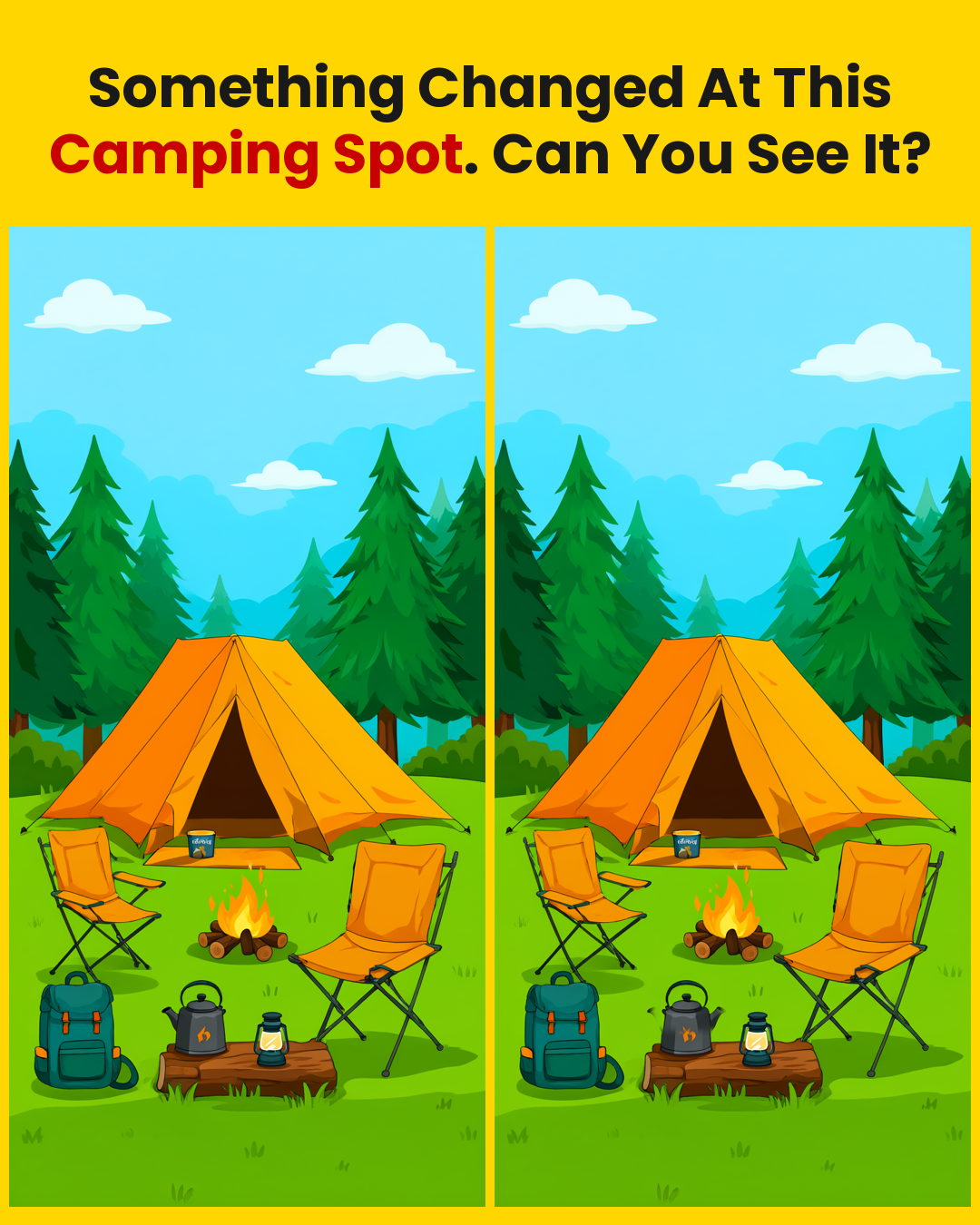
A tent is pitched on the grass, the campfire is crackling, and two folding chairs are waiting for someone to sit down.
There is a backpack, a lantern and an old kettle resting on a log, just like on a real camping trip.
The two pictures look like twins, but one small thing in the picture on the right is not the same.
Nothing has disappeared, so do not waste time looking for an empty space.
Look slowly, from the treetops down to the grass, and let the small things speak to you.
Good luck, and enjoy the fresh forest air while you search.
Take your time and look closely before you scroll down!
Work Through The Camp Like A Careful Visitor
When you arrive at a real campsite, you look around in a certain order: first the tent, then the fire, then the chairs, then the little things lying about. A spot-the-difference picture rewards exactly the same calm habit.
Start at the top of both pictures and come down in wide strips. The sky and the clouds. The row of pine trees. The roof of the tent and its guy ropes. The chairs on the left and on the right. The fire, the log and the grass at the bottom. Finish each strip in both pictures before you move on, and never allow yourself to jump back up to something that simply looks interesting.
When you reach the small objects, slow down and name them in your head: backpack, kettle, lantern, log, firewood. Naming an object forces your eyes to rest on it for a moment longer, and that extra moment is usually all it takes.
Why This One Is Harder Than It Looks
Our eyes are drawn to brightness and movement. In this picture the brightest things by far are the orange tent and the dancing flames of the campfire, so that is where most people spend their first thirty seconds. The change, of course, is not there.
There is a second reason this puzzle is tricky. Human attention is very good at noticing whether something is present or absent, and surprisingly poor at noticing which way something is turned. A cup, a kettle, a shoe, a chair: we recognise them by shape, not by direction. Our brain files the object as known and moves on, without ever recording the little details of its position.
Camouflage helps the puzzle too. A dark grey object standing on a brown log, in front of green grass, is already quiet. Place a bright fire next to it and it becomes almost invisible to a hurried eye.
Puzzles Around The Campfire
Long before magazines printed two pictures side by side, families told riddles around a fire exactly like this one. Travellers and shepherds passed the evening by asking each other questions that had one small, clever answer, and the person who found it first earned a round of laughter.
The printed spot-the-difference puzzle arrived with newspapers and has never really gone away. It survives because it needs nothing at all: no pen, no board, no rules to explain. Just two pictures, your own eyes, and a minute of quiet attention. That is also why it travels so well from a campfire to a kitchen table to a telephone screen.
Your Friendly Challenge
Most people need about forty seconds to find the change in this forest scene, and plenty of readers take longer than a minute. If you catch it in under twenty seconds, your attention for small objects is very sharp indeed.
When you have found it, pass the picture on to a friend and watch where their eyes go first. Nine times out of ten they will stare straight at the tent, exactly as you probably did.
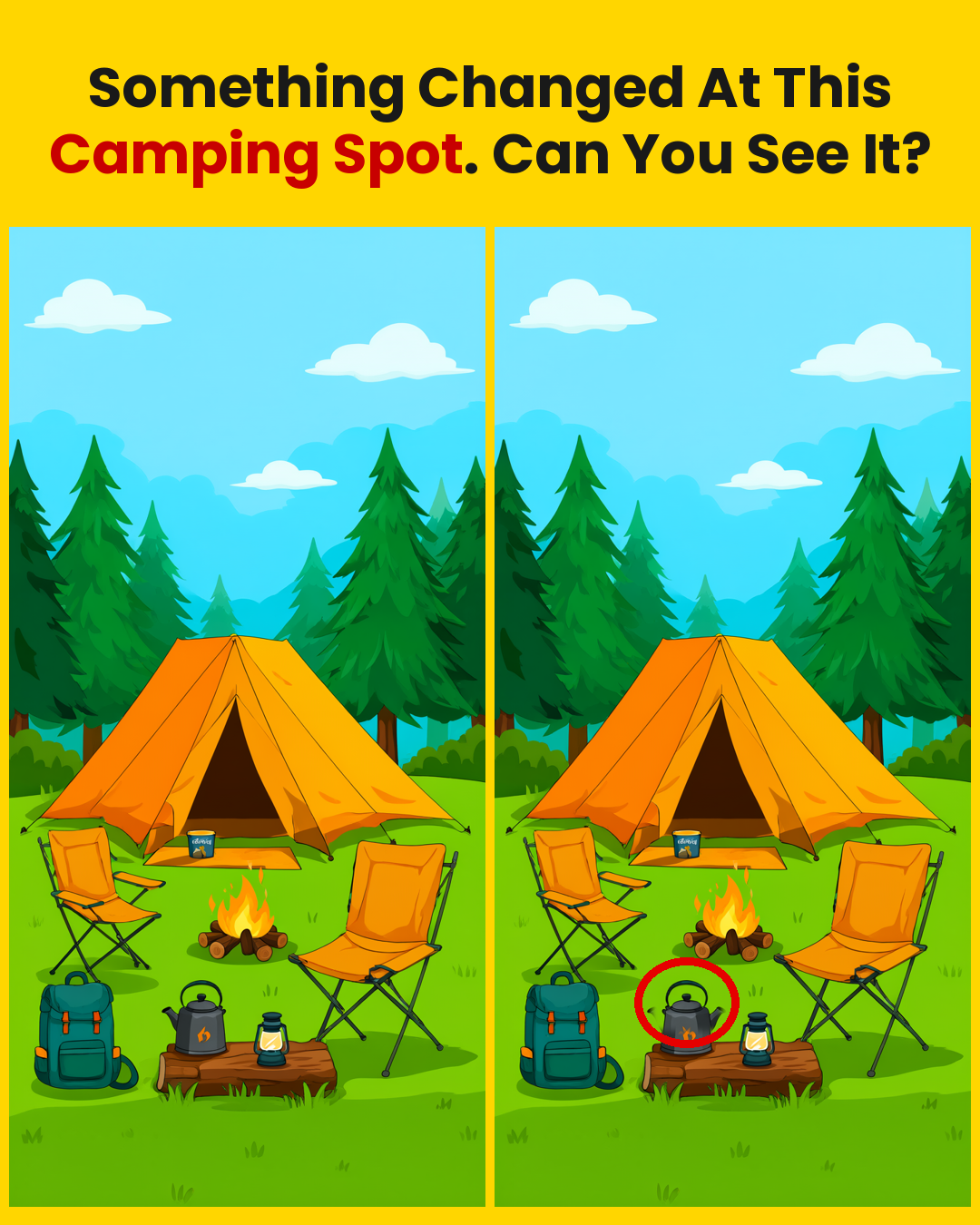
ANSWER: The kettle on the log – its spout points the other way in the second picture.
Where The Change Is Hiding
The difference is the old kettle sitting on the log at the bottom of the picture. In the first photo its spout points one way; in the second it has been turned around, so the spout points the other way and the handle leans in the opposite direction.
This is a perfect example of a change that keeps everything else the same. The kettle has not moved to another place, it has not changed colour, and nothing has grown or shrunk. Only its direction is different, and direction is the detail our brain is least interested in.
There is one more reason so many people miss it. The kettle sits low and dark against a brown log, while the bright campfire burns just above it. Light pulls our eyes like a magnet, and everything in the shadow of that light gets a shorter look.
How Did You Do?
Under 10 seconds: eagle eyes. You looked at the small objects before the big ones, which is exactly how an expert searches.
10 to 30 seconds: very good indeed. You worked with a system and you trusted it.
30 to 60 seconds: a perfectly normal, healthy result and the most common one among our readers.
More than a minute: do not be hard on yourself. A simple turn of an object is one of the hardest changes to see, and this little kettle was placed in the quietest corner of the camp on purpose. Try the next puzzle with the strip method and you will almost certainly be faster.