Hello, puzzle friends!
Today we are sitting on warm sand, with blue waves behind us and palm leaves at the edges of the picture.
A whole family of little green turtles has come out for a walk, and they are standing there very politely, waiting to be counted.
It looks simple at first, and that is exactly the trap.
Plenty of people call out a number after three seconds and get it wrong.
Count slowly, row by row, and look carefully at the spaces between the turtles.
Some of these shells are much smaller than the others.
So, how many turtles are on this beach? Take your time and be honest with yourself.
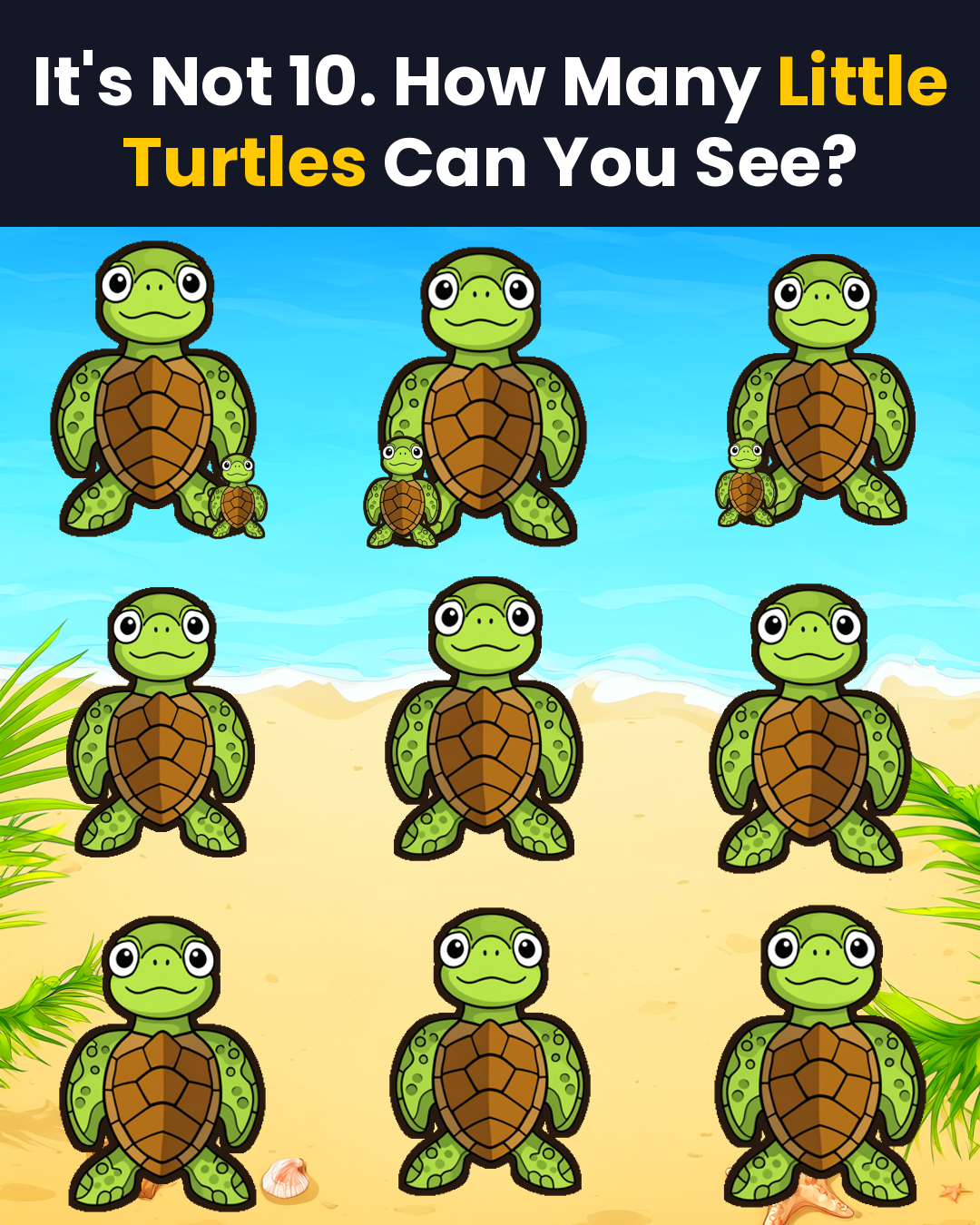
Take your time and look closely before you scroll down!
How To Count Without Losing Your Place
The safest way to count anything in a picture is to give yourself a fixed route and stick to it. Begin in the top left corner, move across to the right, then drop down to the next row and come back again, exactly like reading a page. Never let your eyes jump to a turtle simply because it is bigger or closer to the middle.
The second rule is just as important: count out loud, or at least move your finger along the screen. Speaking and pointing slow your eyes down to the speed of your voice, and that is usually the speed at which mistakes stop happening.
Finally, do the whole thing twice. Count once from the top left to the bottom right, then count again from the bottom right back to the top left. If both counts agree, you can be confident. If they do not, you have already learned something useful: there is something in this picture that your eyes keep sliding over.
Why Counting Pictures Is So Tricky
Our brain has a wonderful ability called subitising. Up to about four objects, we see the number instantly, without counting at all. Three apples on a table do not need to be counted; we simply know. Beyond four, that gift disappears and we have to count one by one, which is slow and needs real attention.
To save effort, the brain then does something clever and dangerous. It looks at the pattern, sees three neat rows of three, says nine to itself, and feels finished. Anything that does not fit the pattern is treated as part of its neighbour rather than as a separate thing.
Size plays a part too. When objects of very different sizes stand together, the large ones dominate completely. A small shape touching a big shape of the same colour is read as a piece of decoration, a shadow or a leg, not as another animal. That is how a whole baby turtle can stand in the open and still stay invisible.
A Little Beach Of History
Counting puzzles are among the oldest teasers we know. Market traders used them to catch a careless customer, teachers used them to wake up a sleepy classroom, and family magazines have printed them for well over a century, usually with ducks, sheep or chickens instead of turtles.
They stay popular because the answer is never a matter of opinion. There is one correct number, and once you see it you cannot unsee it. That tiny moment of certainty, when the picture suddenly makes sense, is the reason these puzzles keep spreading from friend to friend.
Your Friendly Challenge
Most people need about thirty seconds to reach the correct number here, and a great many give their first answer after five seconds and have to take it back.
Before you scroll down, say your number out loud so that you cannot quietly change your mind. Then show the picture to a friend and let them try. If you both get the same number, one of you may still be wrong, so count it one last time together.
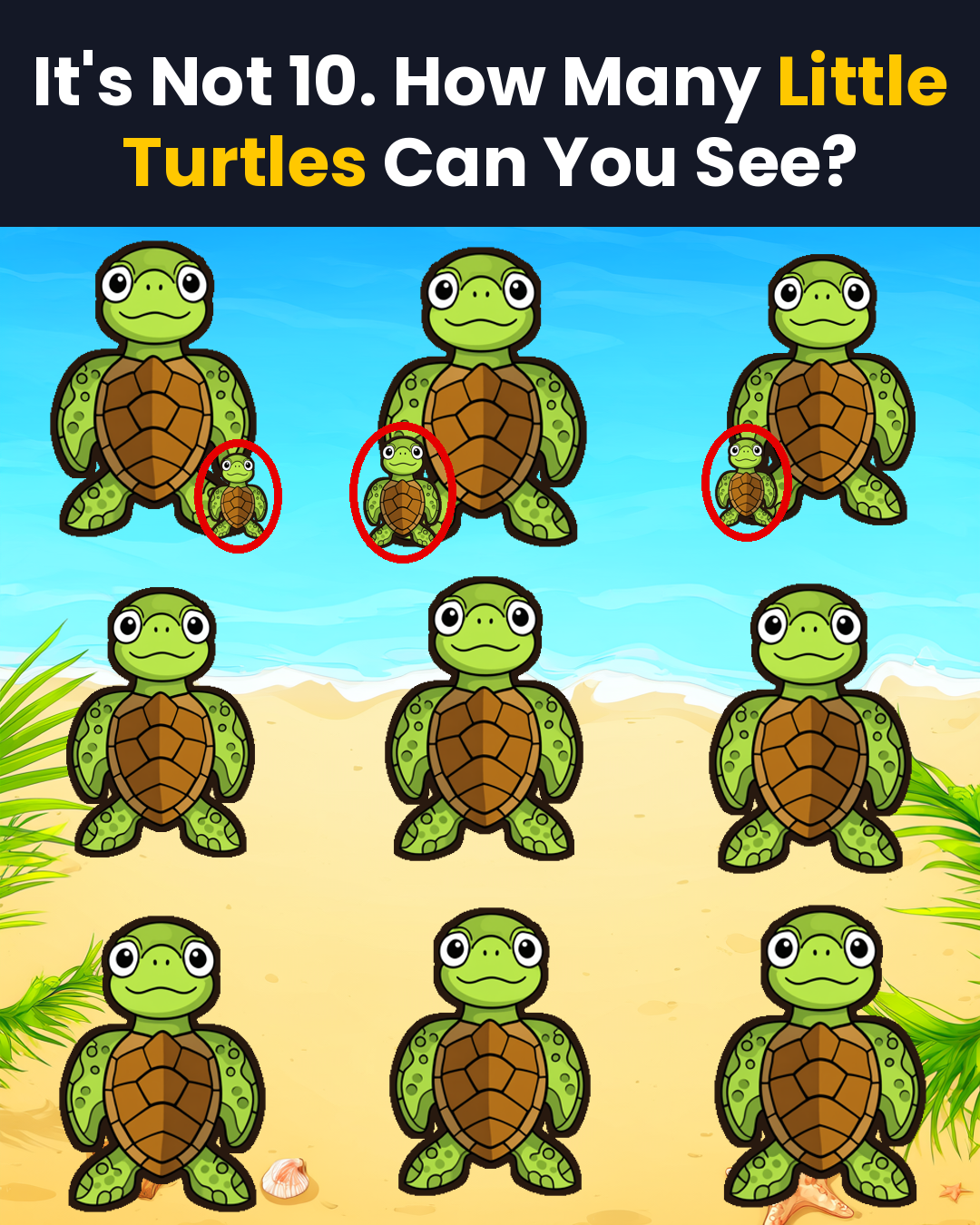
ANSWER: 12 turtles – three tiny babies are standing close beside the big ones in the top row.
Where The Hidden Turtles Are
The correct answer is twelve. Nine large turtles stand in three tidy rows, and that neat arrangement is the heart of the trick. Three rows of three look complete, so most people stop counting as soon as they reach nine.
The three extra turtles are the little ones, and all of them are in the top row, standing right beside the big turtles like babies next to their parents. One stands near the first large turtle, one in front of the second, and one beside the third. They are the same green, with the same brown patterned shell, and because they touch the bigger bodies our eyes read them as part of the adults.
Once you know they are there, you can never miss them again, and that is the strange charm of this kind of puzzle. Nothing was hidden behind anything. The babies were in plain sight from the first second, in the brightest part of the picture.
Why Almost Everyone Says Nine Or Ten
Nine is the answer of the pattern. Ten is the answer of the person who noticed one baby and assumed there was only one. Both are honest mistakes made by a brain that is trying to be efficient.
The cure is simple: whenever a picture asks how many, look for small versions of the same object before you give your number. Puzzle makers hide the extras by size far more often than by position.
How Did You Do?
Twelve on your first try, in under ten seconds: eagle eyes, and a mind that refuses to be rushed.
Twelve after a careful second count: excellent. That is exactly how good counting works.
Ten or eleven: you spotted the babies but not all of them. Very close.
Nine: welcome to the biggest group of all. Try the next counting puzzle with your finger on the screen, and watch your score improve straight away.