
Hello, puzzle friends!
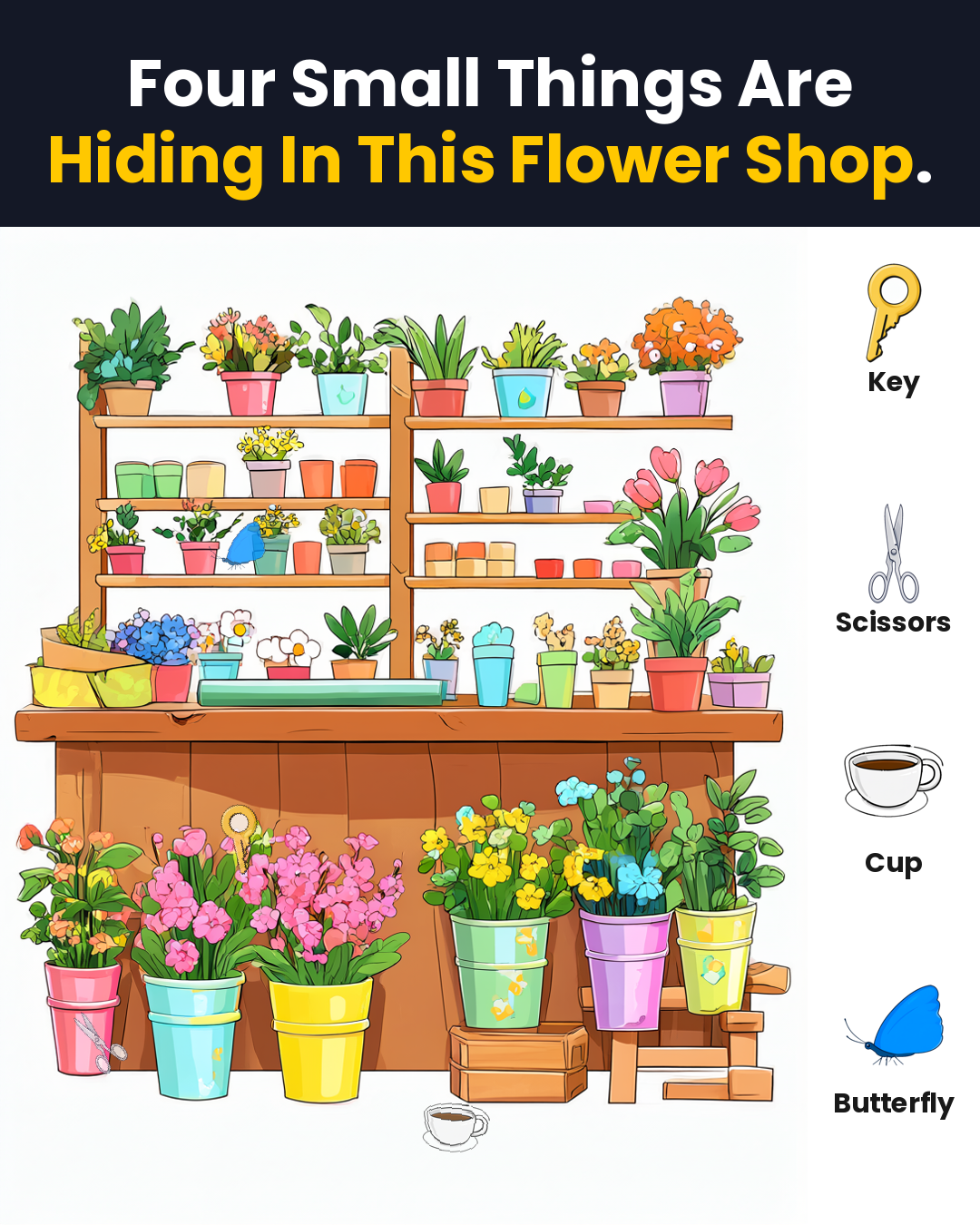
Today we are stepping into a little flower shop on a bright morning.
The shelves are packed with pots, bouquets and buckets of fresh blooms.
Somewhere among all that colour, four small things are hiding in plain sight.
You will find them shown down the right-hand side: a key, a pair of scissors, a cup and a butterfly.
Each one is in the picture, small and a little faded, but none of them is covered up.
Work shelf by shelf rather than letting your eyes roam, and you will do far better.
Ready? Four objects, one busy shop, and no peeking at the answer.
Take your time and look closely before you scroll down!
Search Like A Shopkeeper
The worst way to do a hidden object puzzle is to stare at the whole picture and wait for something to pop out. Busy scenes are designed to stop that from happening, and you can look straight at an object for several seconds without seeing it.
A far better method is to divide the picture into parts and work through them like a shopkeeper tidying up. Take the top shelf first, then the second shelf, then the counter, then the pots on the floor. Finish each area completely before you move on, and never go back to one you have already cleared.
It also helps to hold one object in your mind at a time. Decide that you are looking for the scissors and nothing else. When you are hunting for four things at once, your brain has to compare everything it sees against four templates, and it ends up doing none of them well. One shape at a time is slower to describe and much faster in practice.
Why Clutter Beats Our Eyes
Only a tiny part of your vision is sharp. It covers about the width of your thumbnail held at arm’s length. Everything else is blurred colour and movement, which is why you have to move your eyes across a picture rather than take it in all at once.
In a flower shop that is a real problem. The scene is full of round pots, leaves and petals in every colour, and a small object with a similar shape or shade simply blends into the pattern. Scientists call this visual crowding: the more things sit close together, the harder it becomes to pick out any single one of them.
The objects here have also been made slightly see-through, so their colours sit closer to the colours behind them. That is a gentle kind of camouflage, and it is exactly how an animal hides in a hedge. Nothing is truly concealed; it just stops standing out.
A Game That Started In Print
Hidden object pictures became popular in family magazines more than a century ago. Illustrators would hide faces in the branches of a tree or animals in the folds of a landscape, and readers wrote in with their counts.
The idea grew into the picture puzzle books that many of us grew up with, and later into some of the most popular computer games ever made for older players. The appeal has never changed. There is no time limit, nobody is competing against you, and the reward is that small, satisfying click in the mind when a shape finally resolves.
Doctors and therapists make use of the same pleasure. Searching a detailed picture asks you to hold a goal in mind, work in an orderly way and resist the urge to give up, which is good exercise for attention at any age and a very pleasant way to spend ten quiet minutes.
Four Objects, One Minute
Here is the challenge. Give yourself one minute and see how many of the four you can find. Most people get two quickly, the third with a bit of effort, and then spend a surprising amount of time hunting for the last one.
If you get stuck, change the way you look. Try squinting slightly so the fine detail blurs and only the broad shapes remain, or hold the picture a little further away. Objects that were lost in the clutter often appear at once, because the crowding that hid them disappears along with the detail.
When you have all four, pass the picture to a friend without telling them where anything is. Everyone finds a different one first, and watching someone else search the same shop is every bit as entertaining as searching it yourself.
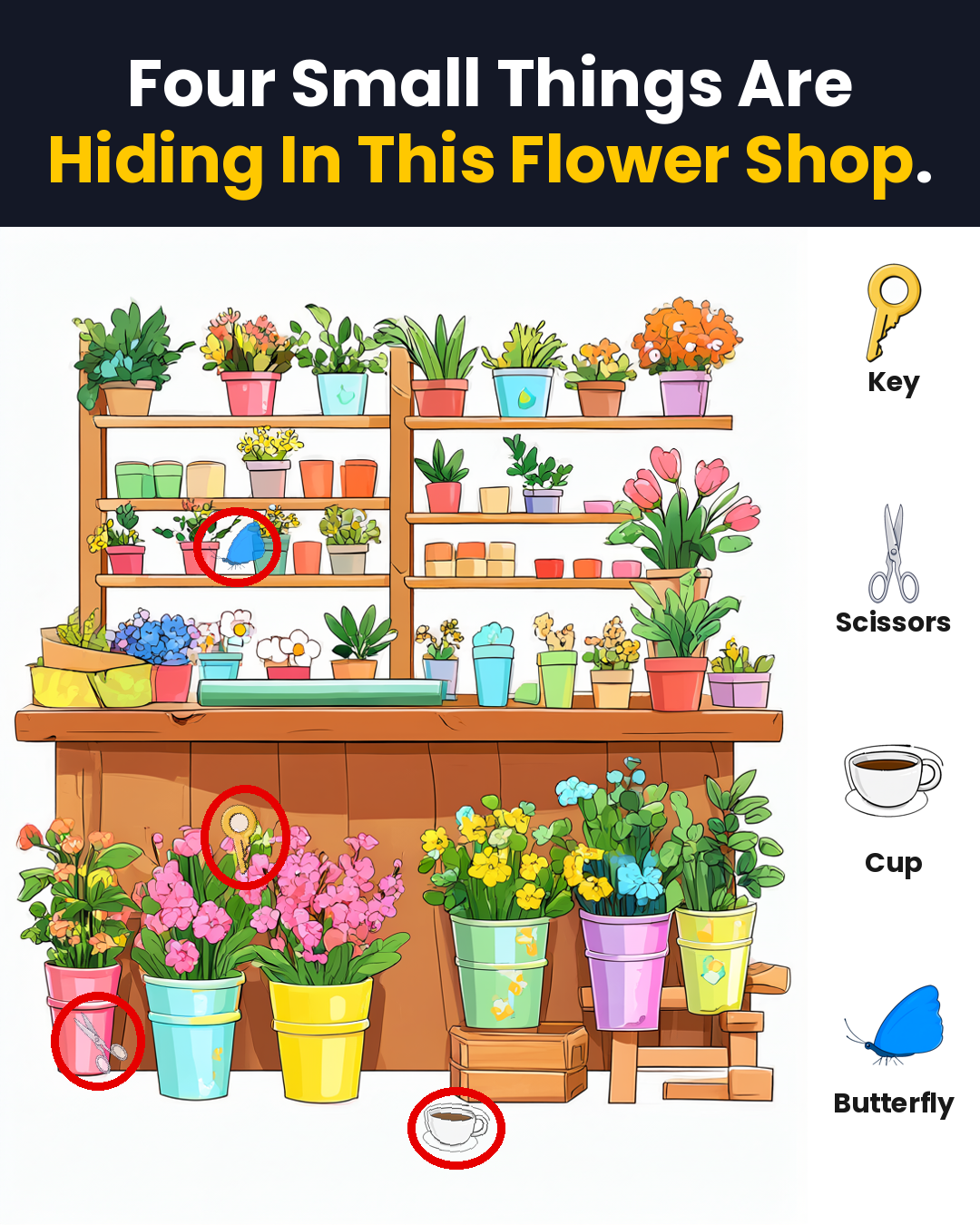
ANSWER: The butterfly sits on the middle shelf on the left, the scissors are inside the pink pot at the bottom left, the key is tucked among the pink flowers in front of the counter, and the cup is down on the floor near the middle.
Where All Four Were Hiding
Start on the left. The blue butterfly is resting on the middle wooden shelf, among the small pots of yellow flowers, roughly a third of the way down the picture. Its blue is close to the blue of the little blooms beside it, which is why so many people look straight past it.
The scissors are at the bottom left, standing inside the pale pink plant pot. Their silver blades sit against a soft pink background, and the thin handles look very much like stems, so the eye reads them as part of the plant.
The golden key is a little higher and towards the middle, tucked among the tall pink flowers in front of the wooden counter. The last object, the white cup and saucer, is right down at the bottom in the middle, sitting on the floor between the yellow pot and the wooden crate.
Why Most People Miss The Scissors
Three of the objects are missed for the same reason: they are the right colour in the wrong place. The butterfly matches the blue flowers, the key matches the warm pinks and yellows around it, and the scissors match the pale tones of the pot they are standing in.
The cup is missed for a different reason. It sits on the floor, in an empty area near the bottom edge, and most people never search empty space. We expect hidden things to be in the busiest part of the picture, so our eyes go to the crowded shelves and stay there.
That is worth remembering for next time. In any hidden object puzzle, give the quiet corners and the bare floor one careful sweep. There is very often something sitting there in the open, waiting patiently to be noticed.
How Did You Do?
All four in under thirty seconds: outstanding. You searched in an orderly way instead of letting your eyes wander.
All four in under a minute: a very strong result and better than most people manage on their first try.
Three out of four: excellent work, and the one you missed was almost certainly the scissors or the cup.
One or two: no need to worry at all. Go back with one object in mind at a time, start at the top shelf and work down, and the rest will come. The method matters far more than sharp eyes.