Hello, puzzle friends, and welcome to the farm!
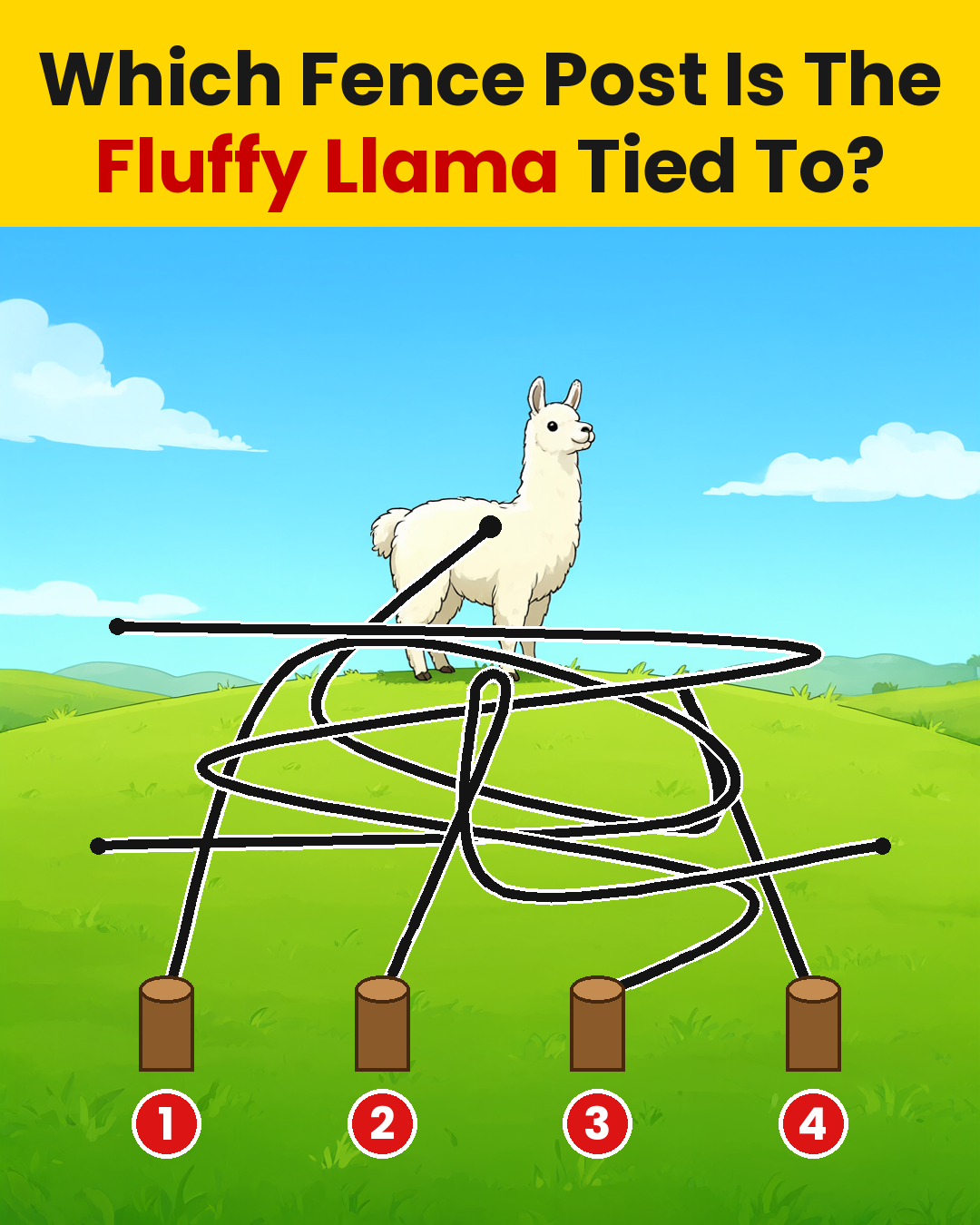
A fluffy white llama is standing out in the meadow on a bright, breezy day.
Someone has tied her lead rope to one of the four wooden posts below.
The trouble is that three other ropes are lying in the grass as well, all tangled together.
Your job is to follow the rope that starts at the llama and see where it ends.
No pens, no fingers on the screen – try to do it with your eyes alone.
Go slowly at the crossings, because that is where almost everyone slips onto the wrong rope.
Is it post one, two, three or four? Take a good look before you decide.
Take your time and look closely before you scroll down!
Start At The Knot, Not At The Posts
Most people begin this kind of puzzle at the bottom, pick a post that looks likely and try to work upwards. It feels sensible, but it is the slowest way to do it. There are four possible starting points down there and only one up at the llama.
Begin instead at the little knot on the llama’s side. That is where your rope starts, and there is no doubt about it. From there, move your eyes along the rope a short way at a time, the way you would trace a road on a map with your finger just above the paper.
The golden rule is simple. A rope never changes direction at a crossing. When your rope passes under or over another one, keep going straight through on the same curve and come out the other side. If you suddenly find yourself travelling in a new direction, you have changed ropes without noticing and it is worth going back to the last crossing you are sure of.
Why Our Eyes Jump The Rails
Following one line through a tangle is harder than it looks, and there is a good reason for it. Our eyes do not glide smoothly across a picture. They move in small jumps, pausing a few times a second, and each jump lands roughly where we intend rather than exactly.
When the ropes are far apart, a slightly inaccurate landing does no harm. At a crossing, where two ropes sit almost on top of each other, landing a few millimetres off is enough to put you on the neighbour’s rope. From that moment on you are following the wrong line with complete confidence, which is why wrong answers in this puzzle feel just as certain as right ones.
The brain also prefers smooth, gentle curves to sharp turns. Given a choice at a junction, it will usually carry on along the easier-looking path rather than the correct one. Puzzle makers have known this for a very long time and lay their crossings out accordingly.
The Long Story Of The Tangled Line
Tangle puzzles are one of the oldest kinds of picture puzzle there is. Children’s magazines in the nineteenth century were full of them, usually drawn as a fisherman with four lines in the water, or a group of boys flying kites with the strings in a glorious knot.
The idea travelled well because it needs no words at all. A child in any country can look at a tangle of lines and understand instantly what is being asked. That is also why you still find these puzzles printed on paper placemats in family restaurants all over the world.
There is a more serious side too. Engineers and electricians spend a good part of their working lives doing exactly this, following one cable through a bundle of dozens, and they use the very same method you are using now: start at the end you are sure of, go slowly, and never guess at a junction.
Your Challenge On The Clock
Here is the test. Trace the rope from the llama all the way down to a post without stopping, and note which number you landed on. Then do it a second time, but backwards, starting at that post and travelling up towards the llama. If you arrive at the llama, your answer holds. If you end up at a loose end lying in the grass, you took a wrong turn somewhere.
Most people need between twenty and forty seconds to feel sure, and a good number change their mind at least once on the way. If you manage it in under fifteen seconds and get it right, your eyes are in excellent shape.
When you have your answer, hand the picture to someone else in the house and ask them for a number before you say yours. Comparing two confident answers that do not match is one of the small joys of this puzzle.
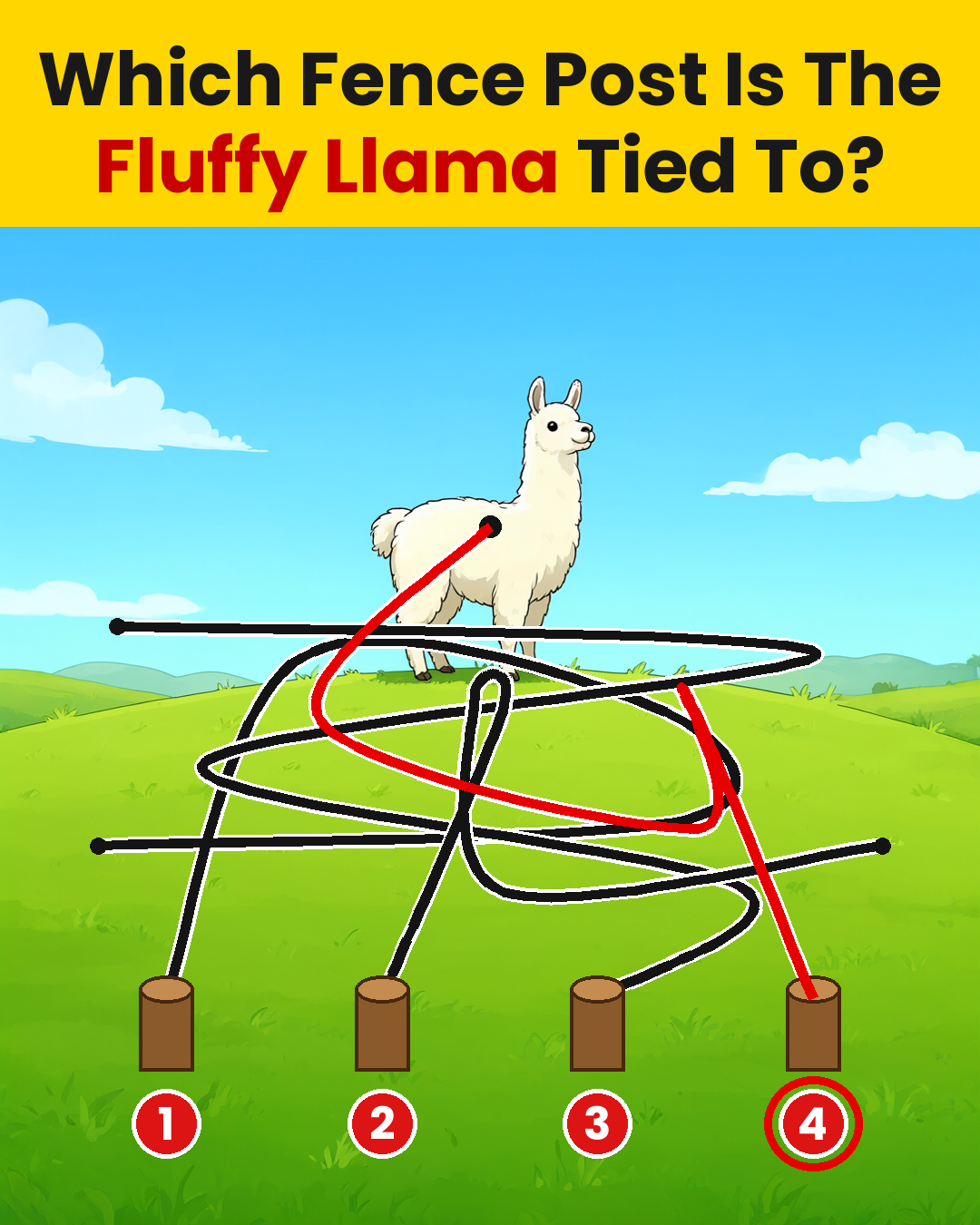
ANSWER: Post 4 – the rope from the llama swings left, loops down through the middle of the tangle and ends at the post on the far right.
Following The Right Rope
The llama is tied to post number four, the one on the far right.
From the knot on her side, the rope runs down and to the left, crosses the long straight rope that stretches across the middle of the field, and then makes a wide loop through the heart of the tangle. It climbs back up towards the right, dips once more and finally drops in a long, almost straight line down to the post at the right-hand end of the row.
The three other ropes do not come from the llama at all. Each one begins at a loose end with a small knot, two out at the sides near the top and one down at the left. They are there purely to be crossed and to tempt your eye away at the moment when the lines sit closest together.
Where Most People Lose The Thread
The trap is in the middle of the picture, where three ropes cross within a small area. Coming down from the llama, the correct rope passes through that knot of crossings and carries on in a smooth curve, while a decoy rope leaves at a slightly gentler angle towards post two.
Because the gentler curve is easier for the eye to follow, a great many people drift onto it and finish at post two feeling perfectly sure. Post one catches others, as its rope arrives from the same part of the tangle.
The simplest safeguard is to trace in both directions. Any rope that genuinely belongs to the llama will take you back to her knot when you follow it upwards. If it leads you instead to a loose end lying in the grass, you know at once that you changed ropes along the way.
How Did You Do?
Under fifteen seconds and correct: wonderful concentration. You followed the curve instead of guessing at the crossings.
Fifteen to forty seconds: a very good result, and the same time most careful people need to check their route twice.
Over forty seconds but correct: there is nothing wrong with slow and steady. Getting it right matters far more than getting it quickly.
If you chose post one or post two, you are in the biggest group of all. Those are the two ropes designed to catch you, and now you know exactly where they do it.