Good day, puzzle friends, and welcome to the farm!
A friendly brown donkey is standing in the middle of the field, and his rope has made a fine mess of things.
Four wooden posts are planted in the grass, and four ropes wander across the picture.
Only one of those ropes actually belongs to the donkey. The other three are loose ends that lead nowhere.
Your task is to follow his rope with your eyes alone, all the way down to the post it is tied to.
No pens, no fingers on the screen, no shortcuts. Just patience and a steady gaze.
The ropes cross one another several times, and that is exactly where most people lose the trail.
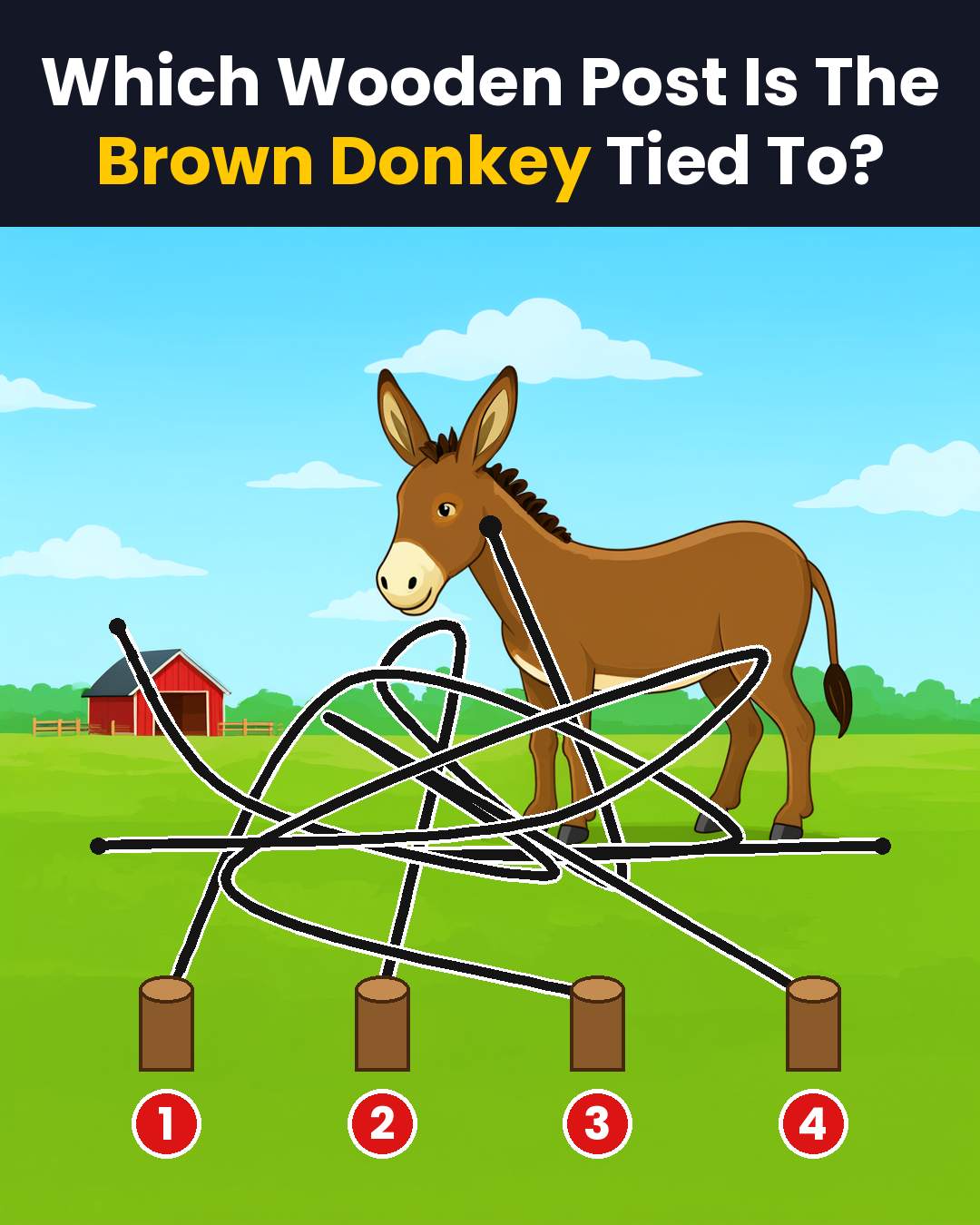
Take your time and look closely before you scroll down!
Start At The Knot, Not At The Posts
Almost everyone makes the same mistake with this kind of puzzle. They look at the four posts first, pick the one that feels most likely, and then try to work backwards to the donkey. That approach nearly always fails, because the loose ropes are drawn to look just as convincing as the real one.
The reliable method is the opposite. Begin at the knot on the donkey himself, where the rope leaves his neck. That is the one point in the whole picture you can be completely certain about. From there, move your eyes slowly along the rope, a short section at a time.
When you reach a place where two ropes cross, stop for a moment. Look carefully at which line passes over and which passes under, then pick up the same line on the far side before you continue. Slow is fast here. People who rush through the crossings almost always end up on a different rope without ever noticing the switch.
Why The Crossings Fool Us
Following a single line through a tangle is a real job for the brain, and it has a name in the world of vision research: curve tracing. Your mind cannot do it all at once. Instead it spreads attention along the line a little at a time, almost like water slowly filling a pipe.
That process works beautifully until two lines meet. At a crossing, your attention can leak onto the wrong line, especially if the angle between them is small. The two ropes look nearly identical in color and thickness, so there is nothing to warn you that you have changed trains.
There is also a helpful habit working against you. When a line bends sharply, your brain prefers to keep going straight, because in the real world most objects continue smoothly. The person who drew this tangle knows that, and the rope takes a few turns at exactly the moments when going straight feels most natural.
A Puzzle As Old As String
Tangled line puzzles have been entertaining people for a very long time. They appeared in Victorian puzzle books, in children’s annuals, and on the back pages of newspapers, usually drawn as fishing lines, kite strings or balloon ribbons.
They have a serious side as well. Electricians reading wiring diagrams, nurses checking tubing, and knitters untangling a basket of yarn all use the same skill you are using now. Following one strand with your eyes while ignoring everything around it is a genuinely useful ability, and like most abilities it improves with practice.
There is something satisfying about a donkey standing patiently while we sort out his rope, too. Nothing in the picture is in a hurry, which makes it easier for us to slow down as well.
Your Challenge For Today
Most people need somewhere between twenty and forty seconds to trace this rope correctly, and quite a few confidently name the wrong post on their first attempt. If you want to be sure, trace it twice: once from the donkey down to a post, and once from that post back up to the donkey.
If both journeys land you in the same place, you have found it. If they do not, you can be certain you jumped lines at one of the crossings, and it is worth going back to find out where.
Then send this picture to a friend. Ask them to say their answer out loud before they hear yours, and see whether the two of you agree. Disagreeing is half the fun, and it always leads to a second, much more careful look.
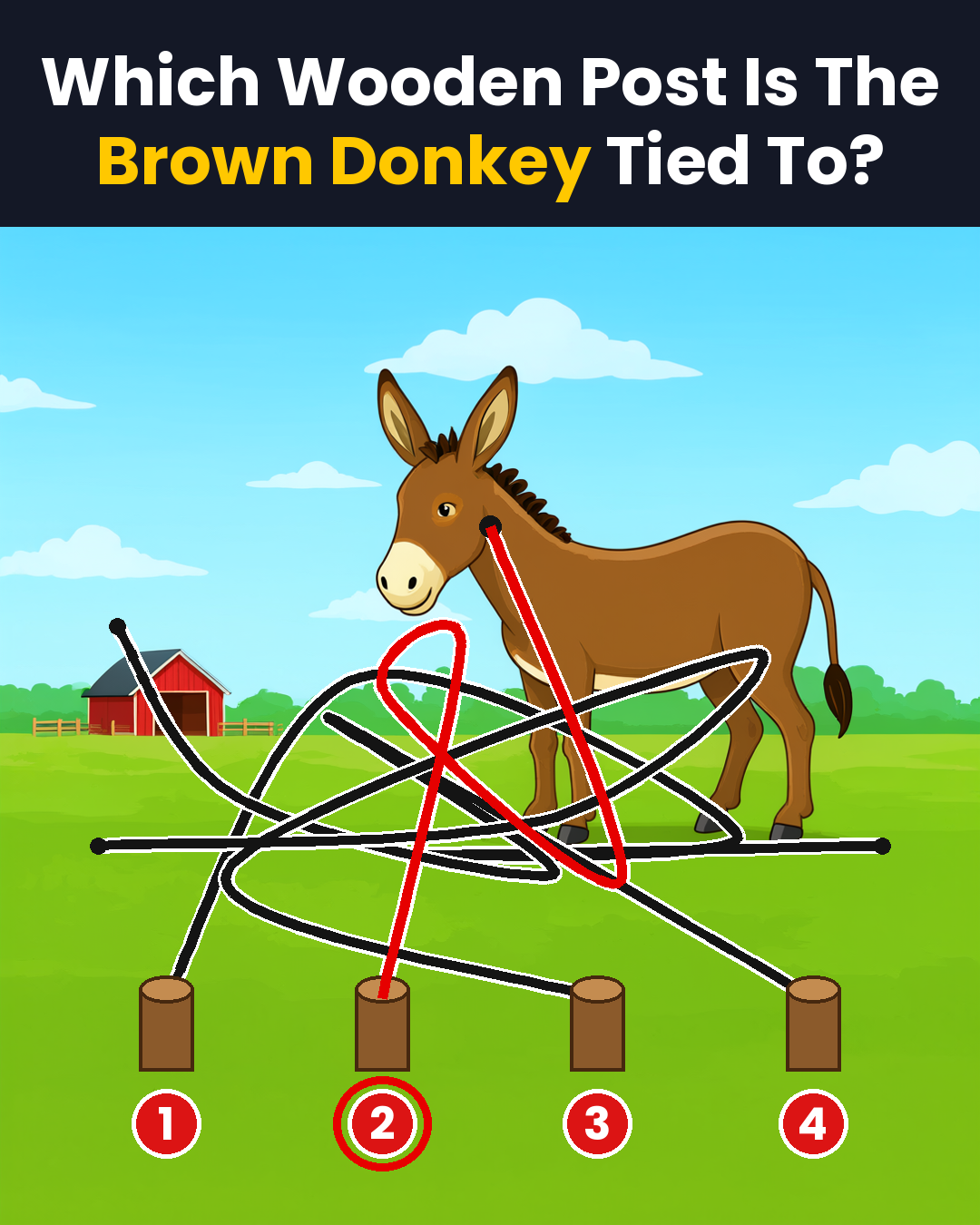
ANSWER: Post number 2 – the donkey’s rope loops left through the tangle and ends at the second post.
The Path Of The Real Rope
The donkey’s rope leaves the knot at his neck and heads down and slightly to the left. Almost immediately it dives into the busiest part of the tangle, right in the middle of the field, where three other ropes are crossing one another.
Inside that knot of lines it makes a wide loop toward the left, swings back toward the center, and then runs down in a long, fairly straight stretch to the bottom of the picture. It finishes at the second wooden post from the left, the one marked with the number 2.
The ropes that reach posts 1, 3 and 4 all begin at loose ends out at the sides of the field, not at the donkey. Each of those loose ends is drawn as a small dark knot, which looks reassuringly like the real knot on the donkey’s neck when you only glance at it.
Why Most People Choose The Wrong Post
The popular wrong answer is post 1. That is because the rope from post 1 rises steeply toward the upper left and, for a short stretch, runs almost parallel to the donkey’s rope. If your eyes drift across at the first crossing, you find yourself on that line and follow it quite happily to the wrong place.
Post 4 catches people too, for a different reason. Its rope makes a long sweep right across the middle of the picture, so wherever you look in the tangle, that rope is somewhere nearby, and nearness feels a lot like connection.
The cure for both mistakes is the same. Never let your eyes jump across a gap. Keep them on the line itself, even when the line is boring and straight.
How Did You Do?
Finding post 2 in under fifteen seconds means you have excellent visual tracking, the kind of eyes that read a map or a wiring diagram without breaking a sweat.
Under forty seconds is a solid, careful result and better than most people manage on the first attempt. If you needed a minute or more but got there in the end, that patience is worth more than speed, and it is exactly the habit these puzzles are meant to build.
If you picked post 1 at first and then corrected yourself, do not be discouraged. That is the most common journey through this puzzle, and the correction is the part where the real looking happens.