Hello, puzzle friends, and welcome to a little visit to the autumn market!
The farm stall is open, the hay bales are stacked, and the shelves are full of bright orange pumpkins.
Your job today sounds simple: count every single pumpkin in this picture.
Most people glance at the shelves, say a number out loud, and feel very sure of themselves.
Then they look again, and the number changes. That is what makes this one so much fun.
A small tip before you start: do not only look at the middle of the picture.
Take your time, count carefully, and see whether your first answer holds up.
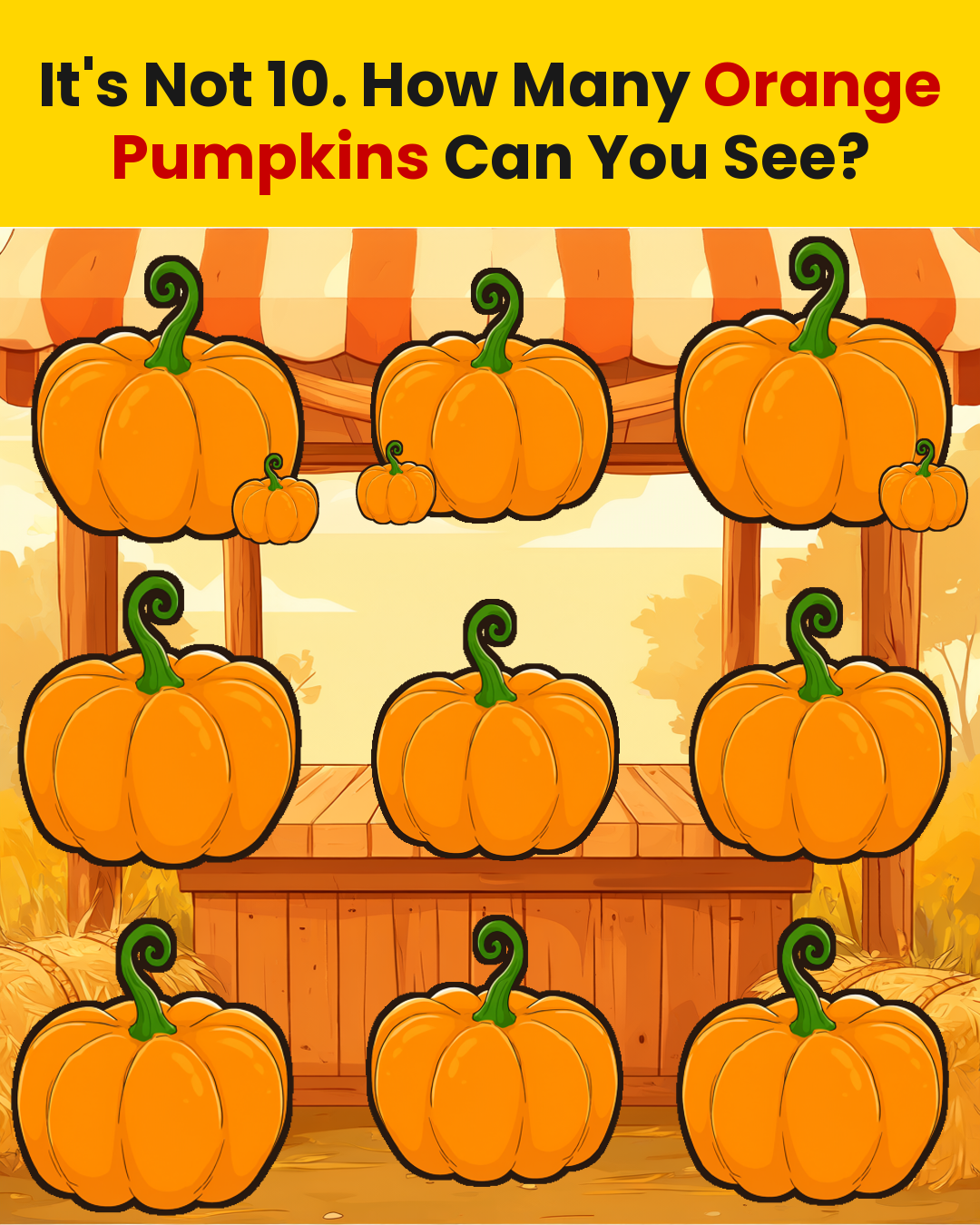
Take your time and look closely before you scroll down!
Count Like A Market Seller
The fastest way to get this wrong is to count the way most of us do: eyes jumping around the picture, picking up pumpkins wherever they catch our attention. That method feels quick, but it almost always ends with one pumpkin counted twice and another one missed completely.
The better way is the way a market seller counts crates. Work in rows. Start at the very top of the picture and move from the left edge all the way to the right edge, saying the numbers quietly to yourself. Then drop down to the next row and do the same thing again. Rows keep your eyes honest, because you always know where you have already been.
When you reach the end, do not stop. Go back to the top and count a second time, but this time move in the opposite direction, from right to left. If both counts give you the same number, you can be fairly confident. If they do not match, the difference is usually hiding in a corner you rushed past.
Why Our Brain Loves To Skip Things
There is a good reason this kind of picture fools us. Our eyes do not glide smoothly across a scene the way a camera pans. They jump in small hops, landing for a fraction of a second and then jumping again. Between those landings, the brain quietly fills in what it expects to be there.
When a picture is full of the same object over and over, the brain decides very early that it understands the pattern. Big round orange shape, green curly stem, repeat. Once it has that pattern, it stops studying each shape carefully and starts counting groups instead of individuals. That is wonderfully efficient in daily life, and completely unhelpful here.
Size makes it worse. A small object sitting right beside a large one of the same color tends to be read as part of the larger one, almost like a shadow or a bump. Your eyes truly do land on it. Your attention simply decides it is not worth a separate number.
A Short History Of The Counting Puzzle
Counting puzzles are much older than the internet. Newspapers in the early twentieth century printed drawings with hidden faces in the clouds and asked readers to find them all, and children’s magazines have been filled with crowded farmyards and busy streets for well over a hundred years.
The pumpkin has its own long story too. It traveled from the Americas to Europe and back again, becoming the symbol of harvest time, of pies cooling on windowsills, and of market stalls just like this one in October and November. A table piled with pumpkins is one of those sights that feels warm before you even start thinking about it.
That warmth is part of why these puzzles work so well. You are not solving a cold math problem. You are standing in front of a friendly stall, taking your time, enjoying the colors, and quietly testing how carefully you really look at the world.
Your Challenge For Today
Here is the rule for a fair try: give yourself thirty seconds, no more. Count once, write your number down somewhere, and only then look again. Most people land on ten or eleven on that first pass and feel completely certain about it.
If your second count gives you a bigger number than your first, congratulations, your eyes are working better than average. If both counts agree and you still feel a little unsure, that small doubt is usually a good sign that something is hiding.
When you have your final answer, share this picture with a friend or with someone in your family and let them try before you tell them anything. Half the fun is watching a confident person say a number out loud, then go very quiet and start counting all over again.
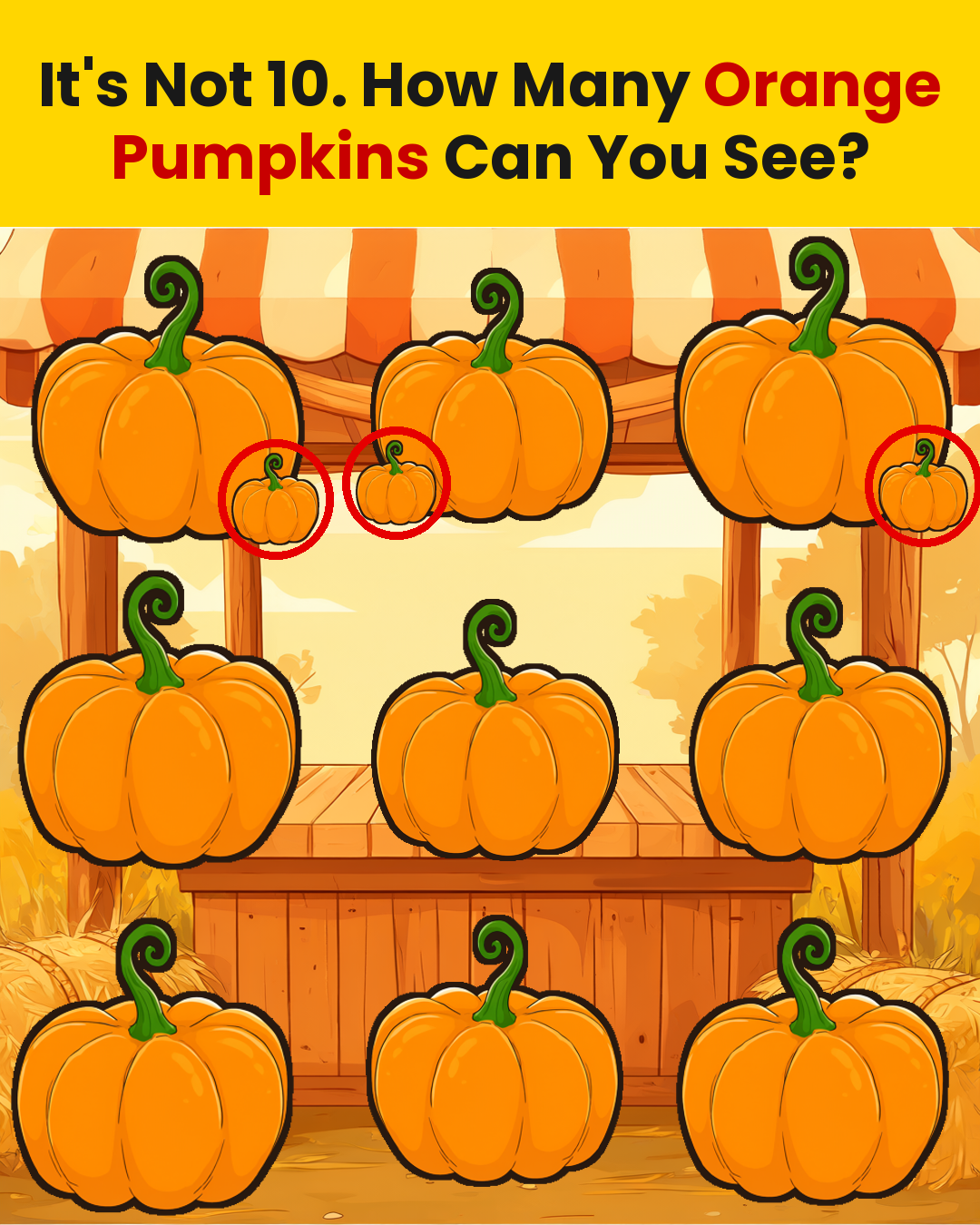
ANSWER: 12 pumpkins – three small ones are tucked beside the big ones on the top shelf.
Where The Missing Pumpkins Were
The nine big pumpkins are easy. They sit in three clear rows across the stall, each one large, bright and impossible to miss. Almost everybody finds those, which is exactly why so many people answer nine, ten or eleven and stop there.
The three that decide the puzzle are all small, and all three are on the upper part of the picture. One little pumpkin sits just to the right of the big one in the top left corner, tucked under the striped awning. The second one leans against the left side of the big pumpkin in the middle of the top row. The third hides at the far right edge, almost touching the frame of the stall.
Each small pumpkin is the same color as the large one it is standing next to, and each one overlaps its big neighbor slightly. That overlap is the trick. Your brain reads two touching orange shapes as one object with a lumpy outline, rather than as two separate pumpkins.
Why So Many People Miss Them
Our attention gives priority to large, central and well separated objects. The three small pumpkins fail all three of those tests at once. They are small, they sit near the edges, and they touch something bigger.
There is another reason too. Once you have started counting and built up a nice rhythm, interrupting that rhythm feels wrong. A tiny shape at the edge of your vision rarely feels important enough to break the count, so you slide right past it and keep going.
How Did You Do?
Twelve in under ten seconds means you have truly sharp eyes and a very systematic way of looking. That is rare, and you should be proud of it.
Twelve in under thirty seconds is an excellent result and better than most people manage. Finding eleven means you caught two of the three little ones, which is still well above average.
If you answered nine or ten, you are in the largest group of all, and in very good company. Now that you know the small ones hide beside the big ones, try the next counting puzzle with that trick in mind. You will be surprised how much faster you spot them.