Hello again, puzzle friends, and welcome to the garage!
Here are the shelves, the workbench, the paint cans and the old bicycle, all exactly where you would expect them.
But four small things have been slipped into this picture, and none of them belongs in a garage.
A key, a pencil, a button and a thimble are waiting somewhere in the clutter.
They are shown on the right side of the picture so you know exactly what you are hunting for.
A gentle tip: three of them are easier than you think, and one likes to sit among things of the same color.
Take your time, look shelf by shelf, and enjoy the search.
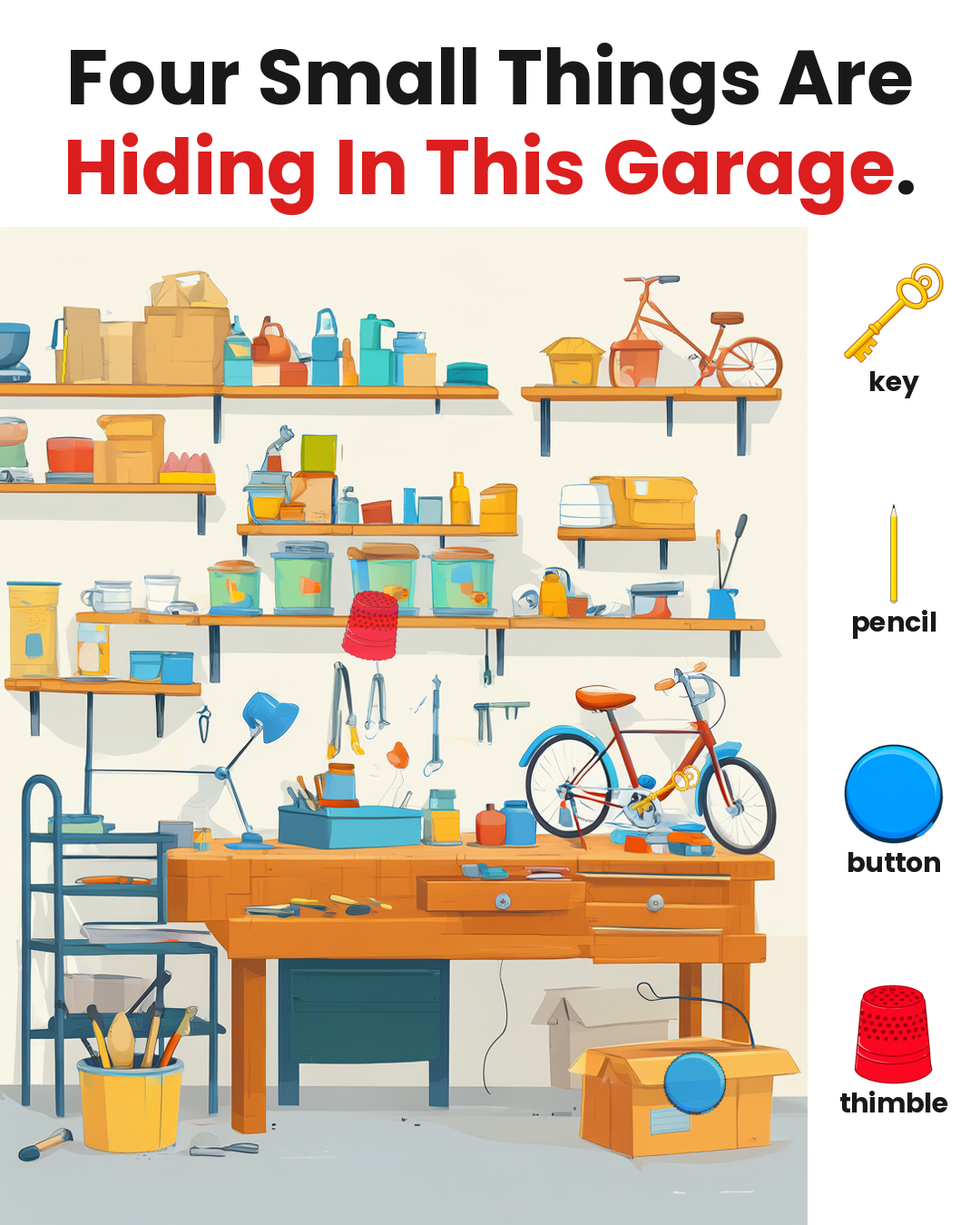
Take your time and look closely before you scroll down!
Search The Room, Not The Picture
When most people meet a hidden object picture, their eyes bounce all over it at random. They land somewhere bright, then somewhere busy, then back to the middle, and after half a minute they have looked at some places three times and other places not at all.
A far better method is to treat the drawing like a real room you are tidying. Start at the top left corner and read across the top shelf as if it were a line of text. Then come back and read the next shelf, and the next, and finally the workbench and the floor. Shelves make this especially easy, because the picture has already divided itself into neat horizontal strips for you.
The second part of the method is just as important: hunt for one object at a time. Hold the shape of the key in your mind and sweep the whole room looking only for that shape. Then start again and look only for the pencil. Searching for four things at once sounds faster, but it is the surest way to walk straight past all of them.
How Small Things Disappear
Hidden object artists rely on a handful of very reliable tricks, and all of them are at work here. The first is camouflage by color. A yellow pencil placed among other warm yellow and tan objects loses its edges, because your eye finds objects mainly by looking for borders between different colors.
The second trick is camouflage by shape. A garage is full of long thin things: screwdrivers, brushes, handles, wrenches. A pencil is simply one more long thin thing, so the brain files it under tools and stops examining it.
The third trick is clutter itself. Your working memory can hold only a few items at once. In a scene with a hundred objects, you are constantly forgetting where you have already looked, which means you repeat some areas and skip others entirely without ever realizing it.
A Tradition Of Hiding Things In Pictures
Pictures with secrets tucked inside them are far older than modern puzzle books. Painters in past centuries loved to hide small symbols in the corners of their work, and illustrators of children’s magazines have been hiding rabbits in trees and faces in clouds for well over a century.
In the 1900s the hidden picture became a regular feature in family magazines, printed as a page where parents and children could lean over the same drawing together. The pleasure was never really about winning. It was about the slow, quiet looking, and the small jolt of delight at the moment of discovery.
A garage is the perfect setting for it. Almost everyone has one somewhere in their memory, full of jars of screws and things that might be useful one day, and a place like that could happily swallow a thimble for years.
Your Challenge For Today
Give yourself one minute for all four objects. That is a fair target for this picture, and most people find two or three in that time and need a little longer for the last one.
If you find all four in under forty seconds, your eyes are doing something genuinely impressive. If one of them refuses to appear, try changing how you look rather than where you look. Lean back a little, soften your gaze, and let the whole picture sit in front of you. Odd shapes often pop out of the clutter when you stop staring hard at one spot.
Then pass this one along to a friend and let them hunt. Watching somebody else search is a strange pleasure, especially when their eyes slide over the same object three times in a row.
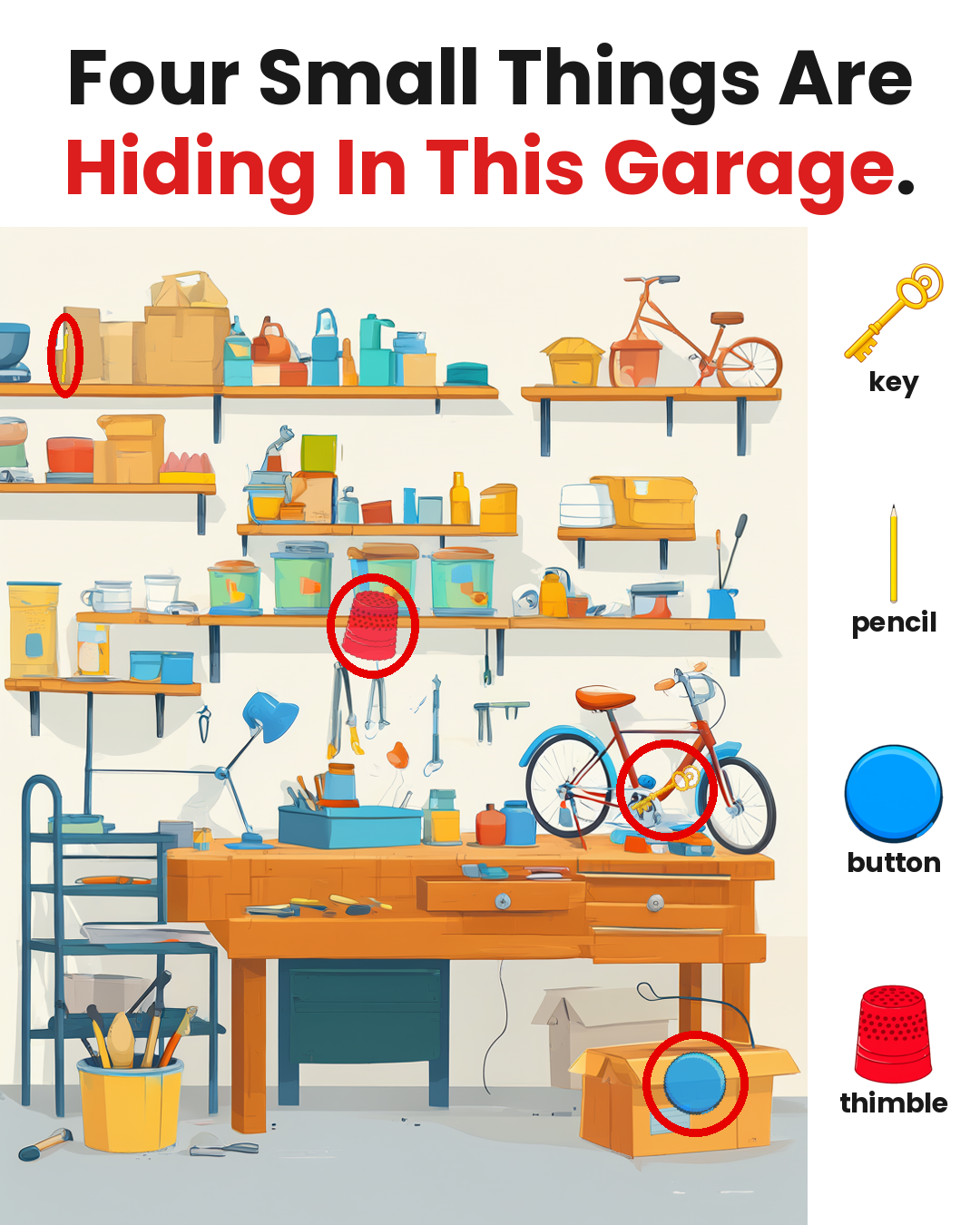
ANSWER: The key is on the bicycle frame, the pencil lies on the top shelf at the far left, the thimble sits on the middle shelf among the jars, and the button is on the cardboard box on the floor.
Where All Four Were Hiding
The key is the one most people find first. It is lying across the frame of the blue bicycle, just below the saddle, where its golden color sits against the dark metal and catches the light. Once you notice it, it seems obvious, which is how good hiding places always feel afterwards.
The button is on the cardboard box on the floor at the bottom right, right in the middle of the open flap. It is big and blue, but it sits low in the picture where fewer people bother to look carefully.
The thimble is on the middle shelf, standing among the glass jars near the center of the room. Its bright red color should make it easy, yet it is exactly the size and shape of a little pot or a paint tin, so the eye accepts it as part of the shelf.
The pencil is the hardest of the four. It is on the very top shelf, at the far left edge, lying flat among the boxes and tins where its yellow body blends into the warm colors around it.
Why The Pencil Wins
Nearly everyone finds the pencil last, and there are three good reasons for it. It is at the edge of the picture rather than the center, where our attention is naturally weakest. It is the same color family as everything around it, so there is no sharp border to attract the eye. And it is horizontal, lying flat on the shelf rather than standing up, which makes it read as just another object in the row.
The button and the thimble, by contrast, both have strong colors that do not belong to a garage at all. If you searched for color rather than shape, those two probably jumped out at you early.
How Did You Do?
All four in under thirty seconds means you have truly remarkable eyes, the sort that spot a dropped earring on a patterned carpet.
All four in under a minute is an excellent score and better than most people manage. Three out of four is a perfectly respectable result, and the one you missed was almost certainly the pencil.
If you found only one or two, do not worry at all. Try the shelf by shelf method on the next picture and you will notice a real difference. Careful looking is a skill, not a gift, and it grows every single time you practice it.