Captain Drake walked into the first-class lounge and stopped a manager from pulling a young mother away from the buffet… But when she looked up at his four gold stripes and said, “They gave me your flag two years ago,” his hand went completely still.
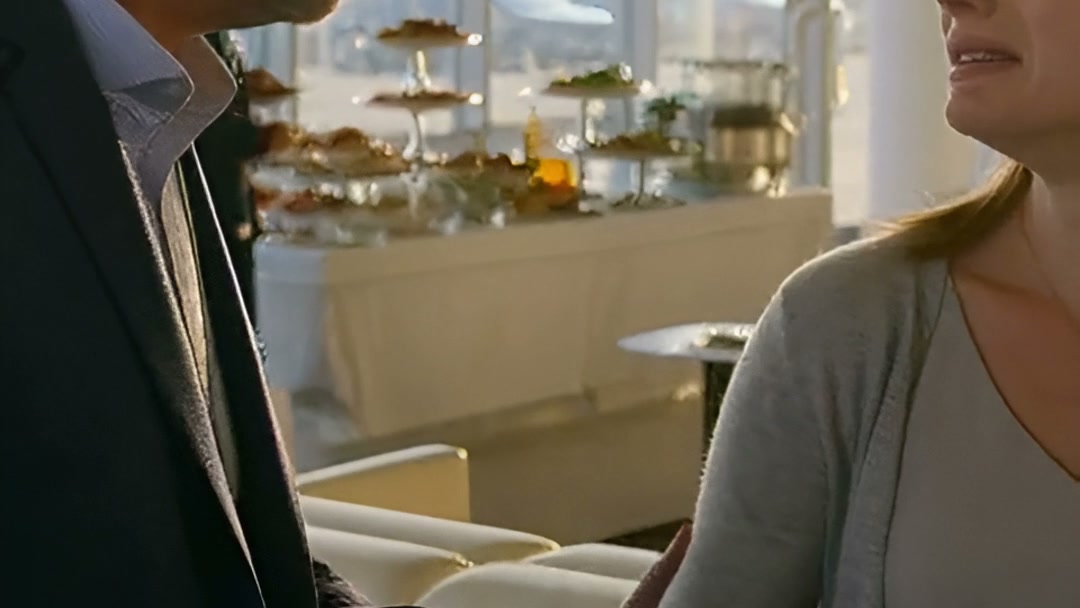
The lounge smelled like fresh coffee and money.
White leather chairs. Floor-to-ceiling glass. Sunlight bouncing off every polished surface. The kind of place that reminded you, quietly and constantly, that some people belonged and others did not.
Mara Chen sat in a chair near the buffet wall, her two-year-old daughter Lily in her lap. Her airport cleaning badge hung from a lanyard around her neck. She had a plate of scrambled eggs balanced on her knee and a small plastic fork she’d brought from her own bag.
She wasn’t sure if she was allowed to eat here.
But it was 5 a.m., she hadn’t eaten since yesterday afternoon, and Lily kept pressing her tiny nose against the glass of the pastry display and making little sounds that broke something in Mara’s chest every single time.
She’d told herself: just this once.
She was wrong about the “just this once” part.
“Excuse me.”
The lounge manager’s voice was the temperature of a freezer. His name tag read GERALD. He had the kind of posture that came from years of deciding who mattered.
“This lounge is for premium passengers only.”
Mara looked up. Lily turned and blinked at him with enormous dark eyes.
“I work here,” Mara said. “I’m on a break. I didn’t think—”
“You didn’t think correctly.” Gerald reached out and wrapped his fingers around Mara’s upper arm, pulling upward with the efficient grip of someone who’d done this before. “Cleaners’ children don’t eat here. Please remove yourself and your—”
His wrist stopped moving.
Because someone else’s hand had closed around it.
Gerald turned.
The man standing behind him was six-foot-two in a navy blue uniform. Four gold stripes on each epaulette. A pilot’s cap tucked under one arm. Late thirties, broad-shouldered, with a jaw that looked like it had been through something and come back harder. His grip on Gerald’s wrist was not aggressive. It was just absolute.
“Let go of her,” he said. His voice was quiet the way a runway at night is quiet: completely controlled, nothing wasted.
Gerald’s mouth opened and closed.
“Now, Gerald.” The captain’s eyes didn’t move from the manager’s face. “Right now.”
Gerald released Mara’s arm. He straightened his jacket with both hands, muttered something about policy, and took four steps back before turning and walking briskly in the direction of his dignity, which had already left the room.
The captain watched him go. Then he looked down.
Lily was staring up at him from Mara’s lap. She had a piece of croissant in one small fist that she’d apparently grabbed from the table at some point during the commotion, and she was studying the four gold stripes on his sleeve with the intense scientific curiosity of a toddler who has found something important.
“Those are pretty,” Lily said seriously, pointing at the stripes with her croissant.
The captain crouched down to her level. His hard face didn’t go soft exactly—it was more like something underneath it surfaced, something that had been waiting.
“They are,” he agreed. “You can touch one if you want.”
Lily considered this for a moment with great solemnity. Then she pressed one small finger against the nearest gold stripe, satisfied, and went back to the croissant.
The captain straightened. He picked up Mara’s plate from where it had slid and nearly fallen during Gerald’s maneuver, set it back on the table properly, and pulled out the chair across from her.
“You don’t have to leave,” he said. “Sit.”
Mara sat. Her hands were shaking. She pressed them flat against her thighs and breathed.
“Thank you,” she managed. “He does that. Gerald does that. I knew he would and I just—Lily was hungry and I thought—” She stopped. She was rambling. She knew she was rambling. “Thank you,” she said again.
“Don’t thank me for something that shouldn’t have happened.”
He set his cap on the table and signaled to one of the attendants. Within two minutes there was a full breakfast in front of Mara, a small bowl of fresh fruit cut into pieces for Lily, and a second coffee that nobody had asked for but somehow appeared.
Lily climbed down from Mara’s lap and stood beside the captain’s chair, very close to his arm, in the way small children sometimes attach themselves to people they’ve decided are safe.
He let her. He didn’t make a production of it.
Mara watched her daughter and breathed and tried to hold herself together.
And then—she didn’t plan it. She wasn’t going to say anything. She’d promised herself she’d stopped doing this, stopped looking at men in uniforms and doing the math.
But she looked at the four gold stripes.
And something in her chest cracked open like a fault line.
“My husband had those,” she said. Her voice came out strange. Quiet. Like it belonged to a different room. “Not—not aviation. He was army. Captain, too. Different kind.”
The man across from her was still. He didn’t fill the silence with comfort. He just let her have it.
“They gave me a folded flag,” Mara said. “Two years ago in March. It was cold. Lily was three months old. She never—” She pressed her lips together. “She never saw his face.”
The captain didn’t say anything for a long moment.
When he spoke, his voice was lower. Rougher around the edges in a way that hadn’t been there before.
“What was his name?”
“James,” she said. “James Chen. He was twenty-nine.”
The captain’s hand, resting on the table, tightened very slightly. His knuckles went white for just a second and then relaxed.
“James Chen,” he repeated. Quietly. Like he was storing it somewhere specific.
“You didn’t know him,” Mara said. It wasn’t a question. She’d stopped believing in the coincidences of grief a long time ago.
“No,” he said. “But I know what that flag means. I’ve folded them.” He paused. “I know what it costs to carry one.”
Lily climbed back into Mara’s lap, apparently finished with her investigation of the stripes. She pressed her face against her mother’s shoulder and blinked sleepily.
“She looks like him,” Mara said, smoothing Lily’s hair. “Around the eyes.”
“Good,” the captain said. And then, after a moment: “He’d want her to eat the croissant.”
Mara laughed. It was sudden and a little broken and completely real, the kind of laugh that only happens when something true is said at exactly the right moment.
“He really would,” she said.
She fed Lily another piece of fruit. Lily ate it with great seriousness and then pointed at the captain again.
“More shiny,” Lily announced, reaching for his sleeve.
“She’s obsessed with your stripes,” Mara said apologetically.
“She’s got good taste.” He let Lily touch the stripe again. Let her pull on it a little. Didn’t move.
When Mara’s break was nearly over and she started gathering her things, the captain stood. He was quiet for a moment, something turning over behind his eyes.
“What terminal are you in today?” he asked.
“C,” she said. “Why?”
“There’s a lounge supervisor in Terminal C I’ve known for eleven years,” he said. “Good woman. She owes me a favor I’ve never called in.” He picked up his cap. “She’s going to know your name by the time you get there. You and Lily will have access to that lounge every shift you work. That’s not charity. That’s correcting a mistake that should never have been made.”
Mara stared at him. “You don’t have to—”
“I know I don’t.” He settled his cap back on. Four gold stripes, straight across each shoulder. “That’s not why I’m doing it.”
Mara opened her mouth and closed it again.
“Why are you doing it?” she asked.
He looked at Lily, who had fallen most of the way asleep against Mara’s shoulder, one small hand still loosely clutching a corner of his sleeve.
“Because James Chen’s daughter deserves to eat breakfast,” he said. “And because he should have been here to make sure of that himself, and he isn’t, and someone has to.”
Mara Chen stood in the bright white lounge with her sleeping daughter and did not cry. She had made a discipline of not crying in public—she’d had to.
But she breathed. Deeply. The way you breathe after a long time of not breathing enough.
“Thank you, Captain,” she said.
He nodded once. Precise. Then he walked toward his gate, his uniform perfect, his stride unhurried, and did not look back—because men like that didn’t need to watch the difference they made in order to know they’d made it.
Three weeks later, on a Tuesday morning, Mara came into work and found a sealed envelope in her locker.
Inside: a letter from the airline’s director of operations. A formal apology for the incident. And a note, separate, handwritten, on plain paper. No letterhead.
*Your husband served. That means something to this airline and it means something to me. Gerald has been reassigned. His replacement has been briefed. You and Lily are welcome here.*
No signature. Just four small gold lines drawn at the bottom, in ink. Like stripes.
Lily found it on the kitchen table that evening and pressed her finger against each one, very seriously, the way she always did.
“Shiny,” she decided.
Mara folded it carefully and put it in the box where she kept the flag.