Good day, puzzle friends, and welcome back to our daily picture test!
Today we are visiting a cheerful little fruit and vegetable stall on a cobbled street.
The awning is up, the crates are full, and the brass scale is swinging in the sun.
Below you will find the very same market stall drawn twice, side by side.
They look identical, but something at this stall has quietly changed.
Just one detail is different in the right-hand picture, and it is a small one.
A friendly tip before you start: the tomatoes and carrots are so bright that your eyes will keep returning to them. Try to look past the colour and watch the shapes of the wooden crates instead.
Ready? Take your time and see if you can catch it.
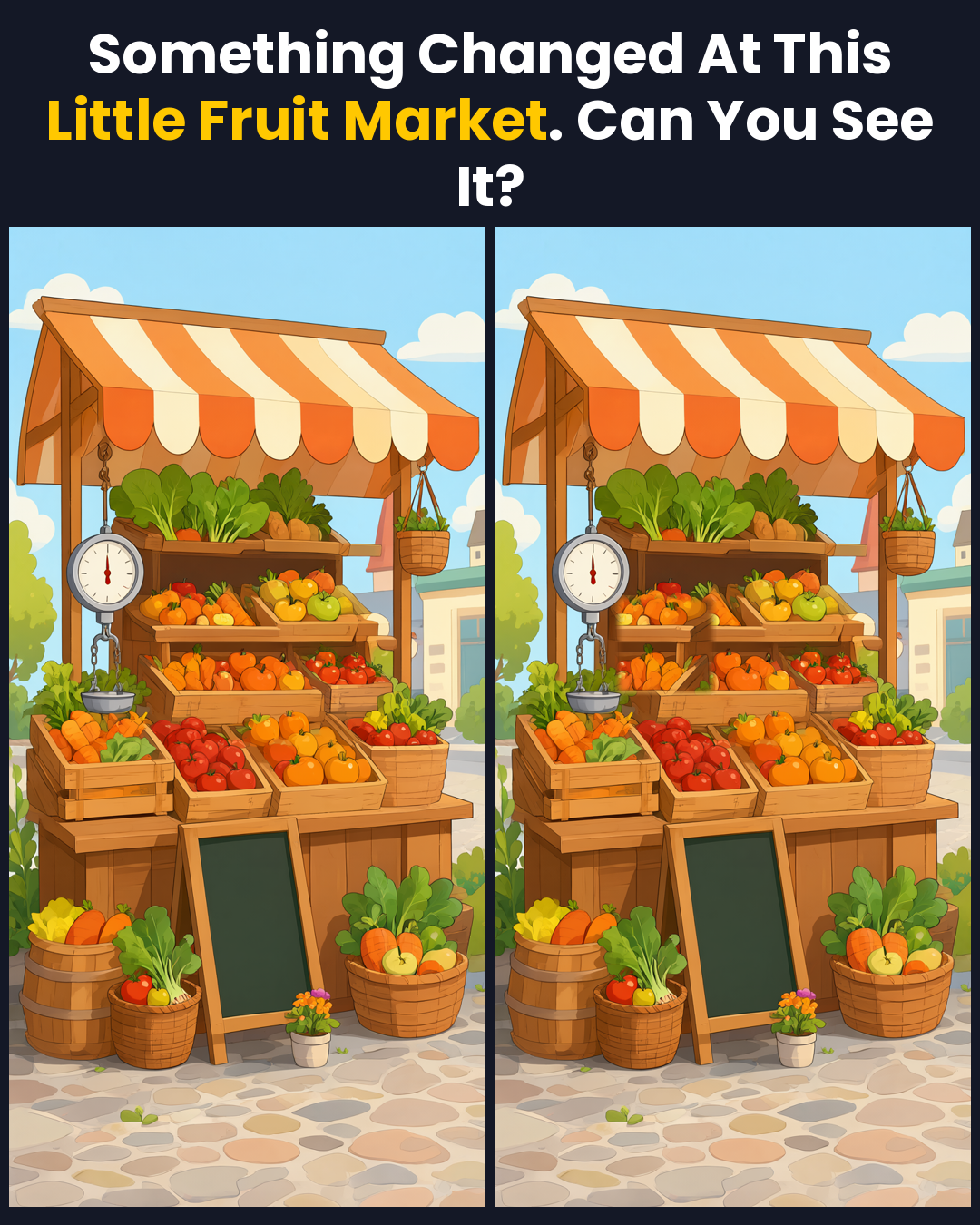
Take your time and look closely before you scroll down!
A Smart Way To Search
A picture this busy can feel overwhelming. There are dozens of tomatoes, a wall of carrots, lettuce leaves everywhere. If you simply let your eyes roam, they will bounce from one bright patch to the next and tell you almost nothing.
The trick is to compare structures, not contents. Ignore the fruit for a moment and look at the wooden frames: the awning poles, the edges of each crate, the legs of the table, the chalk board leaning against the front. Those straight lines are easy to match up between the two pictures, and a change in one of them stands out at once.
Work from the top down, one level at a time. Awning, then the top shelf, then the middle shelf, then the table, then the ground. Finish each level before you move on, and do not let the colours pull you back up.
Why Market Scenes Fool Us
Our eyes are drawn to anything red, and nature made us that way for a reason. Ripe fruit is red, and for most of human history spotting it quickly was worth a great deal. A market stall is almost a trap built from that instinct.
At the same time our brain loves patterns. When it sees a row of crates all filled with round orange things, it stops examining them one by one and simply labels the whole area. From that moment on, the area is marked as understood, and anything that changes inside it slips through unnoticed.
This is also why experienced shoppers sometimes walk right past the item they came for. The brain says shelf of jars, ticks it off, and moves on.
The Long Life Of A Simple Game
Market scenes have been a favourite of puzzle artists for generations. Old magazines were full of them, partly because they were charming and partly because a crowded stall gives an artist so many places to hide a change.
The classic rule has always been fair play: the change must be visible to anyone who looks carefully, with no tiny specks and no tricks of printing. Every good puzzle keeps to it, including this one.
There is a modern reason to keep playing, too. Vision researchers use these very pictures in their laboratories, because they are one of the simplest ways to show how much of the world we look at without truly seeing.
Can You Beat The Clock?
Most readers find today’s difference in about forty-five seconds. Under twenty-five seconds is a fine result, and under twelve is sharp enough to make us raise an eyebrow.
If you are stuck, try this: look only at the middle third of the picture, the part between the hanging scale and the table top, and compare the crates one by one.
And when you have it, pass the picture on without saying a word. Half the pleasure of a puzzle like this is watching somebody else go through the same happy struggle.
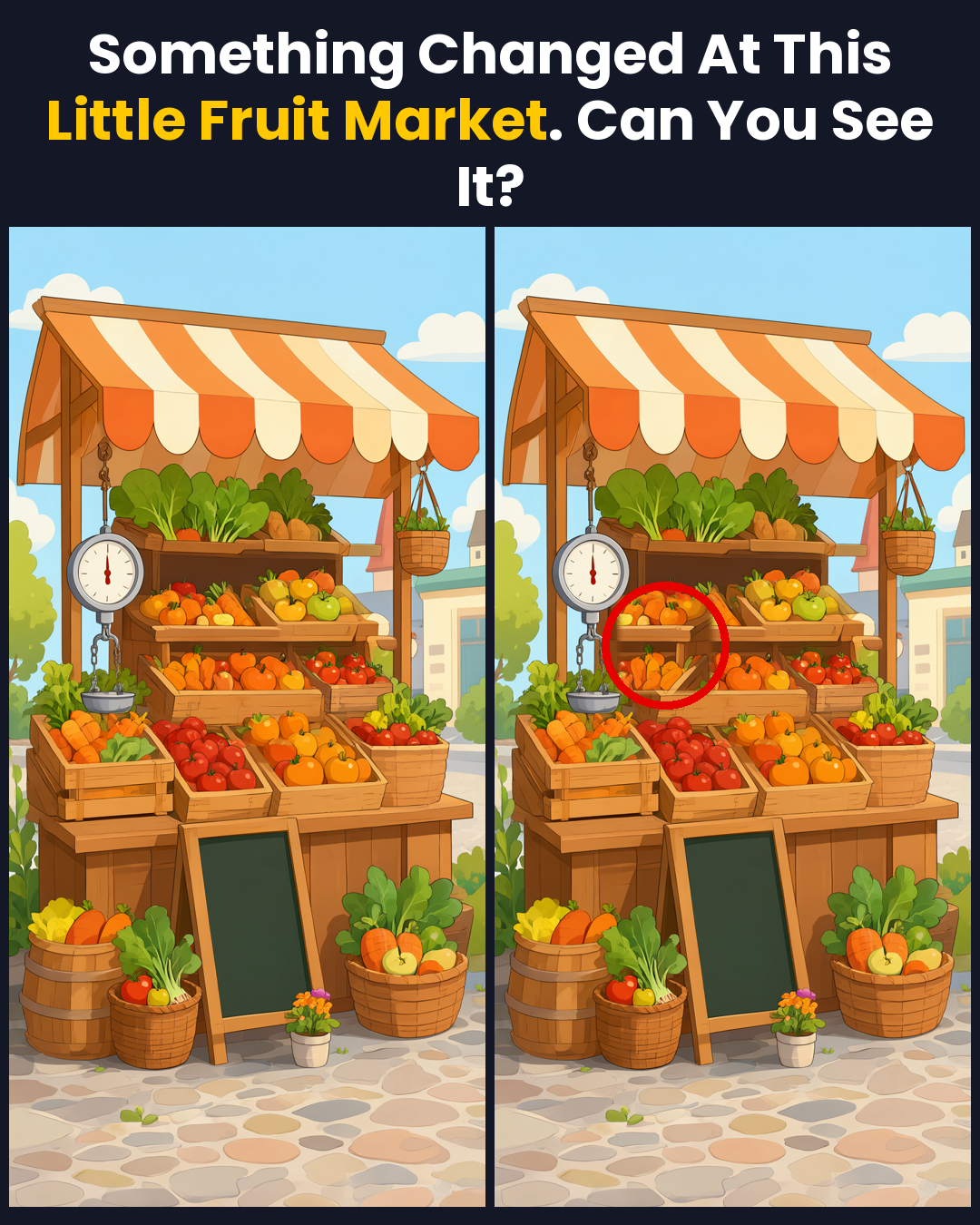
ANSWER: The crate of carrots on the middle shelf is turned around the other way
The Crate That Turned Around
Look at the middle shelf, just to the right of the hanging brass scale. There is a small wooden crate of carrots and orange peppers sitting at the front of that shelf.
In the first picture the crate sits one way, with its open side and its bundle of carrots angled towards the left. In the second picture the whole crate has been turned around, so the carrots now point the other way and the wooden slats run in the opposite direction.
It is exactly the sort of thing that happens at a real market a hundred times a day, which is what makes it so easy to overlook. Nothing is missing and nothing is a strange colour. One box has simply been picked up and put back the other way round.
Why Almost Everybody Misses It
The change sits in the most crowded part of the whole picture. Above it there is lettuce, below it there are tomatoes, and beside it hangs a shiny metal scale with a red needle. Every one of those things is more eye-catching than a brown wooden box.
There is also the matter of height. The crate sits roughly in the middle of the image, and the middle is where our eyes pass through on their way somewhere else rather than where they stop.
The readers who found it quickly nearly all used the same method: they followed the straight wooden edges rather than the fruit. Edges and angles are what change here, and edges are something our quick glance rarely bothers to check.
How Did You Get On?
Under twelve seconds is remarkable and means you have a real eye for shape. Twelve to thirty seconds is very good. Up to a minute is the ordinary, healthy result that most of our readers report, and longer than that simply means the puzzle did its job well.
Try another one tomorrow. Regular players tell us that after a week or two they start spotting these changes almost before they have finished reading the question.