Hello again, puzzle friends, and welcome to today’s picture test!
We are spending this morning in a bright little pet shop, right in front of the shelves.
Every shelf is packed: food bags, bowls, balls, a bird cage, a fish bowl and a friendly toy dog.
The same shop is drawn twice below, left and right, and the two pictures look like perfect twins.
They are not. One small detail has been changed in the second picture.
Nothing has been taken away and nothing new has appeared. Something is simply not quite the same.
Here is a kind tip: this is a very full picture, so do not try to take it all in at once. Pick one shelf, finish it properly, then move to the next.
Good luck, and do not peek at the answer too soon!
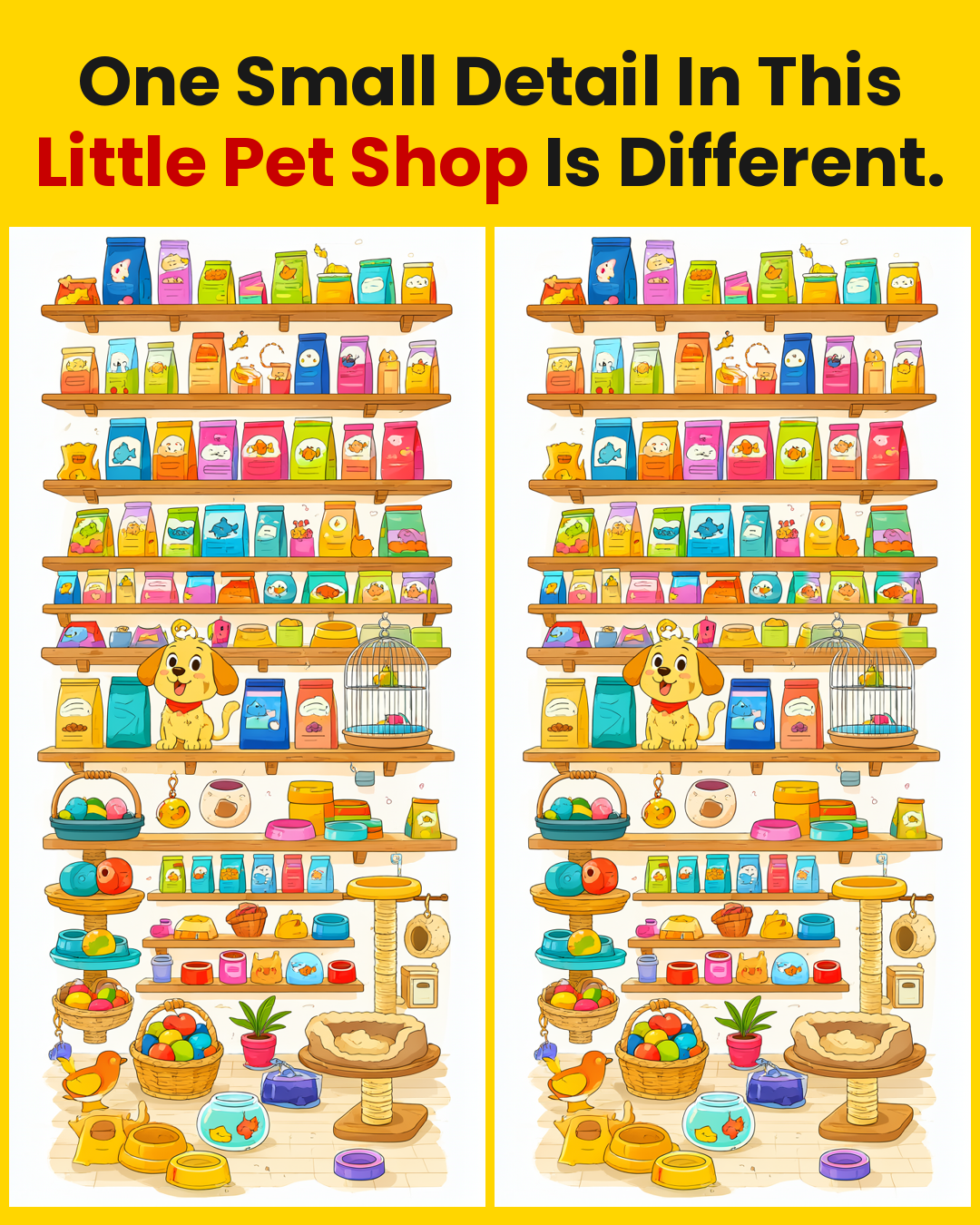
Take your time and look closely before you scroll down!
How To Tackle A Crowded Shelf
When a picture has this much in it, hunting at random is hopeless. There is simply too much for the eye to hold, and after a few seconds you are looking at the same three spots over and over without realising it.
Use the shelf method instead. Treat each wooden shelf as its own little puzzle. Start with the very top shelf on the left, then look straight across at the top shelf on the right, and compare them properly. Count the items if it helps. Then move down one shelf and do the same again.
It takes discipline, because the colourful things lower down keep calling you. But a steady shelf-by-shelf sweep will nearly always beat frantic searching, and you will know for certain when you are finished.
The Trick Of Too Much Information
A shop shelf is one of the hardest places for human eyes. Psychologists call it visual crowding. When many similar objects sit close together, our brain stops seeing them as individuals and begins to see a texture, rather like wallpaper.
Once an area has become wallpaper in our minds, we can look straight at it and take in almost nothing. That is why shoppers so often fail to find a familiar packet that has been moved one shelf up, even while staring right at it.
Colour adds the final layer of difficulty. These shelves are a rainbow, and strong colours actively suppress our sense of shape and direction. We see pink, blue, yellow and green, but we do not really see which way anything is pointing.
A Puzzle With A Long Past
Shop-window scenes have been a staple of difference puzzles since Victorian times, when illustrators filled their drawings with as many little goods as they could fit. The more clutter, the longer the reader stayed with the page, and a long stay was exactly what the magazine wanted.
The same idea survives today in those enormous search-and-find picture books that grandchildren love. The art has barely changed in a century, only the printing.
There is a real benefit hiding inside the fun. Carefully scanning a crowded image is close to the sort of visual work that pharmacists, proofreaders and quality inspectors do all day, and like any skill, it improves steadily with practice.
Today’s Challenge
This one is harder than most. The average reader takes a little over a minute, and anyone who finds it inside thirty seconds has done very well indeed.
If you have been searching for a while, narrow your world. Cover everything except the middle of the picture, around the height of the bird cage, and compare only that narrow strip.
Then share it with a friend or with the family. It is always a pleasure to watch someone else scan the same shelves, certain that the two pictures must be the same.
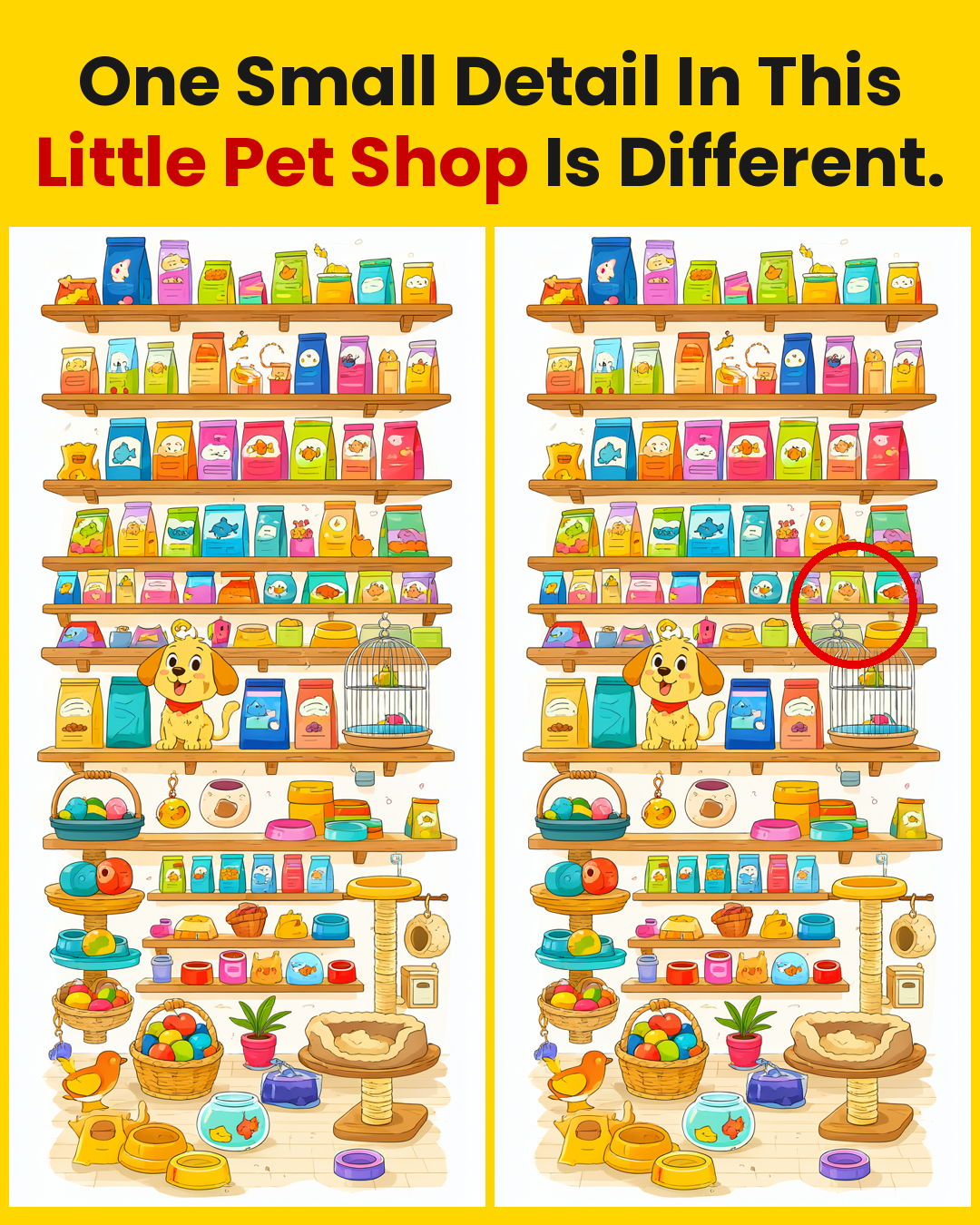
ANSWER: On the shelf just above the bird cage, the little row of pet food packets is turned the other way around
Where The Difference Is Hiding
Find the white bird cage on the right-hand side of each picture. Now look at the shelf directly above it, the one holding a row of small colourful food packets with little fish and cat faces printed on them.
In the first picture that short row of packets runs one way, with the narrow pale packet towards the left and the wider patterned one on the right. In the second picture the whole little group has been turned around, so the same packets now sit in the opposite order and the small hanging bowl beside them has swapped sides as well.
Nothing has vanished and no colour has changed. The group has simply been reversed, which is why the shelf still looks perfectly normal at a glance.
Why It Slips Past Us
Three things work against you here. First, the change sits in the middle of the busiest wall of packets in the whole picture, surrounded by dozens of near-identical neighbours.
Second, it is a change of order and direction rather than of colour or quantity. Our quick glance is excellent at noticing that something is missing or that something has gone red, and surprisingly poor at noticing that things have swapped places.
Third, there is a charming toy dog sitting just below, with big friendly eyes. Faces are the strongest magnet the human visual system has. Almost every reader looks at that dog within the first second, and many keep drifting back to it without ever realising they are doing it.
How Did You Do?
Under twenty seconds on a picture this crowded is outstanding, and it almost certainly means you searched shelf by shelf rather than at random. Twenty seconds to a minute is a strong result. One to two minutes is the usual time for most people, and anything longer simply means you met a well-made puzzle.
Come back tomorrow for another. The readers who play every day tell us the busy pictures are the ones where their times improve the fastest.