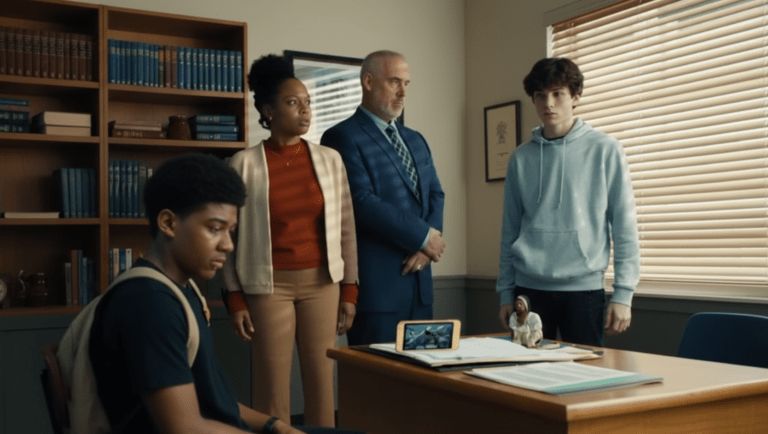
He Survived the Explosion — Then Found His Brother Had Taken Everything
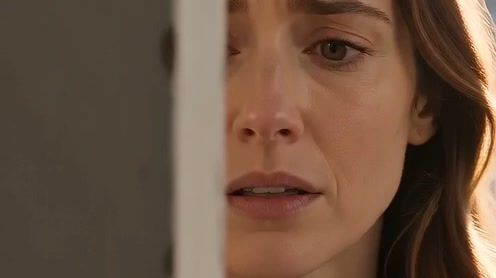
A man walked into his own funeral three years late — and found his wife in his brother’s arms, his business in his brother’s name, and his “accident” was no accident at all.
The town looked the same. Marcus Hale had been gone three years, and Clover Ridge hadn’t even changed its gas station signs.
He pulled his collar up and kept walking. Shorter hair now. A beard he hadn’t had before. Twenty pounds lighter from two surgeries and a year of physical therapy in a hospital outside Lisbon. Nobody glanced twice.
He turned onto Birchwood Lane.
The house was repainted. Navy blue now, where it used to be gray. Elena had always wanted navy blue. He’d kept putting it off.
Someone else had found the time.
He stood at the end of the driveway for a long moment, then walked up and rang the bell.
The door opened.
Elena stared at him. She was wearing a yellow cardigan he didn’t recognize. Her hair was shorter. She looked — he searched for the word — tired in a way that had nothing to do with sleep.
“Hi, Ellie,” he said.
She made a sound he’d never heard from her before. Not a scream. Not a word. Something that came from a place past language.
Then she dropped.
He caught her before she hit the porch.
Behind her, at the end of the hallway, stood Daniel. Marcus’s brother. Wearing Marcus’s old bathrobe — the navy one with the frayed left cuff — holding a coffee mug, looking like a man whose floor had just opened beneath him.
“Hello, Danny,” Marcus said.
Daniel didn’t answer. The mug slipped from his fingers and shattered on the hardwood.
Three years earlier, the Hale Fabrication plant had exploded on a Tuesday morning in March. The official report said a gas line failure. Seven workers were injured. One body was never recovered — Marcus Hale, co-owner and operations manager, age thirty-eight.
What the report didn’t say was that Marcus had been standing near the east wall reviewing inventory logs when the blast threw him through a loading bay door and into the drainage canal behind the property. A Portuguese cargo truck driver named Ferreira pulled him out forty minutes later and drove him to a hospital in Setúbal because the man was breathing but couldn’t say his own name.
He stayed unconscious for eleven days. When he woke, he knew nothing — not his name, not his country, not the woman whose face kept surfacing in his dreams like something half-remembered from childhood.
Eight months. That’s how long the amnesia held.
Then one morning he was watching a nurse write her name on a whiteboard — Elena — and something cracked open behind his eyes.
He remembered everything in a single, nauseating wave.
His name. His town. His wife. His brother. The logs he’d been reviewing. The numbers that hadn’t added up. The meeting he’d scheduled with an accountant for the following week.
He lay in that hospital bed for three hours, staring at the ceiling, doing the math.
It took another sixteen months to get well enough to travel. His left leg had been rebuilt with two plates and a rod. His Portuguese was functional. His English felt strange in his mouth at first, like a shoe worn on the wrong foot.
He found a lawyer in Lisbon named Carvalho who helped him gather records — the hospital intake, the surgeon’s notes, the police report Ferreira had filed the night of the accident. Documentation that Marcus Hale had been alive and in Portugal, unconscious and unidentified, while his brother was back home collecting a life insurance payout of four hundred thousand dollars.
“You were declared legally dead,” Carvalho told him. “Reversing that in another jurisdiction — it takes time.”
“How much time?”
“Weeks. Possibly months. They’ll want the originals, certified translations, a DNA confirmation.”
“What do I do in the meantime?”
Carvalho looked at him over his glasses. “Go home. But carefully.”
Elena was sitting at the kitchen table when she came back around. Marcus had laid her on the couch. He’d made tea — he still knew where she kept the kettle — and set it in front of her without asking.
She stared at him for a long time.
“You’re real,” she finally said. Not a question. A verdict.
“Yeah.”
“I watched them lower an empty casket.” Her voice was flat. “Daniel identified you. He said — he said there wasn’t enough left to —” She stopped. “He cried. He cried at the funeral, Marcus.”
“I know.”
“I was pregnant.” The words hit the room like a stone hitting water. “I lost it. Six weeks after. The doctors said it was stress. I —” She pressed her hand over her mouth. “I have been living in your house, sleeping in your bed, married to your brother, and you were — where were you?”
He told her. All of it. The canal, the hospital, the eight months of blank. The moment the whiteboard cracked it open. He kept his voice level because she needed facts right now, not emotion.
When he finished, she sat very still.
“He knew,” she said. “He had to have known you might have survived.”
“He knew.”
“He married me six months after the funeral.” She said it like she was hearing it for the first time. “He said it was what you would have wanted. That you’d have hated the idea of me being alone.”
“Did you believe him?”
She looked at her hands. “I wanted to.”
Daniel came back to the house at seven that evening with two police officers.
“That man,” Daniel said, pointing at Marcus from the doorway, “is not who he says he is. He’s been harassing my wife. I want him removed.”
The officers looked at Marcus. He was sitting at the kitchen table drinking coffee, completely calm.
“Sir,” one of them said, “can you provide identification?”
“My legal identity is currently in probate in Lisbon,” Marcus said. “I have hospital records, surgical documentation, and a sworn affidavit from the physician who treated me. I also have a DNA sample ready for comparison against any existing record.”
“He’s a con man,” Daniel said. “There are people who prey on grieving families —”
“Daniel.” Elena’s voice came from the hallway. She was standing straight. She’d changed out of the yellow cardigan. “Stop talking.”
“Elena —”
“I know who he is.” She walked into the kitchen and stood beside Marcus. “I’ve known for six hours. I know his voice. I know the scar on his right hand from the table saw in 2019. I know the way he takes his coffee.” She looked at her husband — the man she’d called her husband — without flinching. “I know it’s him.”
Daniel’s face went through several things very quickly.
“You’re making a mistake,” he said quietly.
“I made one three years ago,” she said. “I’m correcting it now.”
The paperwork took six weeks.
During that time, Marcus stayed at a motel on Route 9. Elena stayed in the house — her lawyer advised it, to protect her claim to the marital assets. They talked every evening. Sometimes for ten minutes. Sometimes for three hours.
“I’m not the same person,” he told her one night.
“I know. Neither am I.”
“I don’t know if we just — pick up where we left off. I don’t think we can.”
“I’m not asking you to,” she said. “I’m asking you to have dinner with me on Friday and see what happens.”
He laughed. It surprised him. He hadn’t heard himself laugh in a long time.
“Okay,” he said. “Friday.”
The factory records were subpoenaed as part of the insurance fraud investigation.
What they showed was three years of systematic embezzlement — Daniel had been siphoning from the operational accounts since before Marcus’s father died and left them the business jointly. By the time of the explosion, he’d taken just over two hundred thousand dollars. Marcus had been three days from discovering it.
The forensic accountant’s report was forty pages. The fire marshal’s supplemental investigation — reopened at the district attorney’s request — was twelve.
The conclusion: the gas line had been manually compromised. The valve assembly showed tool marks inconsistent with failure or corrosion. Someone had loosened it deliberately, then triggered the ignition remotely.
Daniel had been on-site that morning. He’d left forty minutes before the blast, citing a doctor’s appointment. There was no doctor’s appointment.
The arrest happened on a Wednesday. Public, because Daniel had made everything public — the police calls, the statements to the local paper about “impostor schemes,” the performance of a grieving brother defending his dead sibling’s memory.
It happened in the parking lot of the county courthouse, where Daniel had arrived to file an injunction against Marcus’s legal reinstatement.
Two detectives. Handcuffs. The full list read aloud in the open air: insurance fraud, embezzlement, conspiracy to commit murder.
Daniel looked at Marcus across the parking lot. His face did something complicated and ugly.
“I built everything,” he said. “You were always going to waste it.”
“You burned it down,” Marcus said. “There’s a difference.”
They put Daniel in the car.
The trial lasted nine days. Elena testified for four hours. She was composed and precise and did not look at Daniel once.
The jury took less than a day.
Daniel Hale was sentenced to twenty-two years. The insurance payout was seized. The embezzled funds were partially recovered. The business — what remained of it — was returned to Marcus through the estate settlement.
He didn’t reopen it. He sold the equipment, paid the remaining employees their severance with interest, and closed the books cleanly. Some things don’t need to be rebuilt. Some things just need to be finished.
Marcus and Elena had dinner on that Friday. And the Friday after. And most Fridays for the next four months.
They fought twice — real fights, about real things. About the year she’d spent wondering if she’d ever loved Marcus the way she thought she had, or if grief had rewritten the memory. About the eight months he couldn’t remember and whether the man who came back was the same one who’d left.
“I don’t need you to be the same,” she told him during the second fight, voice raised, standing in the kitchen of the motel room he’d upgraded to a short-term rental. “I need you to be honest about who you are now.”
“I’m trying.”
“Try harder.”
He did.
On a Sunday in November, fourteen months after Marcus walked back into Clover Ridge, Elena met him at the door of a small house on the east side of town. Two bedrooms. A yard with an oak tree. New construction — no history in the walls.
She’d signed the lease the day before.
She held up a key.
Not to the old house. To the new one.
“I’m not handing this to you because you’re owed it,” she said. “I’m handing it to you because I want you to have it.”
He took it from her hand. It was warm from her palm.
“Okay,” he said.
She opened the door.
They walked in together.