Hello, puzzle friends, and welcome to today’s counting test!
The sun is out, the grass is green, and the garden is full of little red ladybugs.
Your job is wonderfully simple: count every single ladybug you can see in the picture.
It sounds easy, and that is exactly why so many people get it wrong on the first try.
Almost everybody says nine, because nine big ladybugs are sitting there in plain view.
But the number is higher than nine, and it is higher than eleven too.
Here is your tip: some of these little visitors are much smaller than the others, and they like to sit right beside a big one where nobody thinks to look.
Take your time, count slowly, and write your number down before you scroll on.
Take your time and look closely before you scroll down!
The Right Way To Count
Most people count a picture like this the same way: their eyes hop from one red spot to the next, and when the hopping stops they call out a number. It feels thorough, but it is not. Eyes that hop will visit some ladybugs twice and skip others altogether.
The cure is to impose an order. Read the picture like a page of a book: left to right along the top row, then left to right along the middle row, then the bottom row. Say each number quietly to yourself as you go. Your voice slows your eyes down, and slow eyes see more.
Then do one extra pass. Go back over the picture looking only for small things, ignoring every big ladybug completely. That second pass is where today’s answer is won or lost.
Why Our Brain Gives The Wrong Number
Human beings are born with a remarkable gift called subitising. Up to about four objects, we simply know how many there are without counting. Beyond four, the gift stops working and we have to count properly, but the feeling of just knowing does not stop. It keeps whispering a confident number at us.
There is a second trap here, and it is about size. When our brain has decided what a ladybug looks like in this picture, it quietly builds a mental template: big, round, roughly the size of a plum. Anything much smaller no longer matches the template, and gets filed away as a leaf marking or a shadow.
Put those two habits together and you get the classic wrong answer. Nine confident ladybugs, and three little ones sitting in full view, unseen.
A Fun Fact About Ladybugs And Puzzles
Counting puzzles are among the oldest picture games there are. Victorian nursery cards asked children to count hidden rabbits and birds, and the pictures were often sold as a way to teach patience as much as arithmetic.
Ladybugs are a favourite subject for a good reason beyond their cheerful colour. Their spots give the eye something to stop on, which makes an individual insect easy to see but a group surprisingly hard to count. The spots pull your attention inside the creature instead of letting you tick it off and move on.
And here is a pleasant piece of nature trivia: the number of spots on a ladybug does not tell you its age, as the old story claims. It tells you which species it belongs to.
Beat The Average
In our experience, about three readers out of four answer this kind of puzzle with the obvious number and stop there. If you found more than nine, you are already ahead of the crowd.
Give yourself thirty seconds for a first count and another twenty for a careful check. If both counts agree, you can be fairly confident. If they disagree, trust the slower one.
When you have your number, share the picture with somebody at home before you reveal anything. Counting puzzles are at their very best when two people are arguing cheerfully about whether the answer is nine or twelve.
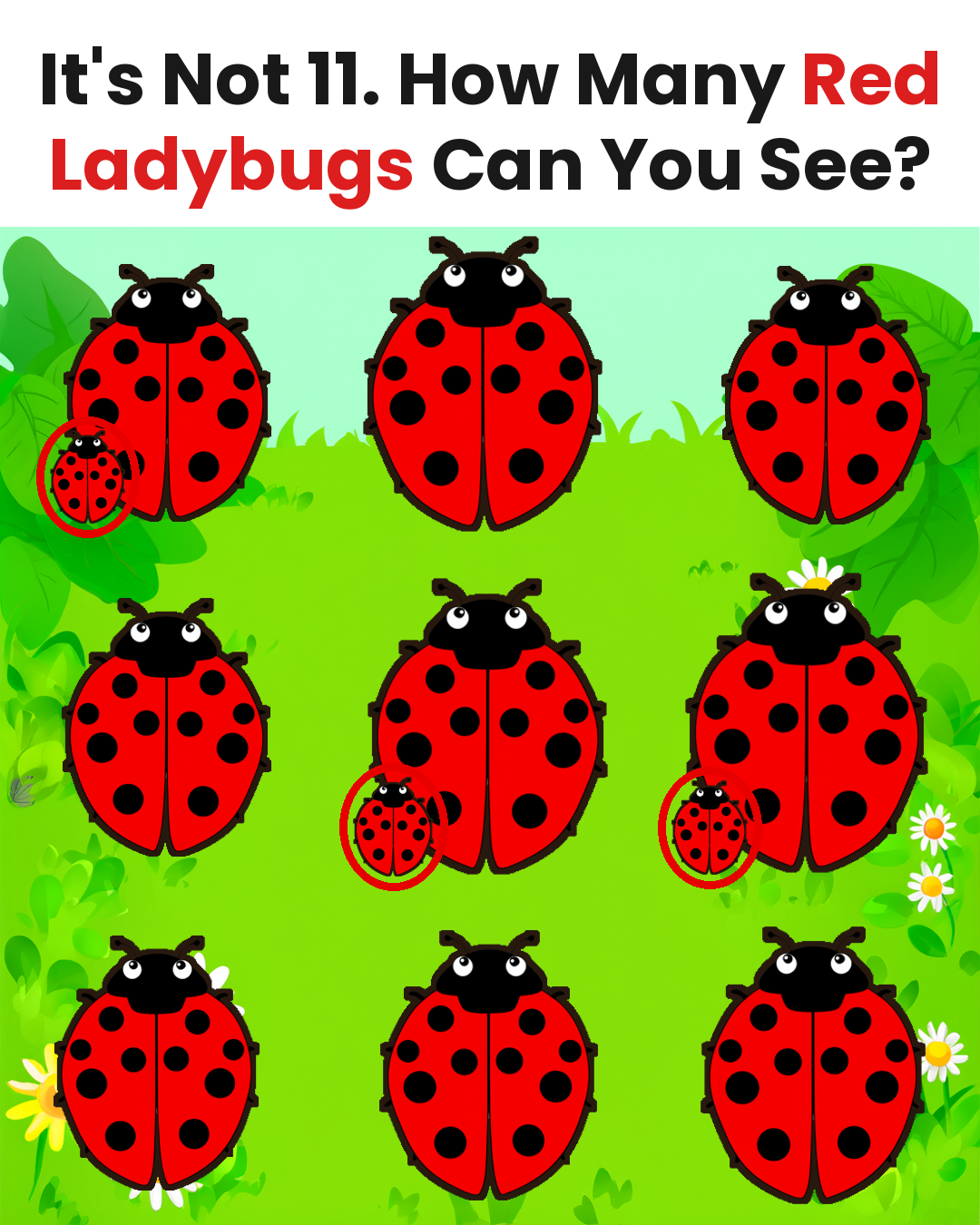
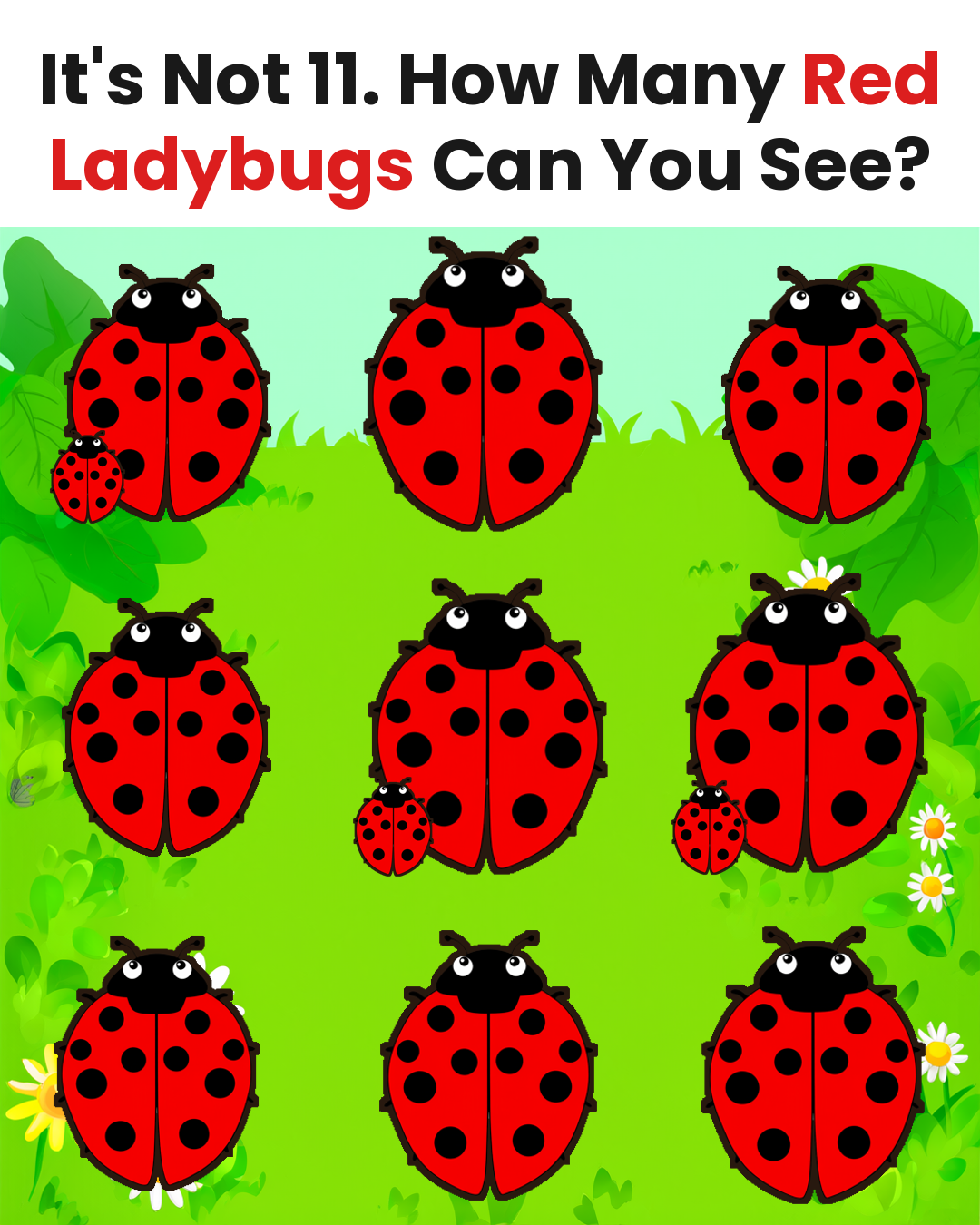
ANSWER: 12 ladybugs – three tiny ones are sitting right beside the big ones
Where The Missing Three Are
The full answer is twelve. Nine large ladybugs sit in a neat arrangement of three rows, and that is the number nearly everyone reports. The other three are tiny, and each one is tucked up against a big one.
The first little ladybug is on the far left of the top row, pressed against the lower left edge of the big ladybug there, half overlapping its red shell. The second is in the middle row, leaning on the left side of the central ladybug, just below its head. The third is also in the middle row, on the right, sitting snugly against the left shoulder of the big ladybug on that side.
All three are fully visible. Not one of them is hidden behind a leaf or cut off by the edge of the picture.
Why They Are So Easy To Miss
Sitting a small object directly against a large one of the same colour is the oldest trick in the counting puzzle book, and it works on almost everybody.
The reason is something called grouping. When two red shapes touch, our brain treats them as one object with a slightly odd outline, rather than as two separate things. We see a ladybug with a bump, not a ladybug and a baby.
Their position matters too. The little ones sit low and to the side of their big neighbours, in the exact places our eyes are least likely to linger. Had the same three been placed alone on the open grass, almost every reader would have counted them straight away.
So How Did You Score?
If you said twelve within ten seconds, you have genuinely sharp eyes and an unusually careful way of looking. Twelve within thirty seconds is an excellent result. If you reached twelve at all, on any count, you did better than most of the people who tried this picture today.
If you said nine, do not be disappointed for a moment. Nine is the answer your brain was built to give, and noticing why is far more interesting than getting it right. Try tomorrow’s counting puzzle and see how much faster that second pass becomes.