Hello, puzzle friends!
A friendly brown goat is standing in the middle of a sunny meadow, and somebody has made a real mess of her rope.
Four wooden posts are lined up along the bottom of the picture, numbered one to four.
Four ropes cross and loop and tangle their way across the grass, but only one of them is actually tied to the goat.
Your task is to follow that rope with your eyes alone.
No pencil, no finger on the screen, no shortcuts – just your eyes and a little patience.
Start at the goat, take the line slowly, and decide which numbered post she is really tied to.
Make your choice before you scroll down, because the answer is waiting at the bottom of the page.
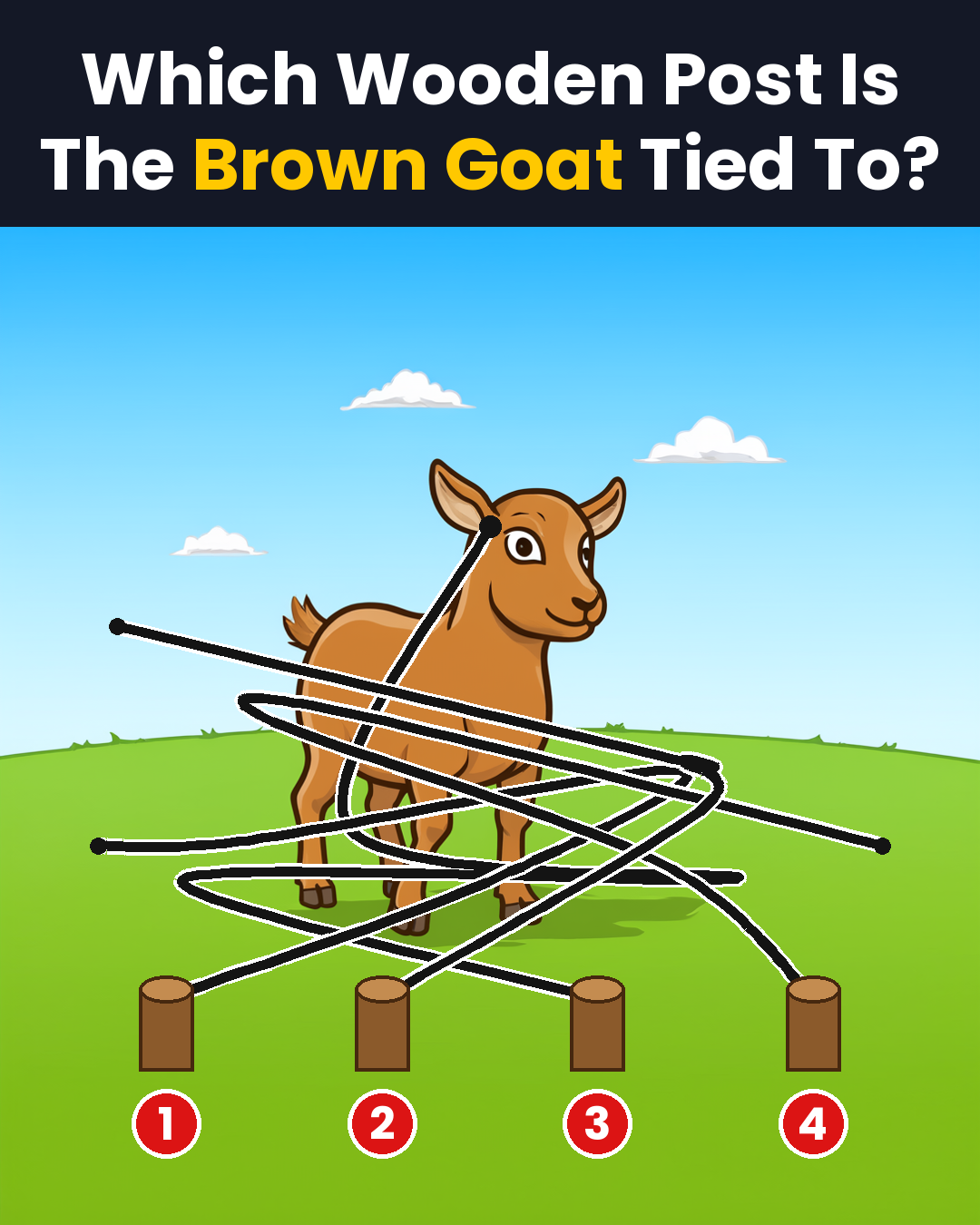
Take your time and look closely before you scroll down!
Start At The Animal, Never At The Post
Almost everybody makes the same first mistake with a rope puzzle. They look at the posts, pick the one that feels about right, and try to work backwards. That is the hard direction, because three of those four ropes are decoys and each of them will happily lead you on a long journey to nowhere.
Start at the goat instead. There is only one rope attached to her, so there is only one line to follow and no choice to make at the beginning. Put your eyes on the point where the rope leaves her neck and move along it one small step at a time.
When the line crosses another rope, pause. Do not drift onto the new line just because it is heading in a friendlier direction. Note the angle your rope was traveling at before the crossing and pick it up again on the far side at the same angle. That single habit solves most of these puzzles on the first try.
Why Crossing Lines Confuse Us
Our eyes do not glide smoothly along a line. They move in small jumps, landing a few times a second, and the brain stitches those landings together into what feels like one continuous sweep. When two lines meet at a shallow angle, a jump can easily land on the wrong one, and we never notice the swap.
The brain also prefers gentle curves to sharp turns. Faced with a junction, it quietly chooses the path that continues most smoothly, even when the real rope takes a sudden bend. That helpful instinct is exactly what a tangle puzzle is designed to exploit.
This is why tracing with a fingertip feels so much easier than tracing with your eyes. The finger gives your eyes an anchor to return to after every little jump. Doing it without one is the real challenge.
A Puzzle With A Long History
Tangled line puzzles have been printed in children’s annuals and family magazines for well over a century. Early versions showed kites with knotted strings, fishermen with crossed lines, or a bunch of balloons held by a crowd of hands.
They stayed popular because they are completely fair. Nothing is hidden, nothing is too small to see, and no clever knowledge is needed. The whole answer is sitting right there in plain view, and the only thing standing between you and it is your own attention.
Your Friendly Challenge
Most people need between twenty and forty seconds to follow the rope properly, and a good number of those people change their mind halfway through.
Try it once at normal speed and commit to an answer. Then pass the picture to a friend or a grandchild and watch them work. It is surprisingly entertaining to see somebody else’s eyes slide onto the wrong rope at exactly the spot where yours did.
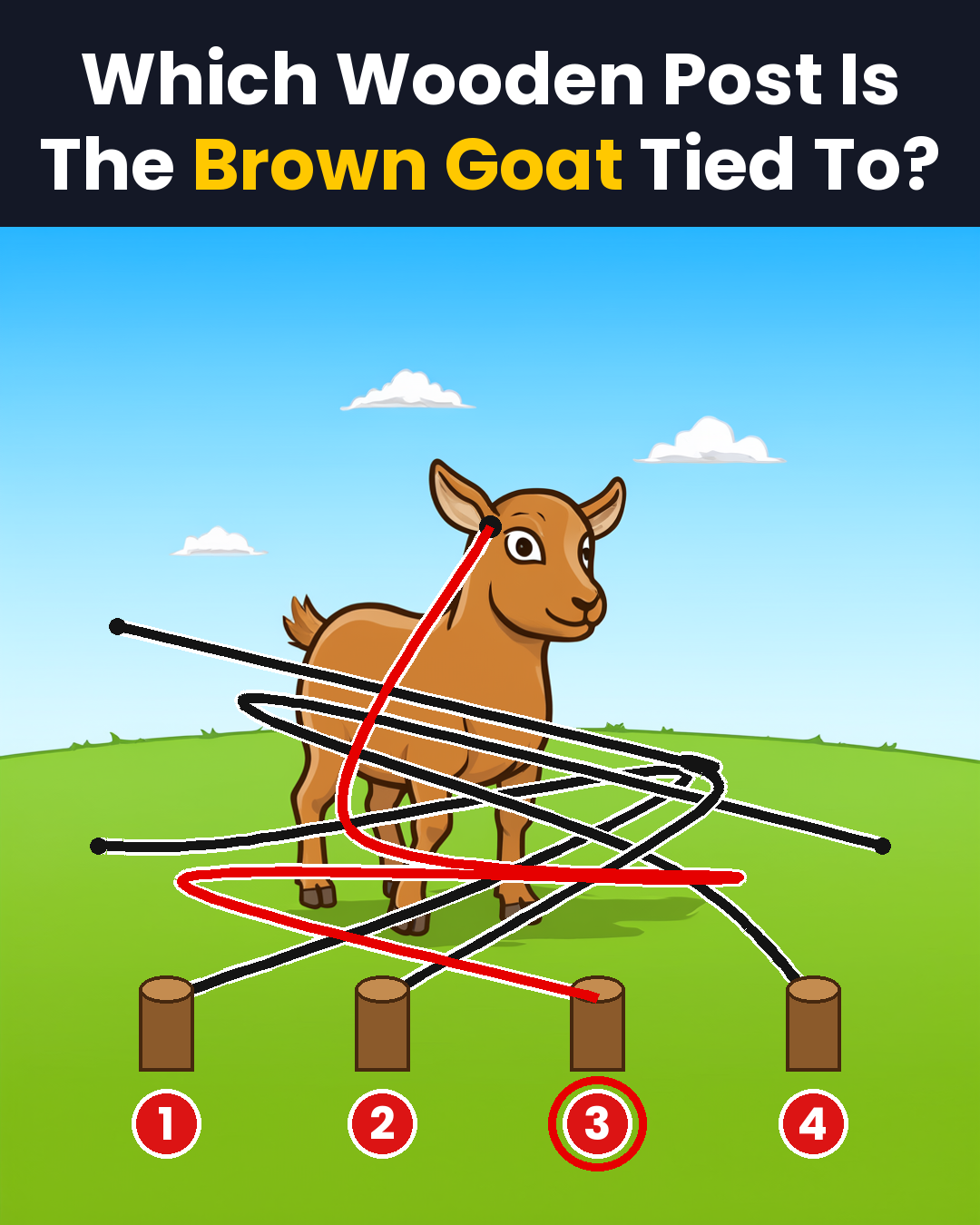
ANSWER: Post 3 – the rope from the goat’s neck curves left, loops back across the meadow and ends at the third post.
Following The Right Rope
The rope that matters leaves the goat high up, right beside her ear, and drops down towards the grass in a long gentle curve. On the way down it bends to the left, almost as if it is heading for the first post, and that is where most people are lost.
Instead of stopping there, the rope sweeps back to the right in a wide loop across the middle of the meadow, passes under two of the straight decoy lines and comes down in a steady diagonal. It finishes neatly at the top of the third post, the one just right of center.
The three other ropes never touch the goat at all. They simply begin and end in open grass, with their ends placed close to her body so that a quick glance makes them look connected. Once you notice that those ends stop short of the goat, the puzzle becomes much easier.
How Did You Do?
If you found post three in under fifteen seconds, your eyes track a line beautifully and you almost certainly started at the goat rather than the posts.
Under forty seconds is a strong result and about average for a careful solver. Longer than that is perfectly fine too, especially if you went back to check after your first answer.
If you chose post one, you are far from alone. That early leftward bend is the trap in this picture, and nearly half of all readers fall for it.