Hello, puzzle friends, and welcome into the laundry room!
The washing machine is humming, the towels are folded, and a little plant is sunning itself on the window sill.
It all looks perfectly ordinary, which is exactly what makes this picture so sneaky.
Four small things have been slipped into the scene where they do not belong.
You are looking for a clothes peg, a rubber duck, a pair of scissors and a red apple.
Three of them sit almost in the open, and one of them is very easy to walk straight past.
The four objects are shown down the right hand side so you know exactly what to hunt for.
Find all four before you scroll down, because the answer picture gives everything away.
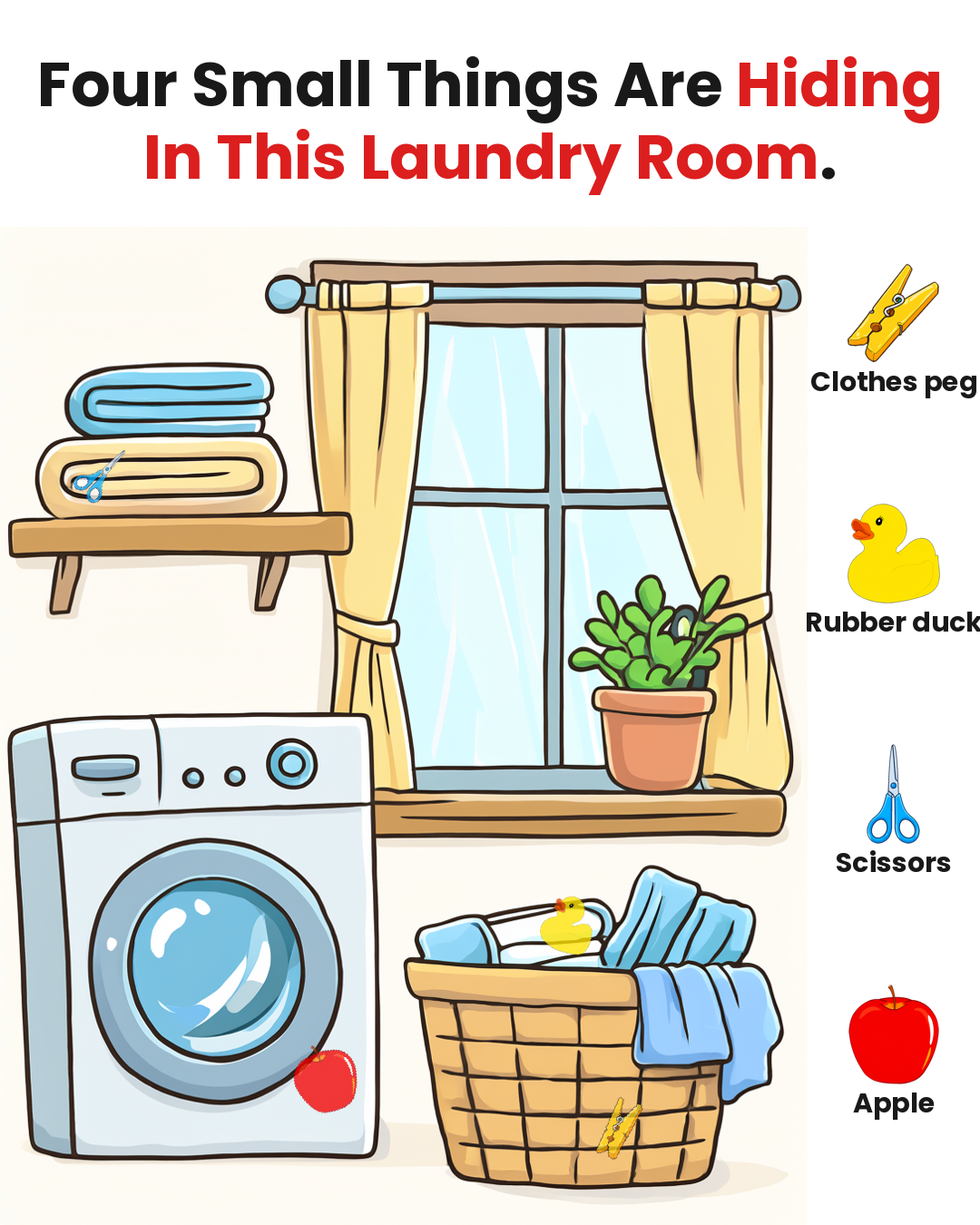
Take your time and look closely before you scroll down!
Hunt By Object, Not By Corner
When most people start a hidden object picture, they sweep their eyes across the whole scene hoping that something will jump out. Occasionally something does, and then the search stalls completely, because the eyes have nothing specific left to look for.
A far better method is to take the four objects one at a time. Look at the clothes peg on the right, fix its shape and its pale wooden colour in your mind, and then search the picture for that one thing only. When you have found it, move on to the duck, and so on.
This works because your brain searches much faster when it has a single clear target. Hunting for one shape at a time feels slower, but it finishes the whole picture in less time than four half-hearted sweeps ever will.
Where Small Things Love To Hide
Objects in pictures like this are rarely hidden behind anything. They are usually sitting in full view, placed somewhere that your eyes have already decided is unimportant. Flat surfaces that are busy with texture, like a woven basket or a pile of folded cloth, are perfect for the job.
Colour matters just as much as position. A yellow object placed against a yellow curtain practically disappears, while the same object on a blue towel would shout at you. Puzzle makers call this camouflage by context, and it works on even the sharpest eyes.
The third great hiding place is the edge of something large. We read a picture by its big shapes first, so anything resting against the rim of a basket, the corner of a shelf or the door of a machine sits in a kind of blind spot while we take in the furniture.
From Puzzle Books To The Kitchen Table
Hidden object pictures have delighted families for well over a century. Victorian printers sold puzzle cards showing a forest or a farmyard with faces concealed in the leaves, and children spent whole rainy afternoons searching them.
In the twentieth century the idea became a fixture of children’s magazines, and many of us first met it in a waiting room somewhere, with a pencil and a page of black and white drawings. The format survived because it asks nothing of the solver except attention.
There is a practical side to it too. Search tasks of this kind are used to train people who must inspect photographs, luggage scans and medical images for a living. The same skill that finds a rubber duck in a laundry basket is the skill that spots a tiny detail that really matters.
Four Objects, One Minute
Here is the friendly challenge. Most people find the first two objects within about fifteen seconds, then slow right down. The average time to find all four is close to a minute, and plenty of people never find the fourth at all without a hint.
If you get stuck, change how you look rather than where you look. Lean back from the screen so the picture becomes smaller, or tilt your head slightly. Both tricks break the pattern your eyes have settled into and often reveal the last object straight away.
When you have all four, pass the picture to somebody else and time them without saying where anything is. Watching a friend stare at an object for twenty seconds before seeing it is one of the great small pleasures of life.
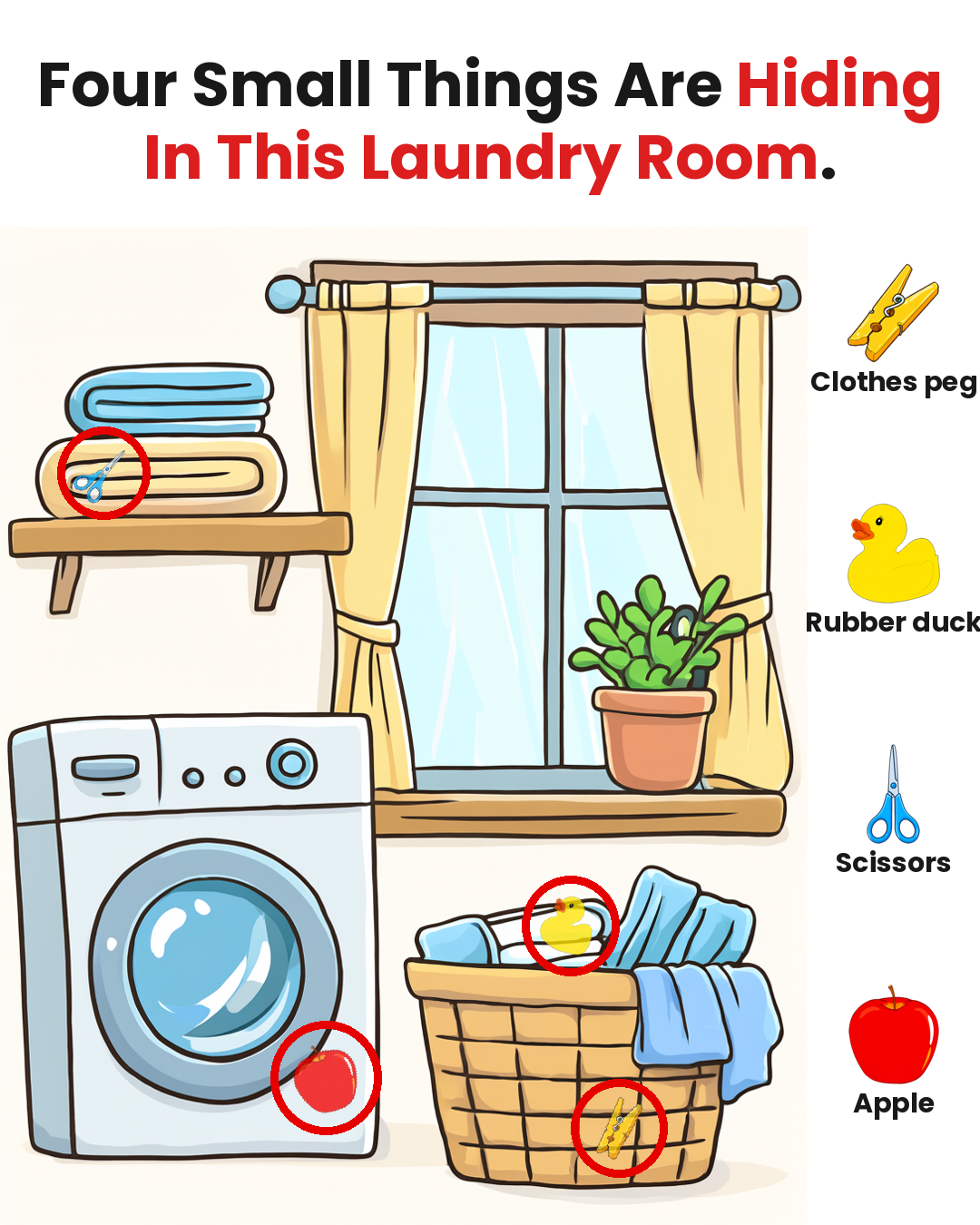
ANSWER: The scissors lie on the folded towels on the shelf, the rubber duck sits in the laundry basket, the clothes peg is clipped to the front of the basket, and the red apple rests on the washing machine door.
All Four, One By One
Start at the top left of the room. On the wooden shelf, lying flat across the lower folded towel, is the pair of blue handled scissors. They are small and pale and they sit along the same direction as the stripe on the towel, which is why so many eyes slide past them.
Now come down to the laundry basket at the bottom right. Peeping over the rim, among the blue towels, is the little yellow rubber duck. He is the one most people find first, because yellow against blue is about as loud as a colour pairing gets.
The clothes peg is clipped to the woven front of that same basket, low down in the middle. Its pale wood is almost exactly the colour of the basket itself, and the vertical weave of the straw hides its shape beautifully. Finally, look at the washing machine: the small red apple is resting against the bottom right of the round door.
Why The Peg Is The Hardest One
Three of the four objects stand out by colour. The red apple, the yellow duck and the blue scissor handles are all clearly different from what surrounds them. The clothes peg has no such advantage, because it is wooden and the basket is wooden too.
On top of that, a clothes peg is a perfectly sensible thing to find in a laundry room. Your mind accepts it as part of the furniture and never flags it as unusual, even while your eyes are passing over it. Objects that belong in a scene are always harder to notice than objects that do not.
The apple is the opposite case. It makes no sense at all in a laundry room, yet it hides well because it sits against the curved machine door, exactly on the line where your eye naturally follows a shape rather than inspecting it.
How Did You Do?
All four in under thirty seconds: outstanding. You have the eyes of a professional proofreader.
All four in under a minute: an excellent score, and better than most people manage on their first attempt.
Three out of four: very respectable, and the one you missed was almost certainly the clothes peg on the basket.
Two or fewer: do not be disheartened for a moment. Look again at the shelf with the towels and at the front of the laundry basket, and the last two will appear as though somebody had just put them there.