Hello again, puzzle friends, and welcome to a walk in the woods!
Today we are standing in a sunny forest clearing where the grass is soft and the air smells of pine.
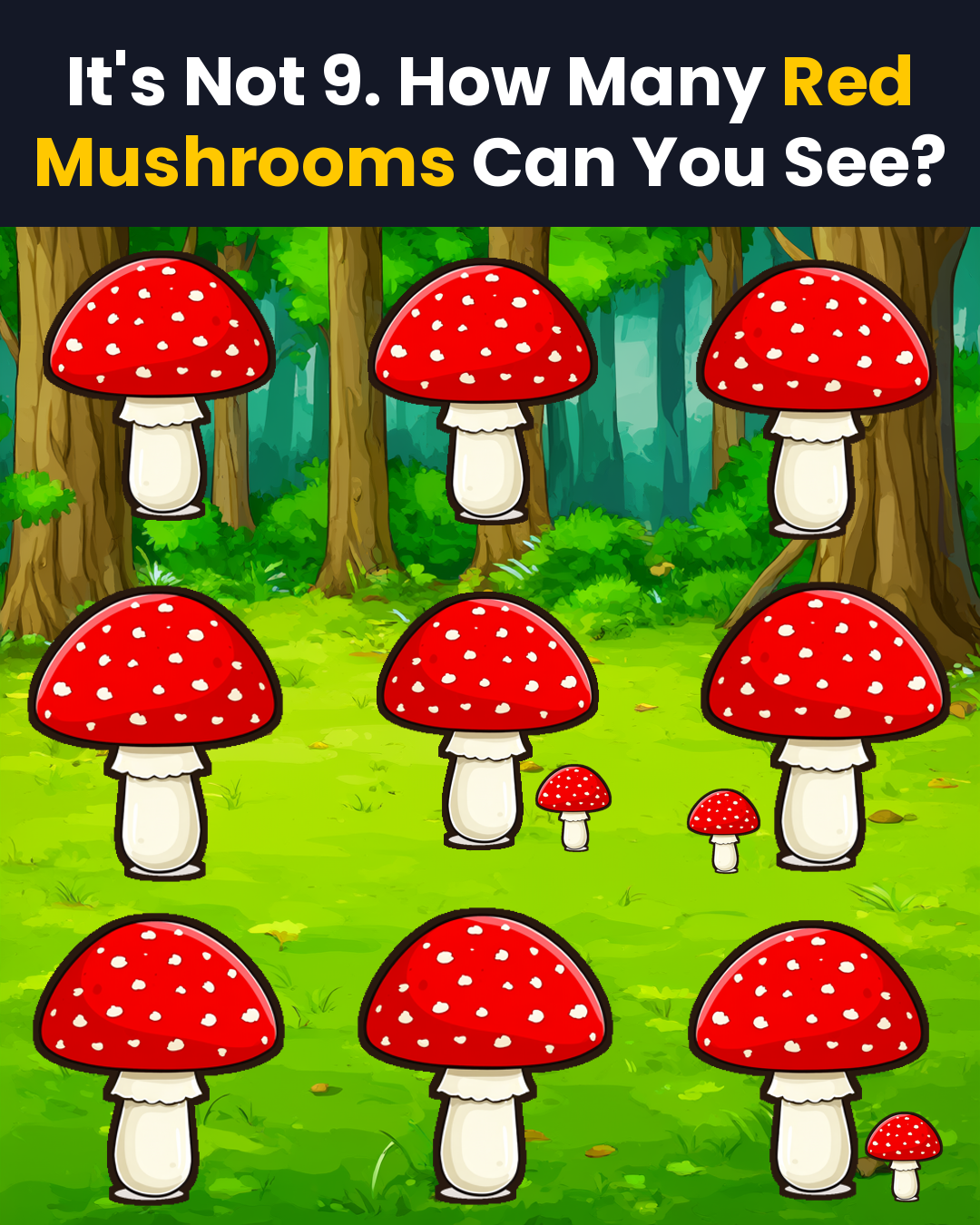
Somebody has left a whole family of bright red mushrooms with white spots scattered across the moss.
Your job is simple to say and not so simple to do: count every single red mushroom you can see.
Most people glance at the picture, count the big ones in a hurry, and give a number right away.
That is exactly how a wrong answer happens, because not every mushroom in this clearing is a big one.
Take a slow breath, look at the whole clearing, and count carefully before you decide.
The correct number is waiting at the bottom of the page, so no peeking until you are ready.
Take your time and look closely before you scroll down!
Count With A Route, Not With Your Eyes
Counting sounds like the easiest task in the world, right up until the objects are spread across a whole picture. Then our eyes begin to wander. We count one mushroom twice, skip another completely, and end up with a different total every time we try.
The cure is to give yourself a route and refuse to leave it. Start in the top left corner, move straight across to the right, then drop down to the next row and cross back again. Treat the clearing like a field you are mowing, one neat stripe at a time, and your eyes will stop jumping around.
It also helps enormously to count out loud, or to tap the table once for each mushroom you find. Saying a number turns a quick glance into a decision, and a decision is much harder to forget than a glance. Many people who repeat this picture after using a route get the right total on their very first attempt.
Why The Small Ones Slip Away
Our brains are wonderfully efficient, and that efficiency is exactly what trips us up here. When you look at a scene, your mind quickly decides what kind of thing it is looking at and then builds an expectation. Here the expectation is a big red cap on a thick pale stem, standing proudly above the grass.
Once that picture is set, anything that does not match the template gets quietly filed away as background. A mushroom that stands only a few inches high, half tucked beside a larger neighbour, simply does not fit the shape your mind is hunting for. Your eyes pass right over it without ever reporting it to you.
Colour plays a part too. The deep green of the moss and the bright red of the caps sit on opposite sides of the colour wheel, which makes the large mushrooms pop. But when a tiny cap sits in the shadow of a big one, that lovely contrast is lost, and the little fellow blends into the clutter of stems and grass.
Mushrooms, Fairy Rings And Old Stories
Red mushrooms with white spots have been drawn in storybooks for hundreds of years, long before anyone made a puzzle out of them. They appear in old European folk tales, in garden ornaments, and in nearly every illustrated fairy book you ever read as a youngster.
Real mushrooms often grow in patterns, including the famous circles that country people once called fairy rings. Farmers used to say that dancing fairies had worn the grass down overnight. The truth is more ordinary and just as pretty: the fungus grows outward from a single point underneath the ground, year after year, and the mushrooms pop up along the edge.
That habit of growing in clusters is what makes mushrooms such a fine subject for a counting puzzle. In nature a big mushroom and its small neighbours really do stand side by side, so nothing in this picture looks forced or unnatural. The trick is hiding in plain sight, exactly where a real forest would put it.
So, How Fast Can You Do It?
Here is the friendly challenge. Most people land on their first answer in about eight seconds, and most of those first answers are wrong by two or three. Those who slow down and use a proper route usually need around thirty seconds, and they are the ones who get it right.
Try it twice. Count once quickly, the way you naturally would, and write that number on a scrap of paper. Then count again slowly, row by row, and see whether the two numbers match. The gap between them tells you something interesting about how your own eyes work.
When you have your final number, share the picture with a friend or with somebody in your family and ask them for theirs. Comparing two confident but different answers is half the fun, and the quiet pleasure of being right is the other half.
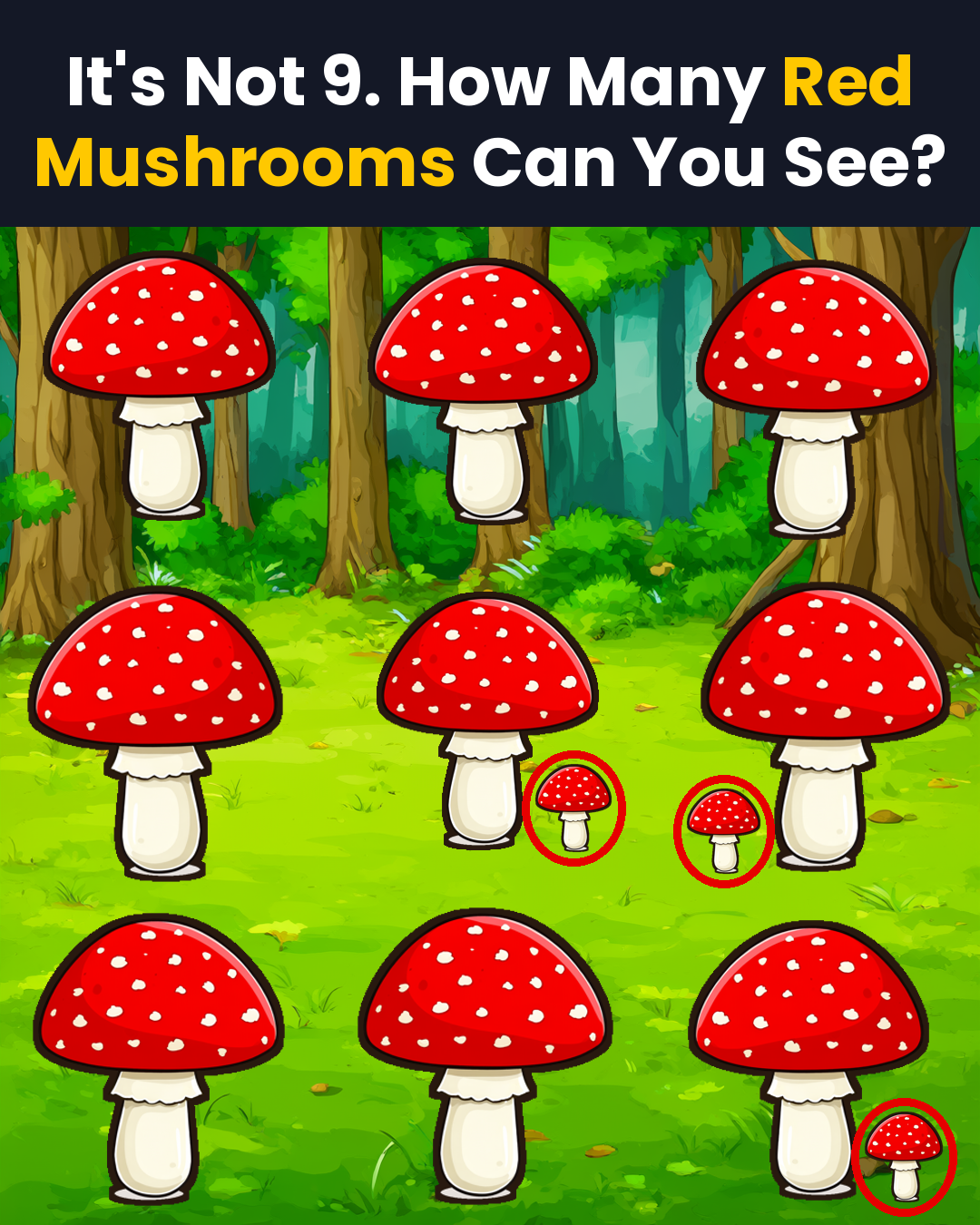
ANSWER: 12 mushrooms – nine big ones and three little ones tucked beside them.
Where The Missing Mushrooms Are Hiding
The picture holds nine large mushrooms, arranged in three comfortable rows across the clearing. Almost everybody finds all nine without any trouble, which is why nine is such a popular first answer, and why it is not the right one.
Three more mushrooms are in the picture, and all three are small. One sits in the middle of the clearing, right beside the stem of the centre mushroom, low down in the grass. A second stands just to its right, a little further along, almost touching the big mushroom on the right of the middle row. The third is tucked into the bottom right corner, close to the base of the last large mushroom, where the edge of the picture draws your attention away.
Nine big ones plus three little ones makes twelve. Once you have seen the small ones, you can never unsee them, and the picture looks completely obvious the second time around.
Why So Many People Say Nine
The large mushrooms are laid out in a tidy pattern of three rows of three. That pattern is comforting, and your mind loves a comforting pattern. As soon as it recognises a neat grid, it quietly announces that the job is done and offers you the number nine.
The three small mushrooms sit in the gaps between rows rather than inside the grid, so they fall outside the shape your mind has already decided to trust. Add their size, which is less than a third of their big neighbours, and they become easy to dismiss as pebbles, leaves or a bit of shadow on the moss.
This is the same reason we walk past a familiar object on a shelf for weeks without noticing it has moved. The pattern is already stored, so the eyes stop checking.
How Did You Do?
Under ten seconds with the correct answer of twelve: you have eagle eyes, and you count like someone who has done this many times before.
Ten to thirty seconds: excellent work. You resisted the easy answer and took the time to check the corners, which is exactly the right habit.
Thirty seconds to a minute: a very good result. You found the small ones, and that is what matters, not the clock.
More than a minute, or an answer of nine, ten or eleven: you are in very good company, because this picture catches most people on the first try. Look again at the middle of the clearing and at the bottom right corner, and the last three will jump out at you.