
Hello, puzzle friends, and welcome into the greenhouse!
The glass is warm, the shelves are crowded with pots, and the watering cans are all in a muddle by the door.
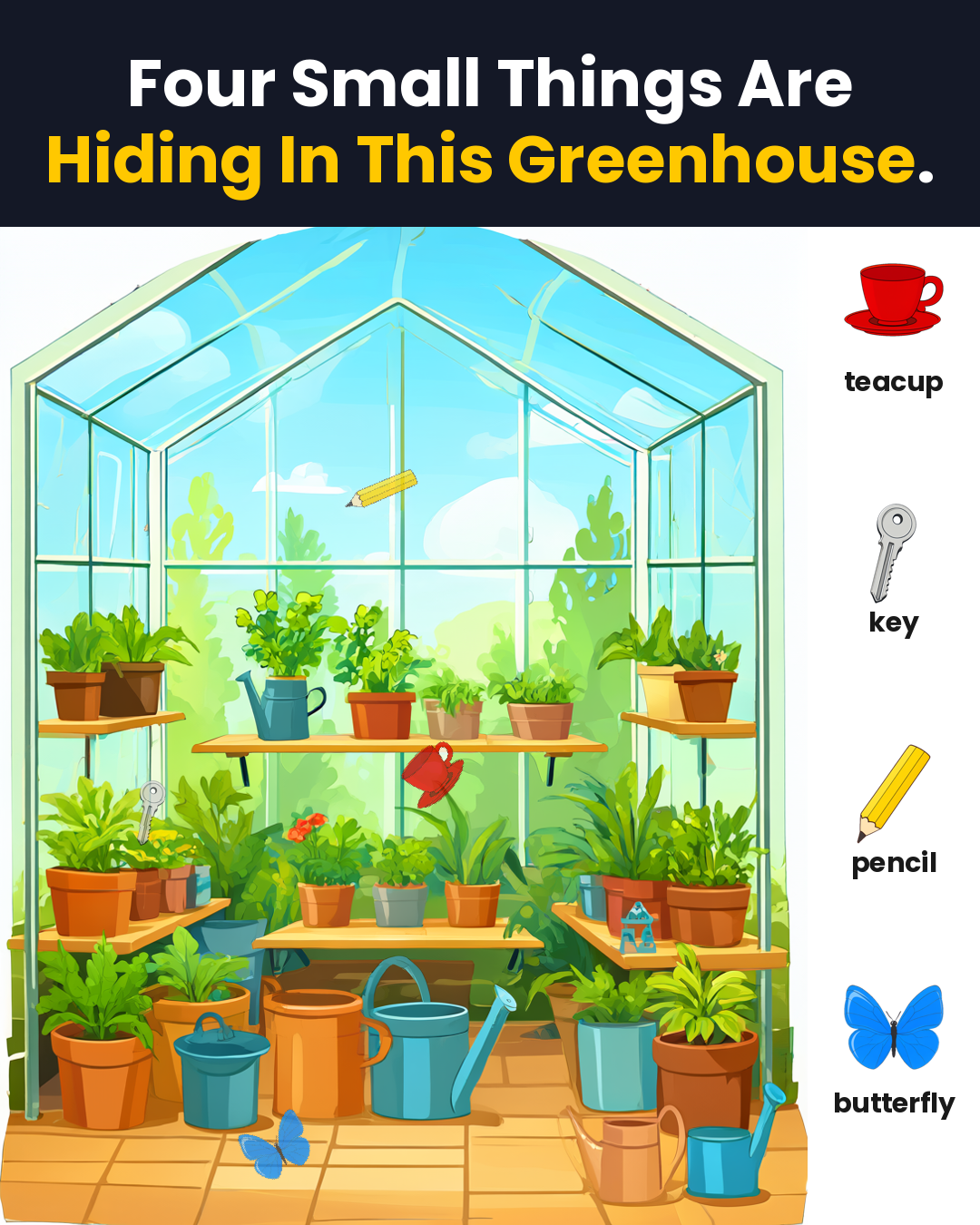
Somewhere among those leaves, four small things have gone missing: a red teacup, a silver key, a yellow pencil and a blue butterfly.
You can see all four of them in the little row beside the picture, so you know exactly what you are hunting for.
They have not been shrunk to specks and they are not behind anything – they are simply sitting where the eye does not expect them.
Look high as well as low, and remember that glass can hold a surprise too.
Can you find all four before the kettle boils?
Take your time and look closely before you scroll down!
Hunt One Object At A Time
The great temptation in a hidden object picture is to search for all four things at once. It feels faster, and it is the reason people stare at a scene for two minutes and find nothing at all. The eye can only hold one target properly, and four blurred targets become no target.
Pick the teacup first, because red is the easiest colour to spot, and sweep the whole picture for red and nothing else. Then do the same for the yellow pencil, then the silver key, then the blue butterfly. Four short, clean sweeps beat one long and hopeful stare every time.
It also helps to divide the greenhouse into bands: the roof, the top shelf, the middle shelf, the floor. Finish a band before you leave it, and nothing can hide in the gap between two glances.
Why A Busy Scene Beats Our Eyes
A greenhouse is one of the hardest backgrounds there is, because it is made of repetition. Leaf after leaf, pot after pot, with the same greens and the same terracotta curves everywhere you look. The brain quickly decides it has understood the pattern and stops inspecting the details.
This is the same shortcut that lets you walk through your own kitchen without bumping into the table, and it is wonderfully useful ninety nine times out of a hundred. In a puzzle it simply hides things from you.
There is one more difficulty here. We expect objects to rest on something solid, so we search surfaces: shelves, tables, the floor. Anything floating in mid air, against the glass, falls outside the places we think to look.
A Tradition Of Hidden Pictures
Hidden object pictures have delighted readers for well over a century. American children’s magazines made them famous in the nineteen forties with line drawings in which umbrellas, spoons and pencils were tucked into tree bark and curtain folds, and families worked through them together on a Sunday afternoon.
The form survives because it rewards patience rather than cleverness. There is no trick to learn and no knowledge to look up, only the quiet satisfaction of noticing something that was in plain sight the whole time.
The Friendly Challenge
Most people find three of the four objects inside thirty seconds and then spend another full minute hunting the last one. If you can get all four in under forty seconds, you have done better than almost everybody.
When you are done, hand the picture to somebody else without saying which object is the hard one. Watching a friend search the same shelf three times, while the answer sits quietly above their head, is the best part of the whole game.
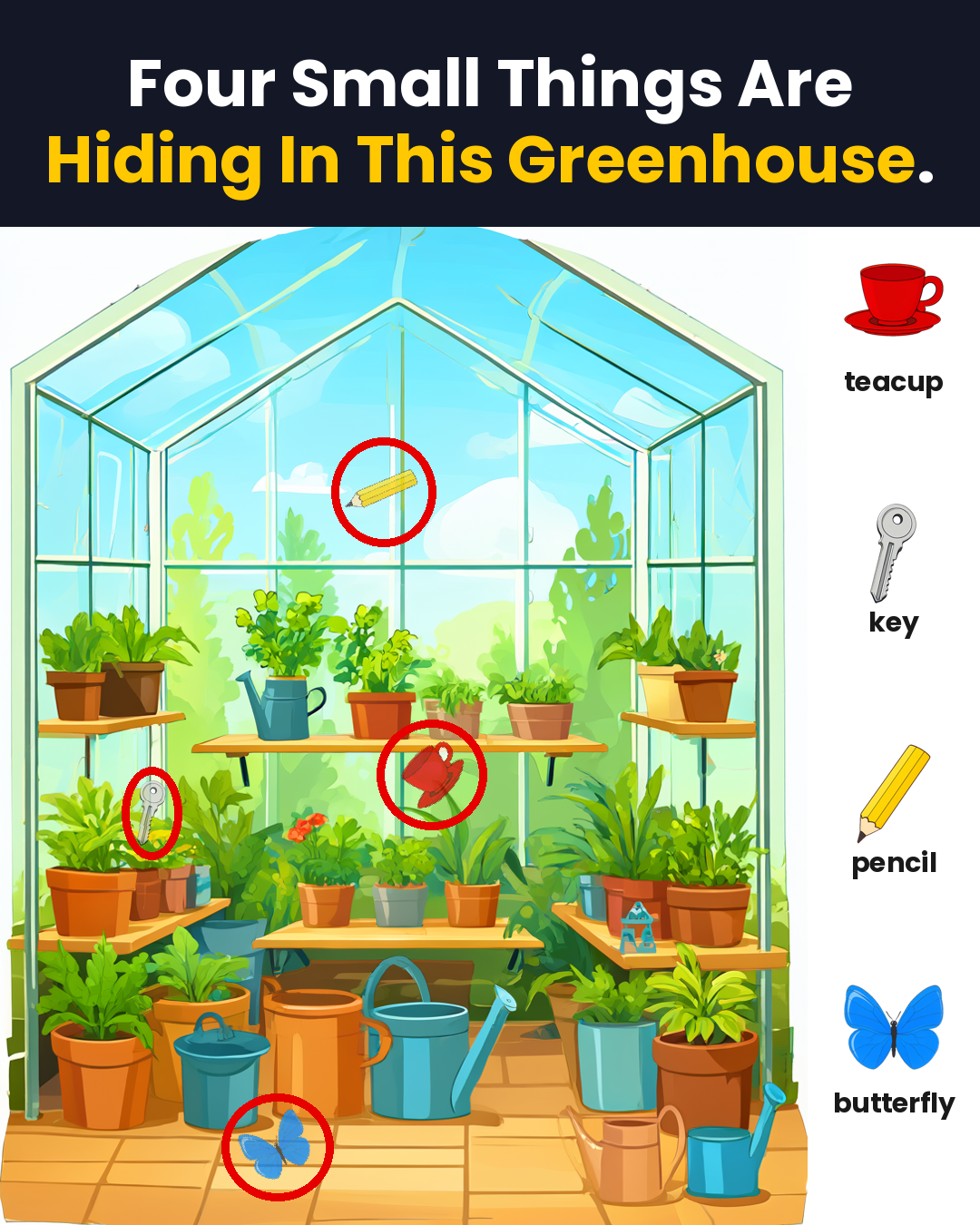
ANSWER: The pencil is floating high up against the glass roof, the red teacup sits on the middle shelf beside the plants, the silver key hangs among the leaves on the left, and the blue butterfly rests on the tiled floor at the bottom.
Where All Four Were Hiding
The yellow pencil is the highest of the four. It is up near the peak of the greenhouse, floating against the glass with the blue sky behind it, which is the last place anybody thinks to search.
The red teacup is sitting in the middle of the picture on the long wooden shelf, just in front of the little pots of herbs. It is the brightest of the four and usually the first one found.
The silver key hangs on the left, among the leaves of the big plant beside the terracotta pots. Its soft grey is very close to the colour of the shaded foliage around it.
The blue butterfly has settled on the tiled floor at the bottom left, near the blue watering cans, where its colour blends straight into theirs.
Why The Key Is The Hard One
Three of these objects are bright and solid colours. The key is not: it is silver, and silver takes on whatever is around it. Against dark green leaves it reads as a reflection or a stray highlight, and the brain files it under scenery.
The butterfly is the second trap for a different reason. It is the right colour to belong beside the blue cans, and anything that looks like it belongs is almost invisible. If you had searched for shapes instead of colours, both would have come to you much faster.
How Did You Do?
All four in under twenty seconds: remarkable – you have the eyes of a professional gardener.
Under a minute: very good indeed, and well ahead of the average.
One or two minutes: a solid, careful search, and you surely got the key the honest way.
And if one object held out on you to the very end, it was almost certainly the silver key. It hides from nearly everyone.