Hello, puzzle friends!
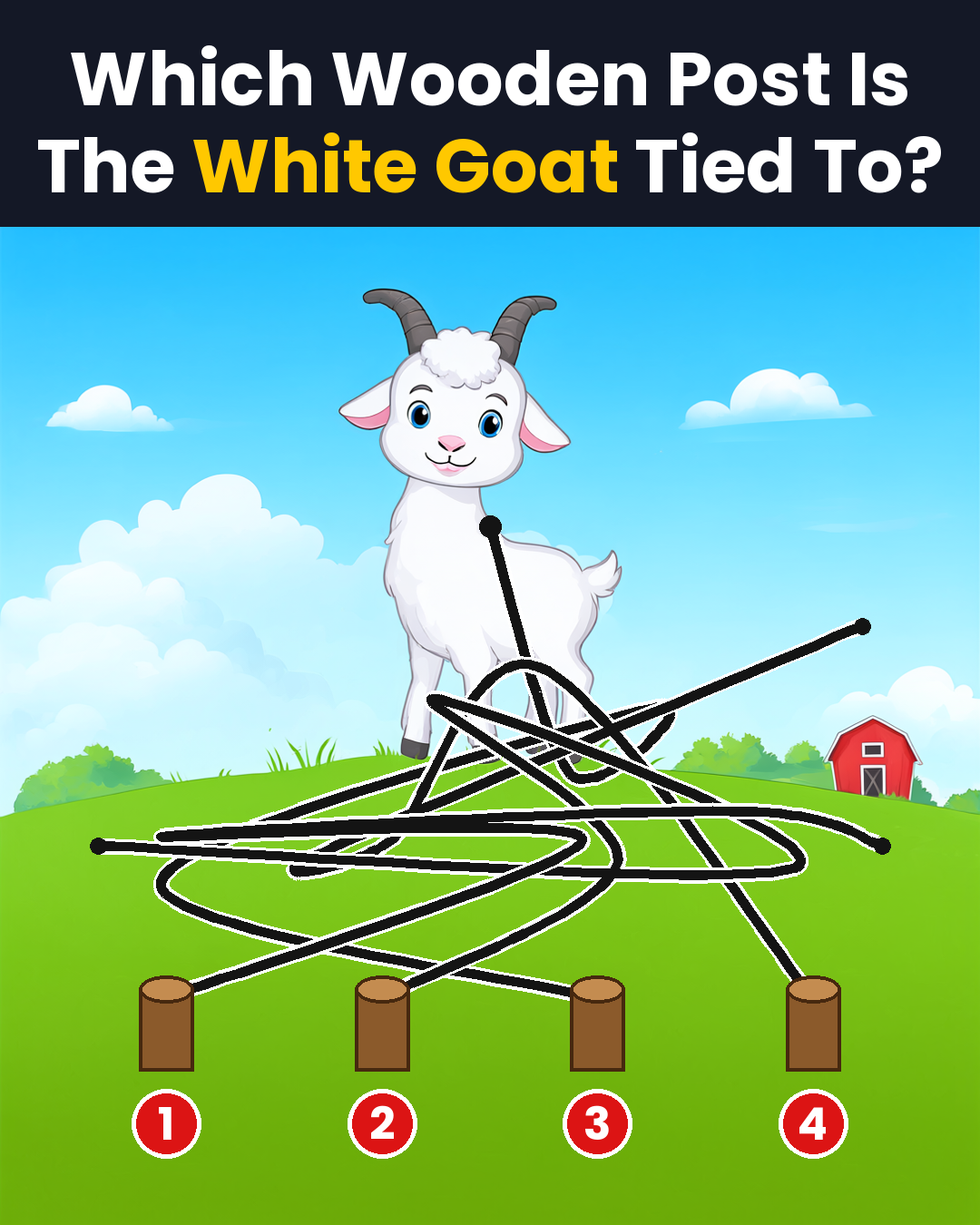
Out in the meadow this morning there is a cheerful white goat with little grey horns, standing on the top of a green hill.
Someone has tied her up with a long rope, and four short wooden posts are standing in a row along the bottom of the picture.
The trouble is the rope. It loops, it crosses, it doubles back on itself, and three other ropes lie tangled in the grass beside it.
Only one of those posts is holding our goat, and the rest are there to lead you astray.
Start at the goat and follow her rope with your eyes, slowly, without jumping across the crossings.
Choose your post before you scroll down, and no peeking at the answer!
Take your time and look closely before you scroll down!
Follow The Rope, Do Not Chase It
The honest way to solve this puzzle is to start at the goat, not at the posts. Put your eye on the knot at her chest and move along the rope a little at a time, the way you would run a thread through your fingers.
The danger is always at the crossings. Where two ropes meet, your eye wants to carry on in a straight line, and that is exactly how people end up at the wrong post. At every crossing, stop for a moment, notice which rope passes in front and which passes behind, and then carry on along your own line.
If you lose your place, do not start again from the posts. Go back to the goat. The rope has one beginning and one end, and the beginning is the only part you can be completely sure about.
Why The Tangle Fools Us
Our eyes are built to see smooth, continuous lines. When one line disappears behind another and reappears on the far side, the brain joins the pieces up without asking permission. Usually this is a gift, because it lets us see a fence behind a tree as one fence. In a puzzle like this it is a trap.
The curves make it worse. A rope that doubles back on itself asks you to reverse direction, and reversing direction is the one thing a fast-moving eye hates to do. Most wrong answers happen at a loop, not at a crossing.
There is also a little bit of gravity in our thinking. We expect a rope to fall straight down to the nearest post, so the post directly below the animal feels right long before we have traced anything at all.
An Old Puzzle With A Long Rope
Tangled line puzzles have been entertaining people for well over a century. Victorian puzzle books were full of them, usually drawn as a kite string, a fishing line or a knotted ribbon, and children were given them to practise patience as much as logic.
The same idea lives on in the mazes on a restaurant placemat and in the wiring diagrams an electrician reads at work. Follow one line, ignore the rest. It is a small skill, and a surprisingly useful one.
Some researchers like these puzzles because they show how carefully we can look when we decide to slow down. The picture never changes. Only the way we read it does.
Can You Beat The Clock?
Most people need between twenty and forty seconds to trace this rope properly. Anyone who answers in five seconds has guessed, and the guess is usually the post straight under the goat.
Try it once at your own speed, then try it again and see how fast you can be while still being sure.
When you have your post, send the picture to a friend and ask them for a number. Comparing two confident and completely different answers is the best part of this puzzle.
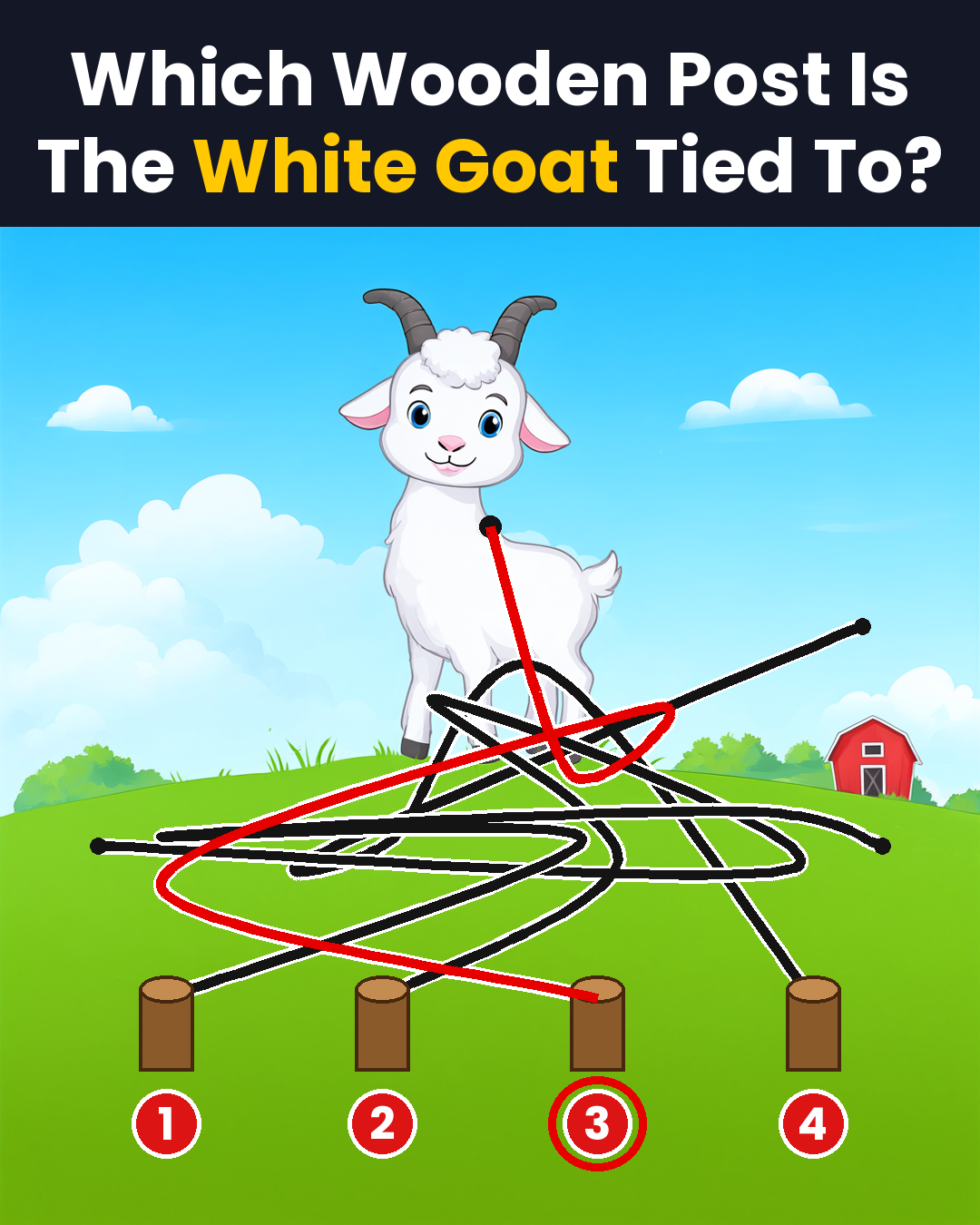
ANSWER: Post 3 – the goat’s rope loops to the right, swings back through the tangle and ends at the third post.
Where The Rope Really Goes
The goat’s rope leaves her chest and runs down to the right, into the middle of the tangle. It curves up and over in a wide arc, then turns sharply back towards the left, dipping below the other ropes as it goes.
From there it sweeps down across the meadow in a long, gentle diagonal, passing over two other ropes on the way, and comes to rest at the top of the third wooden post, the one marked with the number three.
In the marked picture that path is drawn in red, and once you see it you cannot unsee it. The rope never touches posts one, two or four. The lines that arrive at those posts all begin somewhere else in the grass.
Why Most People Pick The Wrong Post
The first rope you meet after leaving the goat is not her rope at all. It crosses hers almost at once, running from the upper right down to the lower left, and the eye follows it happily because it points in a believable direction.
The loop is the second trap. Where the goat’s rope turns back on itself, you have to reverse direction, and most people simply carry straight on into a neighbouring line without noticing the change.
There is one more reason. Post three sits slightly right of centre while the goat stands dead centre, so the correct answer is never the one that feels obvious from the start.
How Did You Do?
Correct in under ten seconds: remarkable. You traced the rope rather than trusting your first impression.
Ten to thirty seconds: a very good result, and the sign of someone who stops at every crossing.
Thirty seconds to a minute: the honest middle, where most careful people land.
Picked the post straight under the goat: do not feel bad. That answer catches more readers than every other mistake put together.