Hello again, puzzle friends!
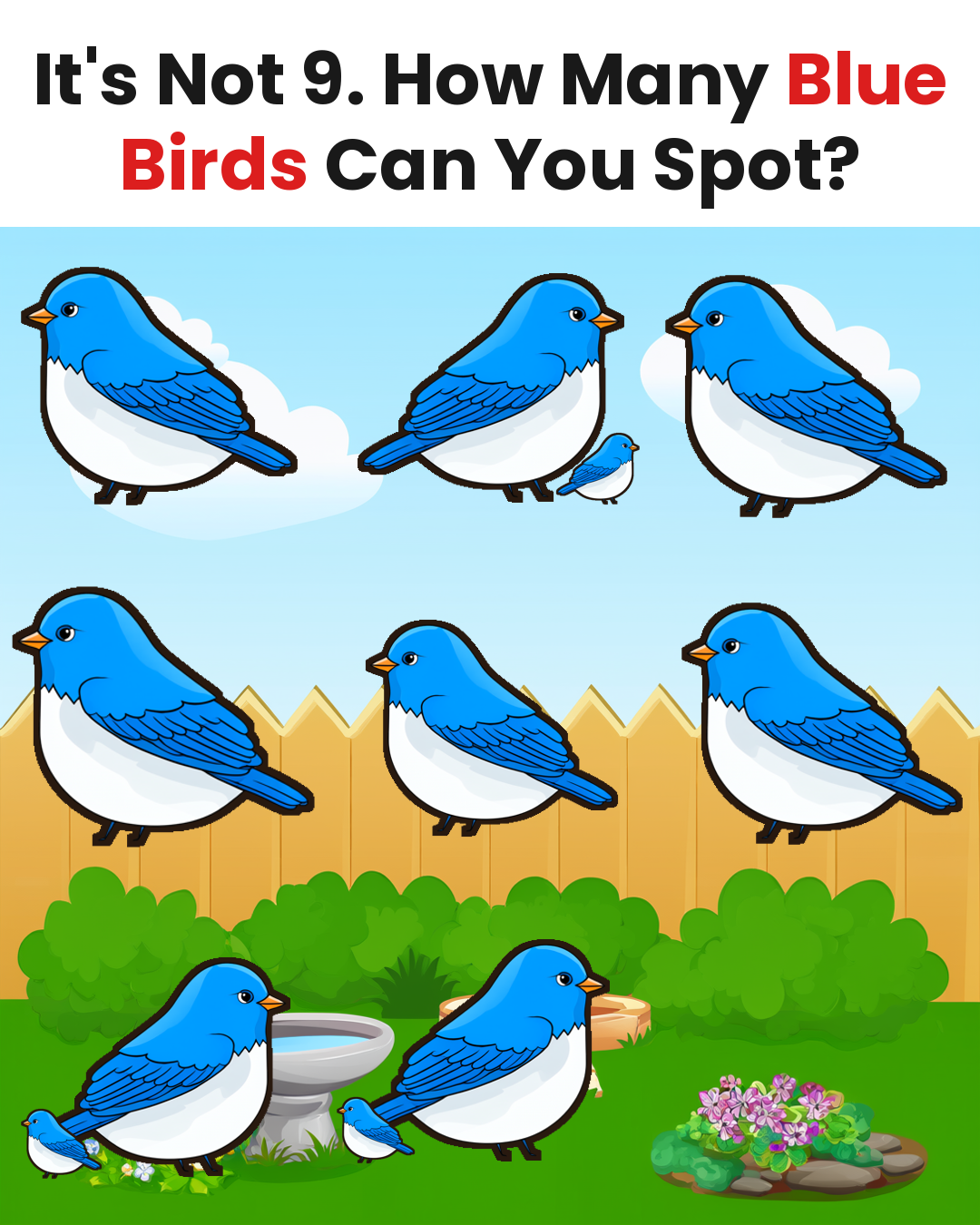
Today we are spending a quiet morning in a sunny backyard garden.
The fence is freshly painted, the bushes are green, and the birdbath is full of clean water.
Word has got around the neighbourhood, and the blue birds have come to visit.
Your job is simply to count them, which sounds easy enough until you begin.
The large birds are easy, but they are not the only ones in the picture.
Look beside the big ones, down in the grass and along the very edges.
Take your time, count twice, and only then decide on your final number.
Take your time and look closely before you scroll down!
Give Your Eyes A Route
The biggest reason people get counting puzzles wrong is not poor eyesight. It is wandering. Our eyes jump about the picture, land on the same bird twice and skip another one completely, and the total comes out short.
The cure is simple. Decide on a route before you start and refuse to leave it. Begin in the top left corner, sweep across to the right, drop down one band and come back the other way, exactly as you would read a page of a book. When you finish a band, it is finished. Do not look back at it.
The second habit worth keeping is counting in small groups. Rather than running one, two, three all the way to the end, total each band on its own and add the bands together at the finish. Three bands of four are far easier to hold in your head than a single run of twelve, and if you lose your place you only have to redo one band instead of the whole garden.
Why Our Brain Likes To Round Down
There is a lovely piece of science behind this. Up to about four objects, people can see the number instantly without counting at all. Researchers call this subitizing, and it is the reason three apples on a table never need counting.
Past four, the shortcut stops working and we have to count properly, one item at a time. But the brain does not like slow work, so it tries to carry on guessing. It takes in the general look of the picture, decides it feels like about nine birds, and hands you that number with great confidence.
There is a second trap as well. Once your brain has decided what a blue bird looks like in this picture, it builds a mental template of a large bird. Anything much smaller does not match the template, so it is quietly filed away as scenery rather than counted. That is exactly how a small bird can sit in plain sight and still be missed by almost everyone.
A Puzzle With A Long History
Counting pictures are far older than the internet. Victorian magazines printed puzzle pages where readers were asked to count the sheep in a field or the faces hidden in a tree, and whole families would argue over the answer until the following week’s issue arrived.
The same idea was later used by schoolteachers, because counting a crowded drawing teaches children to work in an orderly way rather than guessing. It turns out adults benefit just as much. A few minutes of careful counting is good practice for any task that asks you to be thorough, from checking a shopping list to reading a form properly.
Bird counting in particular has a real tradition behind it. Every winter, thousands of volunteers around the world spend a morning counting the birds in their own gardens so that scientists can follow how the flocks are doing. They use the same trick you are about to use: a fixed route, a steady pace and no guessing.
The Friendly Challenge
Here is the challenge. Count the blue birds once at your normal speed and write the number down somewhere. Then count again, but start from the bottom right corner and work backwards. If both counts agree, you can be fairly confident. If they do not, the second count is usually the honest one.
Most people settle on their answer within thirty seconds and feel quite sure of themselves. Rather fewer end up with the correct total. The title has already warned you that the obvious number is not the right one, and that warning is there for a reason.
When you have your final number, show the picture to a friend or a family member without saying a word about what you found. Watching someone else count the same garden is half the fun, and you may be surprised how often two careful people come back with two different answers.
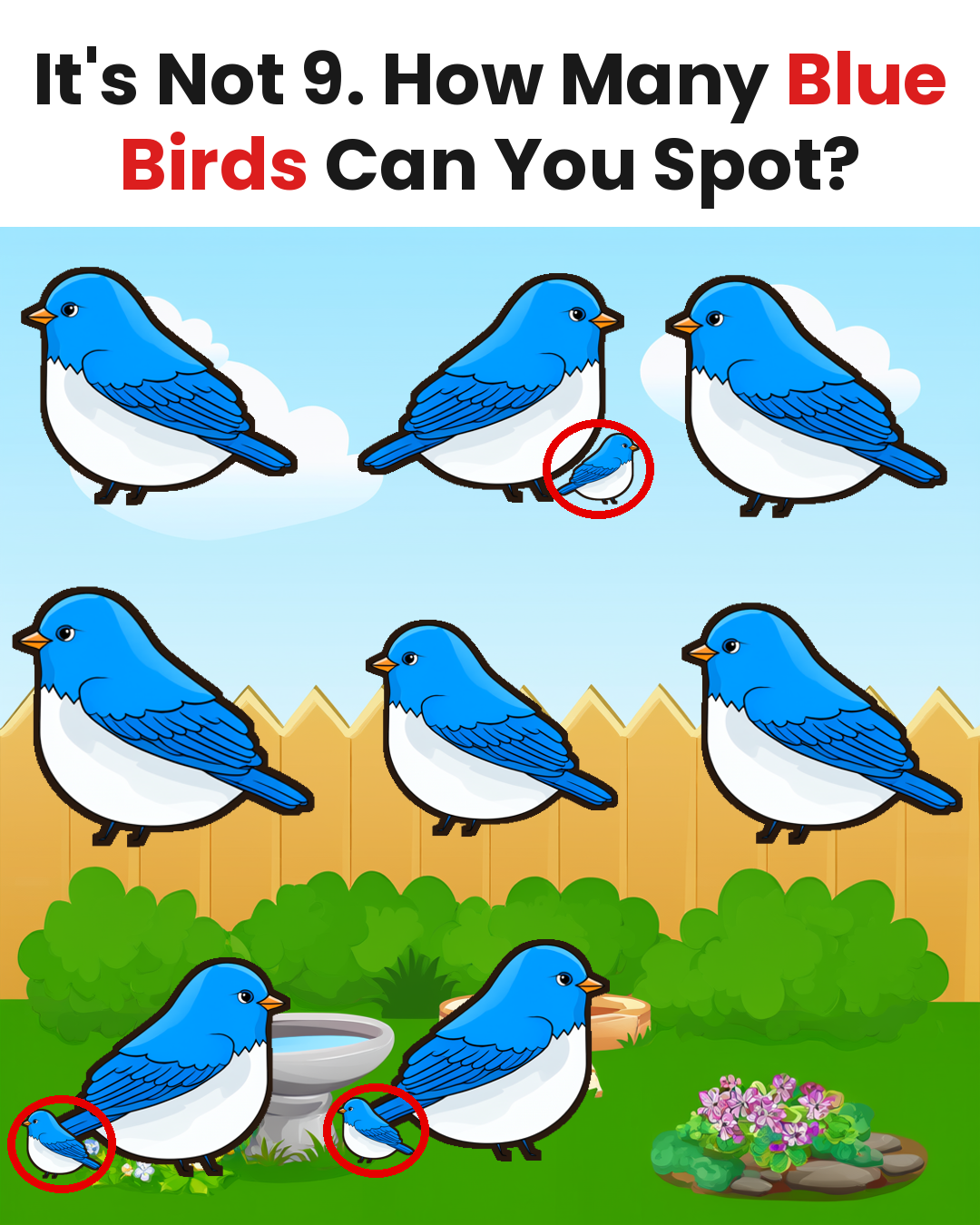
ANSWER: 11 blue birds – eight large ones plus three tiny ones tucked in beside them, near the birdbath and by the little flowers.
Where The Missing Birds Were Hiding
There are eleven blue birds in the garden, not nine and not ten. Eight of them are the large, obvious ones perched across the sky, along the fence and on the grass by the birdbath.
The other three are the reason this puzzle works. One tiny bird sits just below and to the right of the bird in the middle of the sky, so close that the two read as a single shape. The second is down in the bottom left corner, almost touching the big bird beside the little white flowers. The third is in the grass near the middle, tucked right against the tail of the bird standing by the birdbath.
Each small bird is perfectly visible. Not one of them is behind a bush or cut off by the edge. They are simply standing next to something larger and brighter, and that is enough to make most people’s eyes slide straight past them.
Why Almost Everyone Says Nine
Two things work against you here. The first is size. Your brain decides very early what counts as a bird in this picture, and the small ones fall outside that decision.
The second is closeness. When two shapes touch or overlap, we naturally read them as one object with a bump on the side rather than two separate things. Painters have used this for centuries to make a crowd look busy without drawing every face.
The way around both problems is to stop looking at the birds and start looking at the gaps between them. Run your eye along the grass line, the base of the fence and the bottom edge of the picture, where small details like to settle. Anything with a beak counts, no matter how little it is.
How Did You Do?
Under ten seconds with the right answer of eleven: truly remarkable eyes, and a very steady counting habit to go with them.
Ten to thirty seconds: excellent work. You counted properly instead of guessing, and you noticed that small shapes count too.
Thirty to sixty seconds: a fine result. Most people land here once they decide to go back and check the corners.
Over a minute, or a final answer of nine or ten: you are in the largest group of all, and in very good company. Now that you know the trick of hunting beside the big shapes rather than away from them, the next counting puzzle will feel much easier.