Hello, counting friends!
Today we are standing in a sunny meadow full of daisies and tulips.
Orange butterflies have come to visit, and your job is simply to count them.
It sounds easy, and that is exactly why this one catches so many people out.
The big butterflies are easy to see, but they are not the whole story.
Look between the wings, along the edges of the picture and down near the flowers.
Count once, then count again in a different order, and see whether you get the same number.
Take your time, and no peeking at the answer until you are sure!
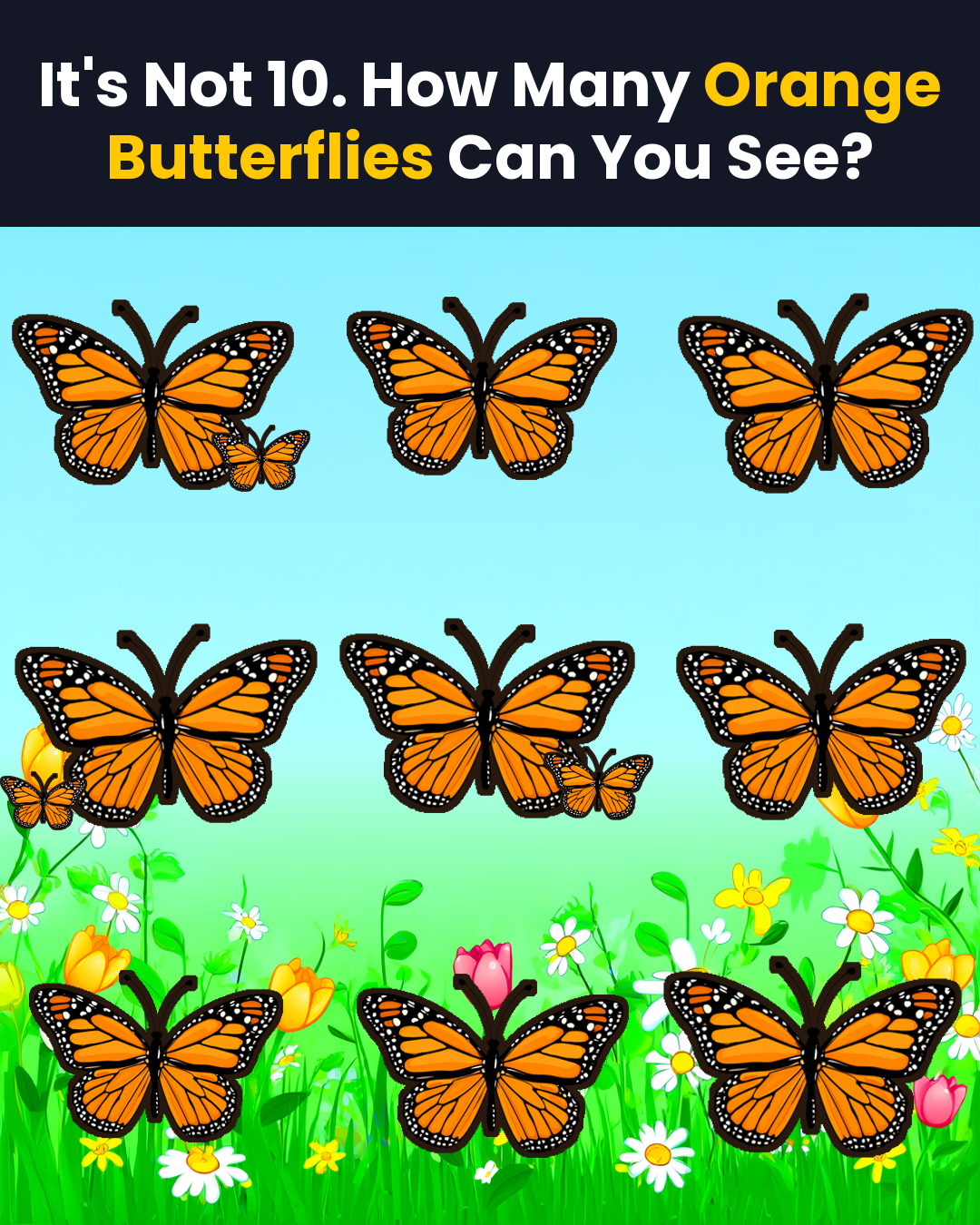
Take your time and look closely before you scroll down!
How To Count Without Losing Count
The safest way to count anything in a picture is to give yourself a route and stick to it. Start in the top left corner, move across to the right, then drop down one row and come back across to the left, like reading a page. Never let your eyes wander back to a row you have already finished.
The second rule is to count in small groups. Instead of saying one, two, three all the way to the end, take each row as its own little total and add the rows together at the finish. Three rows of four are much easier to hold in your head than a single long chain of numbers.
And the third rule, the one that decides this puzzle: do not count by colour, count by bodies. In a picture like this it is very easy to see a big orange shape and tick off one butterfly, when in fact two of them are overlapping. Look for each pair of antennae, and each one you find is a butterfly, no matter how small it is.
Why Counting Pictures Is Harder Than It Looks
Our brains are brilliant at estimating. Shown a handful of objects, we can tell at a glance whether there are three or four of them without counting at all. That gift is called subitising, and it works beautifully up to about four items.
Above four, we have to count one by one, and that is where mistakes creep in. Attention gets tired, the eyes revisit the same object, and an object sitting next to a bigger one is read as part of it rather than as something separate.
Size matters enormously. When the brain has decided that “a butterfly in this picture” is a large shape with wide wings, anything much smaller stops matching the template and is quietly filed as decoration, part of the flowers or part of the pattern on a bigger wing. That single habit is responsible for nearly every wrong answer in this kind of puzzle.
A Little Butterfly Lore
The orange butterflies in our meadow are drawn in the style of the famous monarch, with patterned wings and bold black veins. Real monarchs are known for one of the greatest journeys in the animal world, travelling thousands of miles between North America and their winter forests.
There is a nice link with puzzles here. The markings on a butterfly’s wings are nature’s own trick of attention: bright patterns that draw the eye to the wrong place while the body itself stays safe. Our puzzle does the same thing, only in flat colours on a sunny afternoon.
Your Challenge For Today
Most people come up with a number in about twenty seconds, and most of those numbers are too small. Count once quickly, write your answer down, then count again slowly in a different direction and see whether the two agree.
If you get two different numbers, the second one is usually the better one. And when you are finally certain, send the picture to a friend and ask them for their total before you tell them yours.
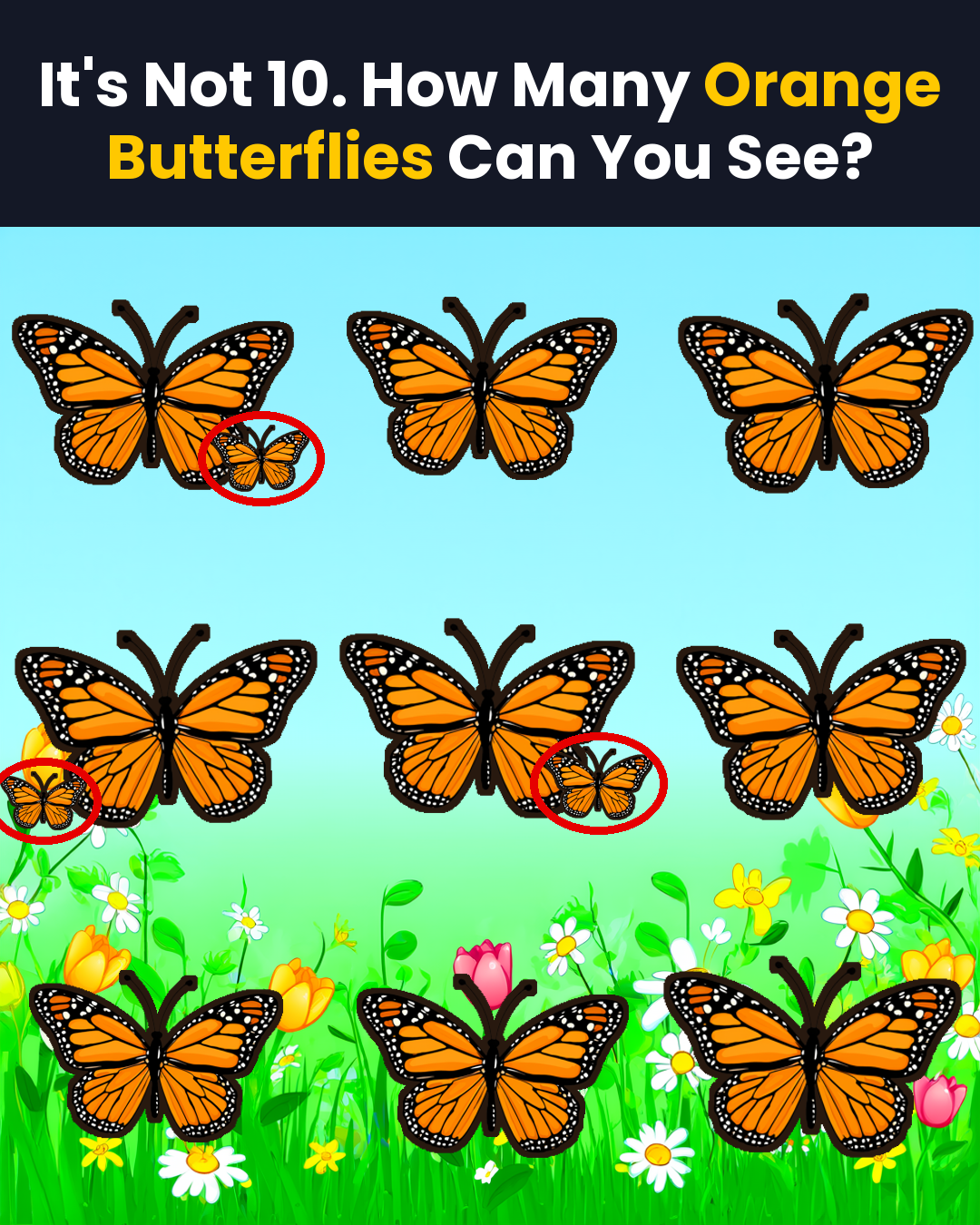
ANSWER: 12 butterflies – three tiny ones are hiding right next to the big ones, near the edges and in the middle.
Where The Hidden Ones Are
The correct answer is twelve. Nine large butterflies are easy to find: three across the top of the blue sky, three in the middle of the picture and three down among the grass and flowers.
The other three are tiny, and each one has tucked itself close to a big one. The first little butterfly sits just below the right wing of the butterfly in the top left corner. The second is on the far left edge of the middle row, almost touching the frame of the picture. The third is right in the centre, resting against the right wing of the middle butterfly.
They hide so well because of their size. Once your eye has decided what a butterfly looks like in this picture, the small ones no longer match that idea, and the brain treats them as part of the big wings beside them or as a splash of pattern. Sitting next to a large butterfly also hides them: we see one object with a busy edge instead of two separate creatures.
How Did You Do?
You said twelve straight away: eagle eyes, and a careful counter. You looked at the gaps and the edges rather than only at the obvious shapes.
You said eleven: so close. One little one slipped by, most often the one near the left edge of the middle row.
You said ten: a very common answer. You found one of the small butterflies and the other two blended into their big neighbours.
You said nine: you counted the big ones perfectly, and that is a good result in itself. Now look again at the picture with the three hiding places in mind, and you will never miss a small one again.