Hello, puzzle friends, and welcome into the craft room!
This is the cosy corner of the house where the yarn lives and the sewing table is always a little untidy.
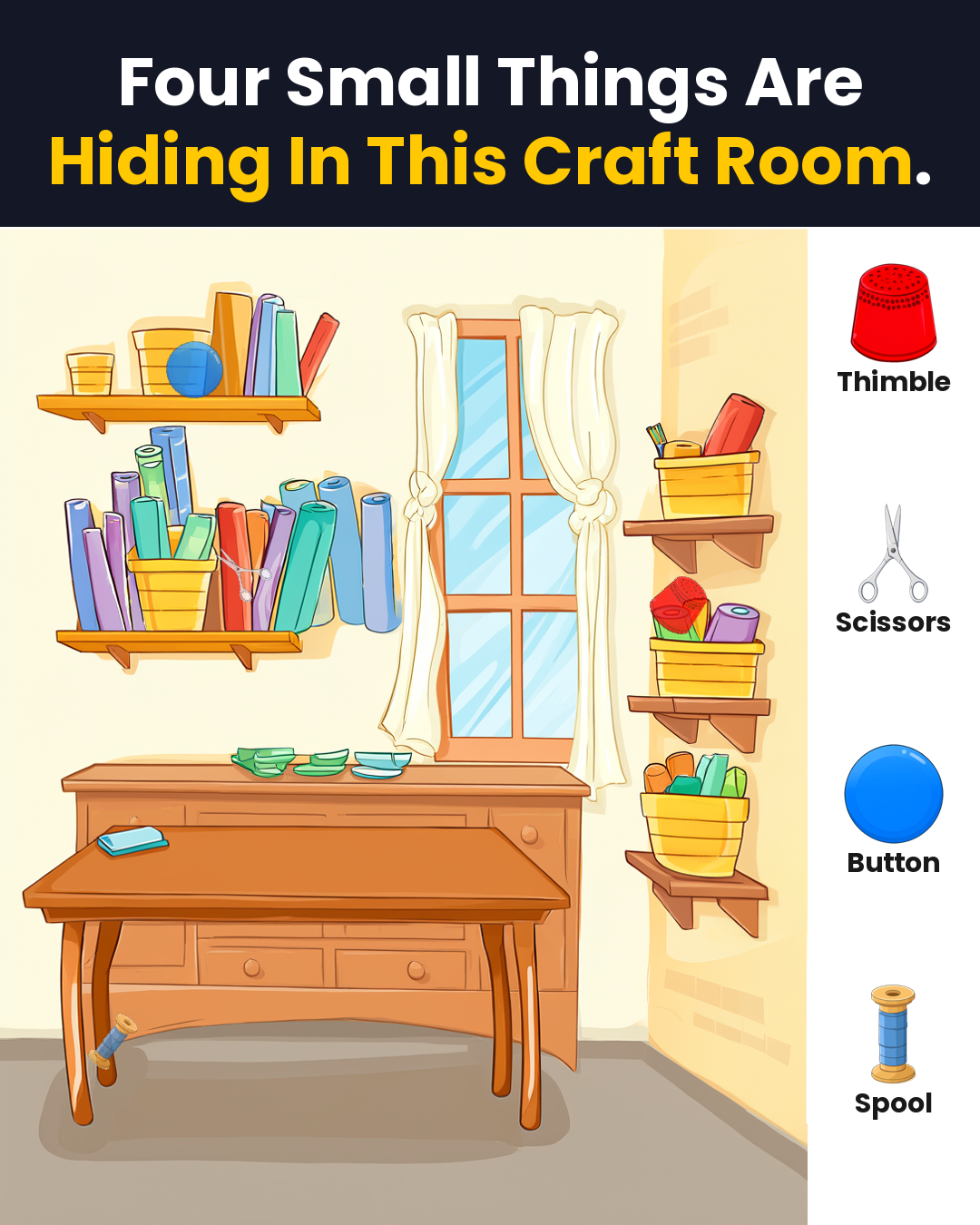
Four small things have gone missing in here, and they are all shown along the right-hand side of the picture.
A red thimble, a pair of silver scissors, a big blue button and a wooden spool of thread.
Every one of them really is somewhere in the room, in plain sight, no trickery.
A friendly tip: look at the edges, the corners and underneath things, where small objects love to sit.
Find all four before you scroll down – and no peeking at the answer early!
Take your time and look closely before you scroll down!
Search The Room Like A Grid
The natural thing to do with a busy picture is to let your eyes roam about and hope that something catches them. It feels like searching, but it is really just looking, and it is the reason people stare at the same scene for two minutes and still miss an object sitting in the open.
A better method is to turn the picture into a grid. Divide it into four quarters in your mind, then search one quarter at a time, top left first, and refuse to move on until you have really finished with it. Your eyes will keep trying to escape to the brightest corner of the room, so bring them back.
It also helps to search for one object at a time. Hold the shape of the thimble in your head and sweep the room for that shape alone. Looking for four things at once means your brain is holding four pictures at the same time, and it will quietly drop three of them.
Why A Small Object Can Hide In Plain Sight
Nothing in this room is truly covered up. Every one of the four objects is visible, yet most people still walk right past at least two of them. The reason is camouflage, and it works through colour, through size and through context.
When a small object sits against something of a similar colour, the edge between them almost disappears. Our visual system works by finding edges, so when the edge is weak, the object is never built into a separate thing in our mind. It is absorbed into the background instead.
Context does the rest. A craft room is supposed to be full of small bright odds and ends, so an extra little object fits the expected pattern perfectly. Hide a thimble in a basket of ribbons and it is simply one more colourful thing on a shelf – which is exactly why nobody questions it.
Where Hidden Object Puzzles Came From
Hidden picture puzzles have been a family favourite for well over a century. Magazines in the eighteen hundreds printed elaborate engravings with faces and animals tucked into the leaves of a tree, and whole families would gather around one page arguing about how many they could see.
The form became famous in children’s magazines in the twentieth century, where a drawing of a farm or a picnic would conceal a broom, a candle and a fish hook among the ordinary lines of the scene. Readers were promised nothing was truly concealed – only cleverly placed, which is precisely the promise made here.
Today the same idea keeps millions of people busy on their phones, and it has quietly become a tool for training observation skills at any age. The pictures have got brighter, but the pleasure of shouting “there it is!” has not changed at all.
Four Objects, Sixty Seconds – Go!
Most people find two objects almost at once, the third after a short hunt, and then spend far longer than they expect on the fourth. If that happens to you, you are perfectly normal.
When you get stuck, change how you look rather than where you look. Lean back from the screen so the details blur, and let the odd shape stand out from the pattern. It sounds strange, but blurring a picture is one of the fastest ways to find something that does not belong.
Give yourself a minute, and then send this craft room to a friend and ask which object they found last. Almost everyone has a different one – and almost everyone insists their missing object was the hardest.
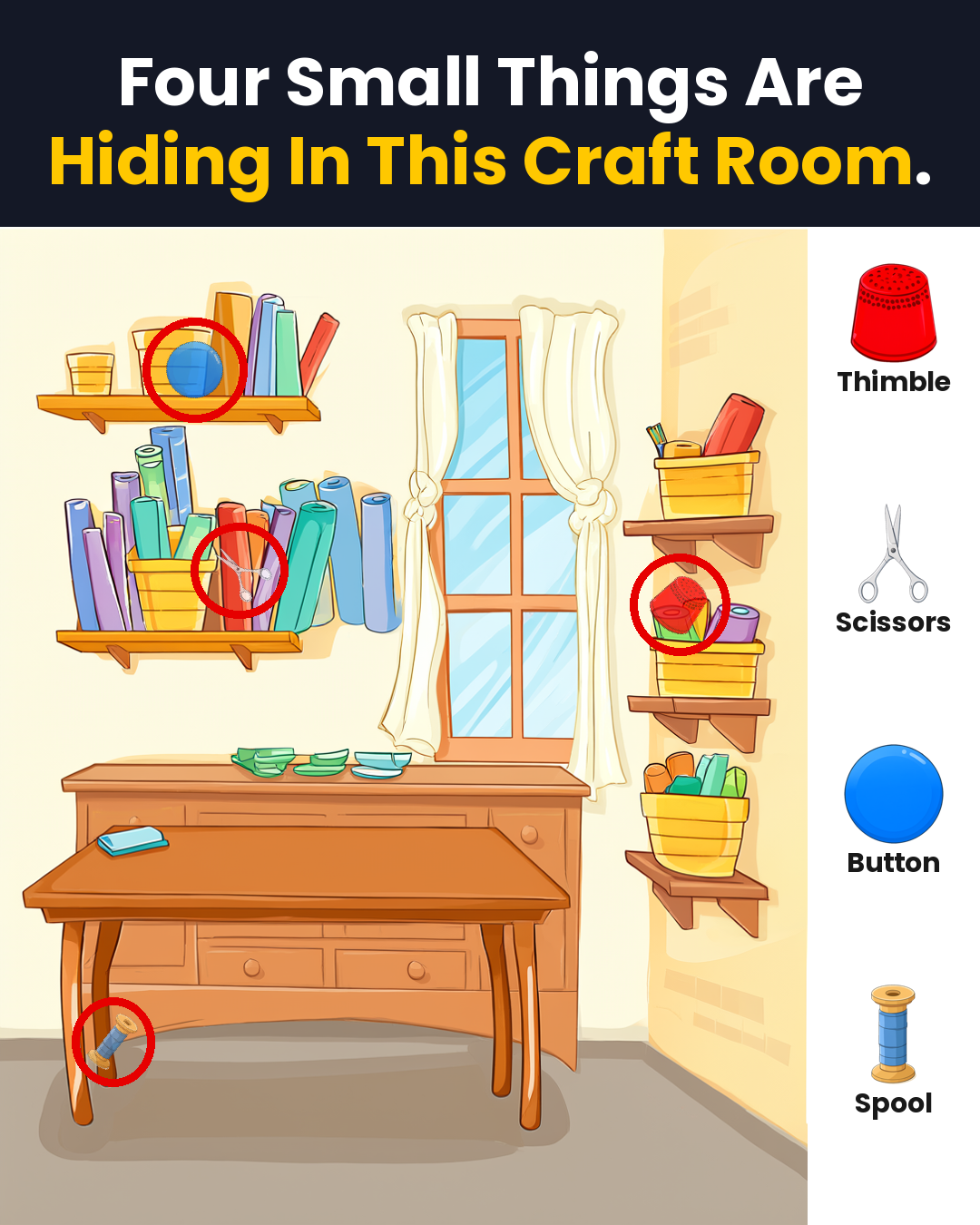
ANSWER: The blue button is on the top shelf among the books, the scissors are tucked in among the tall fabric rolls, the red thimble sits in the middle basket on the right-hand shelves, and the wooden spool is leaning against the front left leg of the table.
All Four, One By One
The big blue button is on the top shelf on the left, sitting between the upright books and the yellow pots. It is round, flat and bright, but it reads as just another ornament on a tidy shelf, so the eye slides past it.
The silver scissors are standing among the tall fabric rolls on the second shelf, with only the handles and one blade showing between a red roll and a blue one. The thin metal shape blends straight into the vertical lines of the rolls.
The red thimble is on the right-hand wall, in the middle of the three small shelves, sitting in the yellow basket among the ribbons. And the wooden spool of thread is right at the bottom, leaning against the front left leg of the table, where almost nobody thinks to look.
Why The Spool Is The Last One Found
For most people the spool of thread is the hardest of the four, and it has nothing to do with its size. It is low, it is at the very edge of the room, and it is touching a table leg of a similar warm colour.
We search pictures from the middle outwards and from the top downwards, because that is where interesting things usually are. The floor along the bottom edge is the last place our eyes visit, and by then we have often decided the object simply is not there.
The lesson for next time is a simple one: when you cannot find the last object, go straight to the floor, the corners and the edges of the frame, and search those slowly before anything else.
How Did You Do?
All four in under twenty seconds – outstanding, you have a real eye for detail.
All four in under a minute – very good, and better than most people manage.
Three out of four – a strong result, and the missing one was almost certainly the spool.
Two or fewer – no need to worry at all. Try the grid method on the next puzzle and you will be surprised how much more you see.