Hello again, puzzle friends, and welcome to the farmyard!
It is a bright morning, the grass is green, and a very fluffy white sheep is standing quietly in the field.
A long rope runs from the sheep all the way down to a row of wooden posts.
The trouble is that several other ropes are lying across the grass as well, and they loop, cross and tangle together.
Your task is to follow the sheep’s rope with your eyes alone – no finger on the screen, that would be too easy.
Which post is she really tied to: number one, two, three or four?
Take your time, pick one number, and say it out loud before you scroll down.
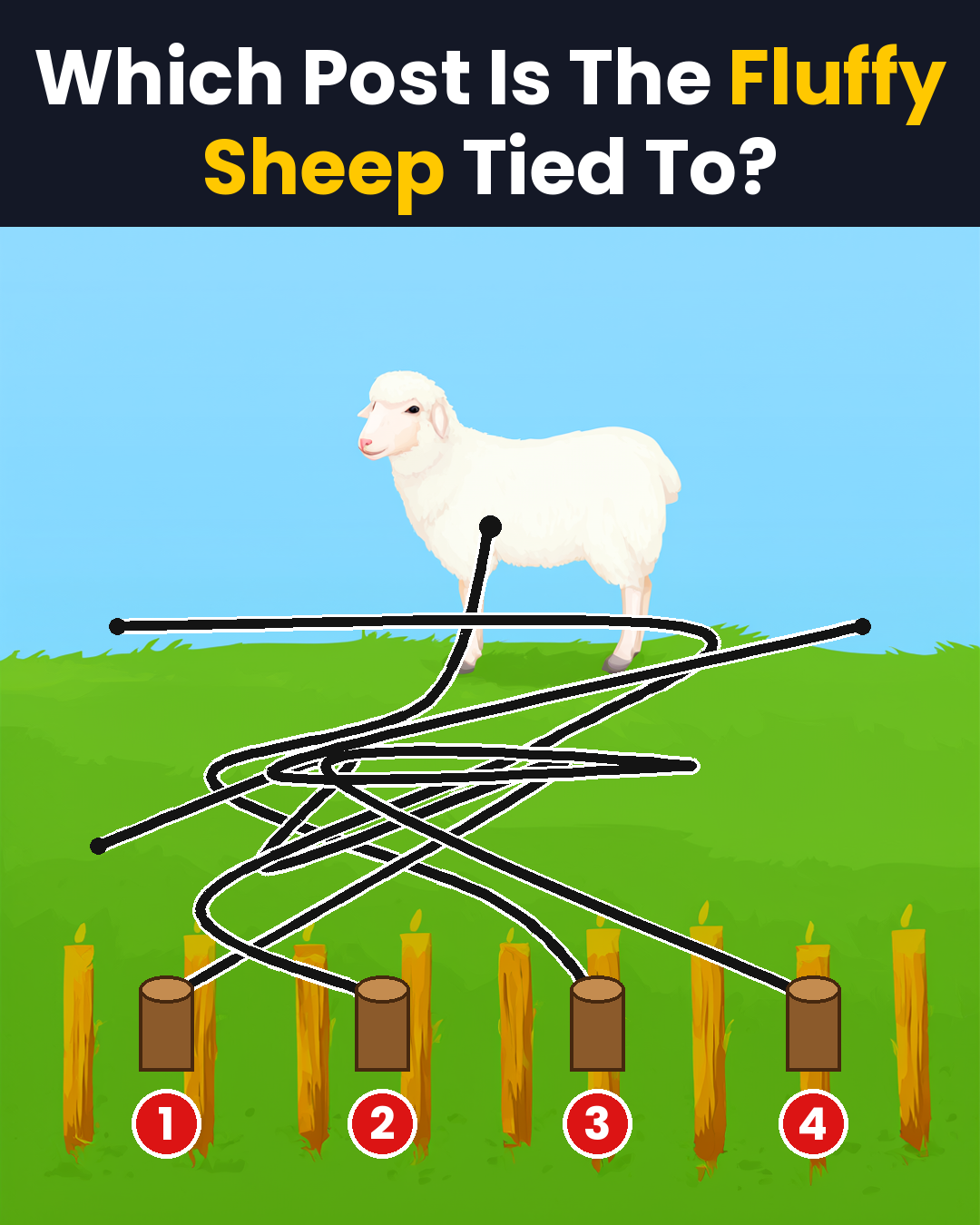
Take your time and look closely before you scroll down!
Start At The Sheep, Not At The Posts
Almost everybody begins this puzzle at the bottom of the picture. The numbers are down there, so the numbers feel like the natural place to start. It is also the slowest possible way to solve it, because you have to try all four posts and three of those journeys are wasted effort.
Start at the animal instead. There is only one rope attached to the sheep, so there is only one path to follow, and every crossing you meet is simply a place where another rope passes over or under yours. Keep your eyes on your own line and let the others go by.
When two ropes cross, do not look at the crossing point itself. Look just past it, a little further along, and ask which line continues in the same direction and with the same gentle curve. Rope does not change direction sharply in mid-air, so the one that carries on smoothly is yours.
Why Our Eyes Jump The Rails
Following a single line through a tangle is one of the hardest things we can ask our eyes to do, and there is a good reason for it. Our eyes do not glide along a line in a smooth motion. They move in quick little jumps, resting for a moment, then jumping again, and each jump covers a surprising distance.
If a crossing happens to fall in the middle of one of those jumps, the brain simply picks up whichever line is nearest when the eye lands, and it does this so confidently that you never feel the mistake. That is how you can trace a rope with complete attention and still arrive at the wrong post.
Curves make it harder still. Our visual system prefers straight lines and gentle arcs, so when a rope doubles back on itself, we tend to carry on along the imaginary straight path instead of following the real bend.
An Old Puzzle With A Long History
Tangled-line puzzles are one of the oldest forms of picture riddle there is. Victorian children’s books were full of them, usually drawn as kite strings, fishing lines or the leads of several dogs being walked by one unfortunate owner, and readers were invited to work out who had caught what.
They have had a serious life as well. Psychologists have used almost exactly this kind of picture for decades to study how we track objects through clutter, and anyone who has traced a single wire through a tangle behind a television has solved the very same problem without calling it a puzzle.
The design has barely changed in a hundred and fifty years, which says something about how well it works. Only the pictures have grown friendlier – these days it is far more likely to be a sheep than a schoolboy’s kite.
Can You Beat The Average?
Most people need between twenty and forty seconds to follow the rope properly, and a good number of them change their answer at least once along the way. That is not a failure, it is the puzzle doing its job.
If you lose the thread halfway down, do not start again from the posts out of frustration. Go back to the sheep and set off once more, a little more slowly this time, pausing after each crossing to be sure you are still on the same line.
When you are certain, send the picture to a friend and ask for their number before you tell them yours. Four people, four confident answers, one friendly argument – that is exactly how this puzzle is meant to be enjoyed.
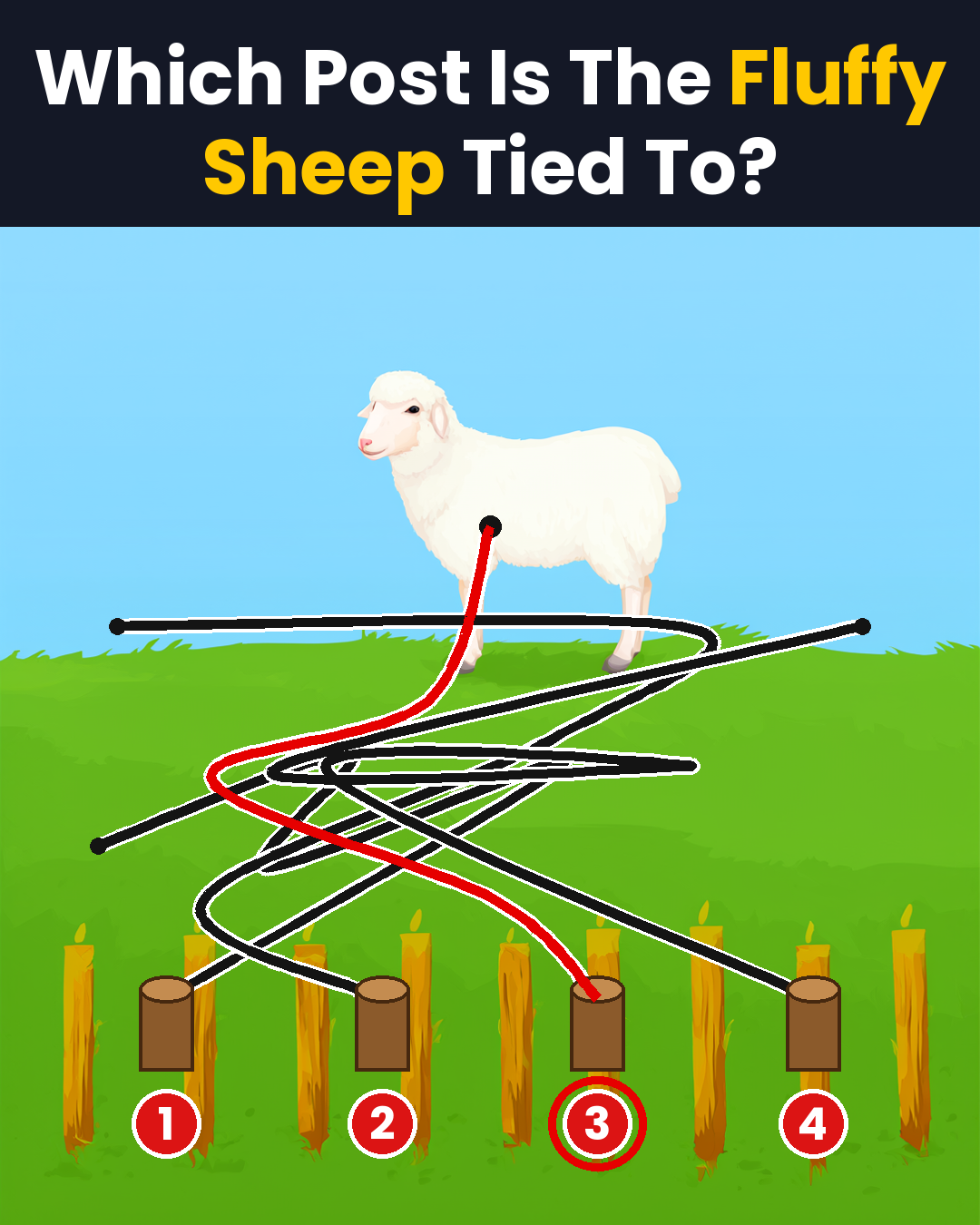
ANSWER: Post number 3 – the sheep’s rope swings left across the field, loops back to the right and ends at the third post.
Following The Sheep’s Rope
The right answer is post number three. The rope leaves the sheep’s body in the middle of the picture and drops straight down into the grass, which makes the first part of the journey look very simple.
Then it swings out to the left, loops around in a wide curve near the left edge of the field and comes back across the middle, crossing two other ropes on the way. From there it bends gently down to the right and finishes at the third post, the one marked with the number three.
In the answer picture, that single path is drawn in red from the sheep all the way down, and the ring around the third post marks the end of the line. The other ropes are decoration – each one starts and ends somewhere that has nothing to do with the sheep.
Why Most People Say Two Or Four
Post two is the most popular wrong answer. The sheep’s rope passes very close to another line just above the posts, and at that moment the two run almost side by side. If your eye jumps at that exact spot, you slide onto the neighbouring rope and land one post to the left.
Post four catches the people who follow the long rope that sweeps in from the right-hand side of the picture. It is the boldest, most obvious curve on the whole page, which is precisely why the puzzle puts it there.
The cure for both mistakes is the same. Slow down at every crossing and look a short distance ahead of it rather than at the crossing itself.
How Did You Do?
Under ten seconds and correct – remarkable, you have the eyes of a shepherd.
Ten to thirty seconds – very good indeed, and faster than most.
Thirty to sixty seconds – a solid, careful result, which is exactly how these puzzles should be solved.
Wrong post, or more than a minute – you are in excellent company. Try it once more starting at the sheep, and watch how much easier it becomes.