Hello again, puzzle friends!
Today we are visiting a quiet little garden pond on a warm summer afternoon.
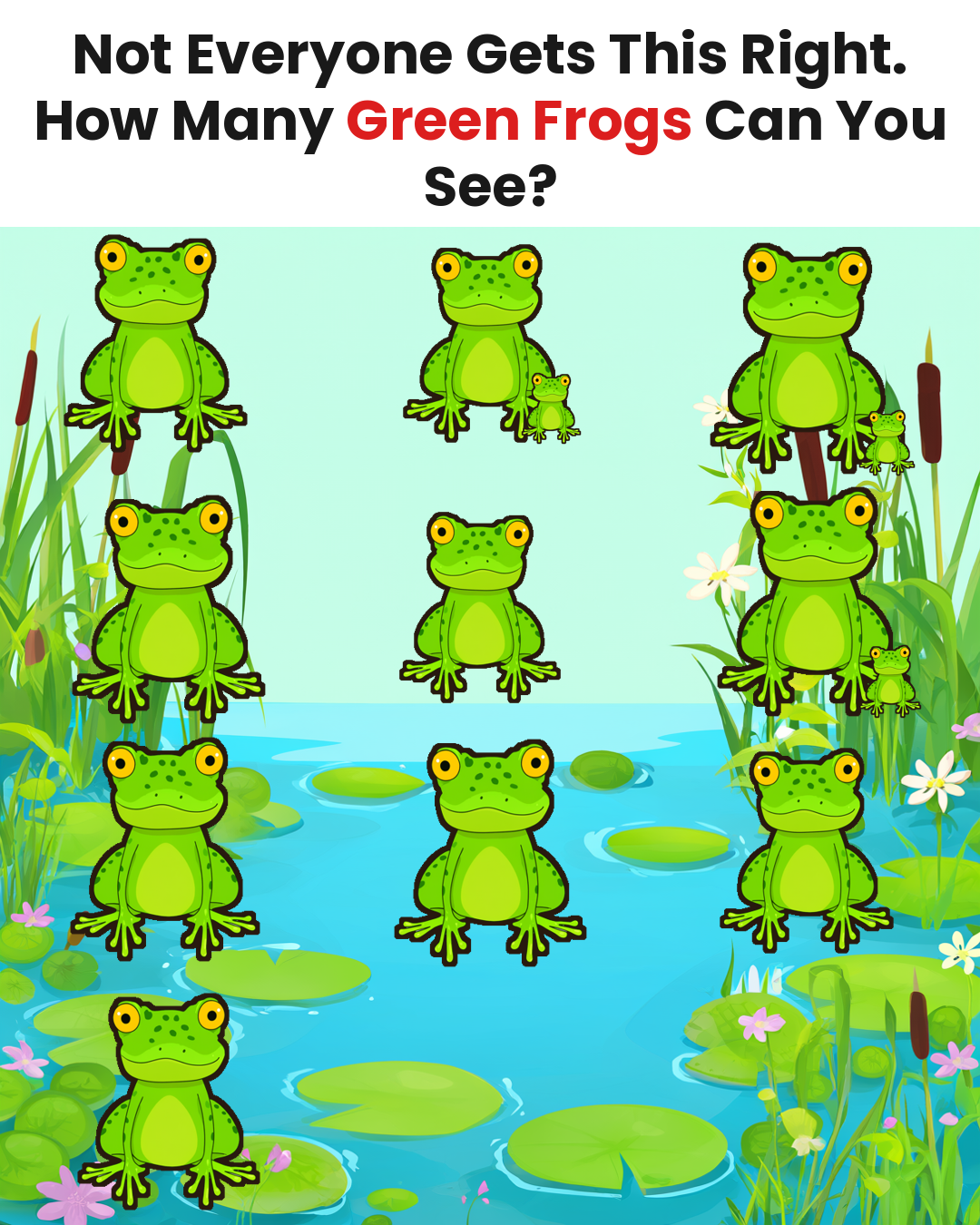
The lily pads are open and a whole family of cheerful green frogs has come out to sit in the sunshine.
Your job is simple to say and much harder to do: count every single frog in this picture.
Take your time, because the frogs are not all the same size.
Some are big and bold and sitting right out in the open.
Others are very small, and they like to sit close beside a bigger friend where they are easy to overlook.
Write your number down, then count once more before you look at the answer.
Take your time and look closely before you scroll down!
The Simple Method That Stops Double Counting
Counting puzzles feel like the easiest kind of brain teaser, and that is exactly why so many people get them wrong. We look at the picture, our eyes dance around it, and we arrive at a number that feels right. Then we check, and the number has changed.
The trouble is that our eyes do not travel in an orderly way unless we ask them to. They jump to whatever is brightest or biggest, then back again, and along the way we count the same frog twice and skip another one entirely.
The cure is to give yourself a fixed route and stick to it. Read the picture the way you read a page of a newspaper: across the top from left to right, then across the middle, then across the bottom. Never jump back up. If you lose your place, start that row again instead of guessing where you were.
Why Our Brain Prefers To Estimate
There is a lovely quirk in human vision that researchers call grouping. When several objects of the same shape and colour appear together, the brain treats them as one crowd rather than as separate items. It gives you a quick estimate, which is wonderfully useful when you are looking at a flock of birds and not at all useful when somebody asks you for an exact number.
Size makes it worse. A small object sitting next to a large one of the same kind barely registers at all. Your attention locks onto the big shape, and the little one is quietly filed away as part of it.
Colour plays its part too. Green frogs against green reeds and green lily pads give the eye very little to grab hold of. Camouflage does not need to be clever to work. It only needs to make the edges of a shape hard to see, and a few inches of pond weed will do the job nicely.
A Short History Of The Counting Puzzle
Puzzles like this one are much older than the internet. Children’s magazines in the nineteen thirties were full of crowded farmyard drawings with a question underneath: how many ducks, how many kittens, how many hats.
The skill being tested is a genuinely old one. Shepherds counted sheep coming through a gate, market traders counted crates, and anyone who has ever set a table for a large family has done the same mental work. Counting carefully under a little pressure is a real ability, and like any ability it stays sharp only if you use it.
Frogs turn up in these puzzles again and again for a good reason. Those round eyes and that simple rounded body read clearly even when the drawing is very small, which lets an artist tuck an extra one almost anywhere.
Now Take The Challenge
Most people need between twenty and forty seconds to count this pond properly, and the great majority of first answers are at least two frogs short. Count once quickly, then count again slowly, and only then decide on your final number.
When you have it, share the picture with a friend and let them try before you say a word.
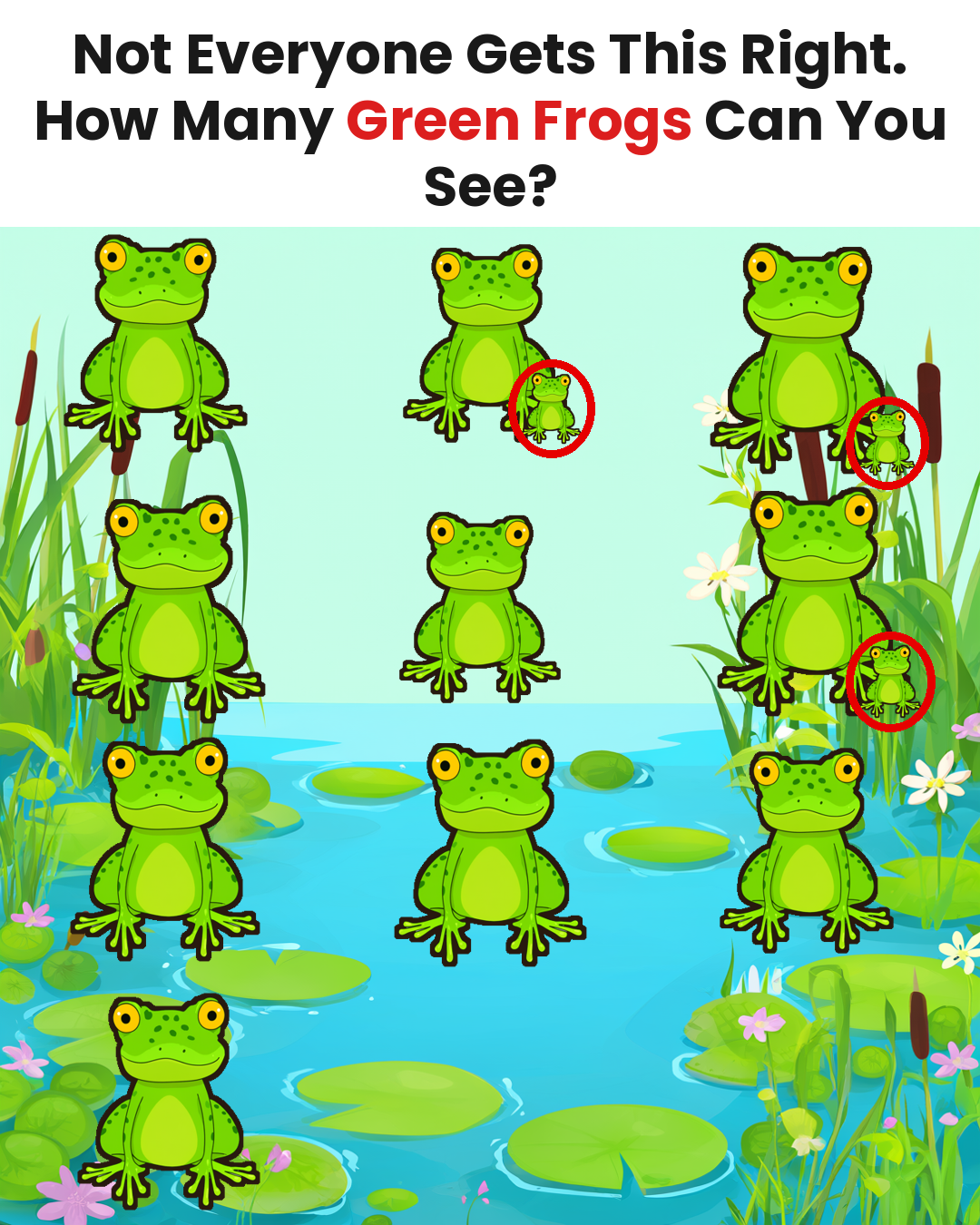
ANSWER: 13 frogs – ten big ones and three tiny little frogs sitting right beside them.
Where The Little Ones Were Hiding
The ten big frogs are spread across the picture in three loose rows, and almost everybody finds all ten of those without any trouble. The extra three are the ones that decide whether you got the right answer.
One tiny frog sits just to the right of the frog in the top middle of the picture, tucked against its side. The second is on the right hand edge, below the large frog in the top corner, half surrounded by reeds and white flowers. The third is lower down on the right, sitting in the greenery beside the big frog in the middle row.
All three are placed in the same way, and it is a trick that works every time: put a small object immediately beside a large one of the same kind, and the eye reads the pair as a single thing. The little frog never gets its own moment of attention, so it never gets counted.
Why Most People Answer Ten
Ten is the most common wrong answer by a wide margin, and that is no accident. Ten is the number of large frogs, and the large frogs are the ones that announce themselves. Once the brain has finished the easy part of the job, it feels finished, and it quietly hands you a number.
The second reason is the right hand edge of the picture. Our eyes spend most of their time near the middle of an image. Anything sitting at the border gets a fraction of the attention, and two of the three babies are sitting out there in the reeds.
If you want to catch these in future, do one extra pass along the edges of the picture before you commit to a number. It takes five seconds and it will save you from a great many wrong answers.
How Did You Do?
Thirteen in under fifteen seconds means you have genuinely sharp eyes and a very orderly way of looking. That is rare, and you should be pleased with yourself.
Thirteen in under forty seconds is an excellent result and puts you well ahead of most people who try this one. Twelve means you found two of the three little frogs and were only one small green friend away.
If you answered ten or eleven, you are in the largest group of all, and there is nothing at all wrong with that. Go back to the picture, look along the right hand side, and you will see them straight away. Then the puzzle is yours.