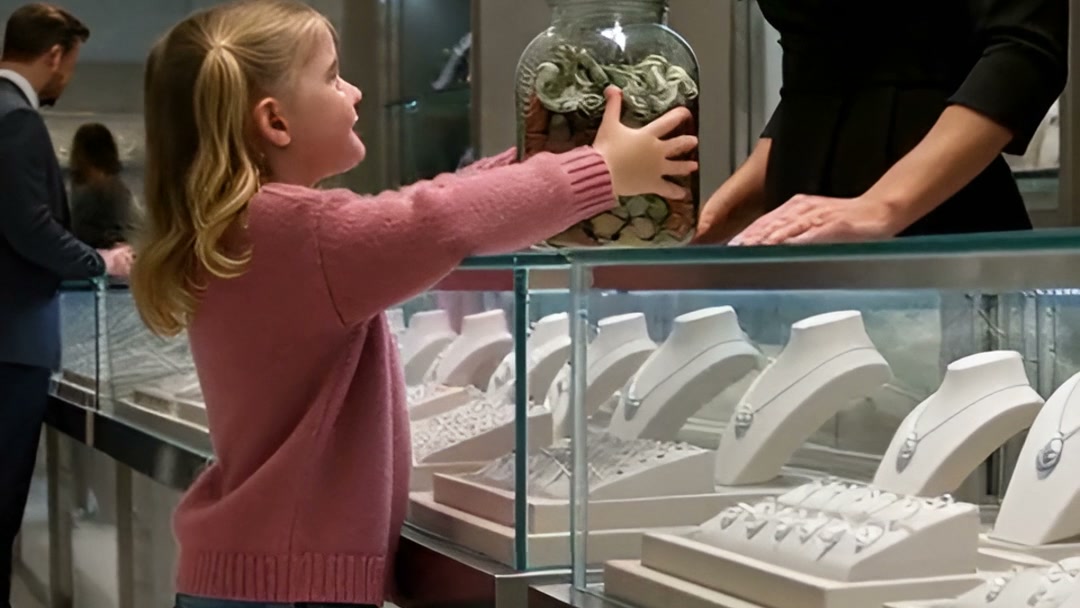
A saleswoman smashed a little girl’s coin jar and called her a beggar… But the little girl’s father owned every display case in that store.
The mall was loud and bright the way malls always are on a Saturday afternoon. Families drifted past storefronts carrying bags and smoothies and the particular tired happiness of people spending money.
Maya didn’t notice any of it.
She was seven years old and she had been planning this moment for eleven months.
The glass jar was heavy in both her arms. She’d started filling it last June with the fifty cents her grandma gave her for sweeping the porch. Then birthday money. Then the five dollars she found in a coat pocket that she was pretty sure was hers to keep. She had counted the total four times that morning at the kitchen table: forty-three dollars and seventy-two cents.
She pushed through the glass door of Calloway Fine Jewelry and stopped.
The store smelled like cold air and something expensive. Long glass cases ran the length of the room, lit from below, full of things that sparkled. Maya had looked through this window a hundred times on the way to the food court. She knew exactly which necklace she wanted.
She walked to the counter.
The woman behind it was tall, with dark hair pulled back and a black dress that looked like it had been ironed twice. Her name tag said DIANE. She was typing something into a tablet and did not look up.
“Excuse me,” Maya said.
Diane looked up. Her eyes went from Maya’s face to the glass jar to Maya’s pink sweater, which was faded at the elbows, and down to her sneakers, which had a small crack along the right sole.
Something shifted in the woman’s face.
“Can I help you?” The words came out flat, like a door being closed.
Maya set the jar on the glass counter with a careful thud and pointed into the case. “I want that one. The little heart. It’s for my mom’s birthday.” She straightened her back the way her father had taught her to do when she was serious about something. “I saved all year.”
Diane stared at the jar. At the crumpled dollar bills pressed against the glass. At the coins layered at the bottom like sediment.
Then she hit it.
Not a bump. Not an accident. She brought her open palm down against the side of the jar with a sharp, deliberate slap, and it went over the edge of the counter and fell and exploded on the marble floor like a small grenade.
The sound cracked through the store. Coins flew. A dime rang in a circle near the door. Dollar bills drifted flat against the floor.
Every customer in the store turned.
Maya stood very still for one second. Her brain was doing what brains do when something impossible happens: trying to make it make sense.
Then her legs bent and she was on her knees on the cold marble and she was crying before she even understood she was doing it. She picked up a quarter with shaking hands. Then a nickel. Her fingers kept slipping.
“Get out,” Diane said from above her. Her voice was sharp and perfectly controlled, the voice of someone who has decided something and will not be argued with. “This store is not for beggars. You’re making a scene.”
The family by the engagement ring display looked away. A woman in a yellow coat picked up her daughter and turned toward the door. A man in a baseball cap stared at his shoes.
Nobody moved to help.
Maya kept picking up coins. She didn’t know what else to do. She had saved all year. She had saved all year and she just wanted the little heart.
The glass door opened behind her.
She didn’t look up. She was focused on reaching a dime that had slid under the cabinet near the wall. She could feel people looking at her and she didn’t want to see their faces.
She heard footsteps. Good shoes on marble. Then the footsteps stopped.
Then someone was beside her, crouching down, and she felt a large warm hand close gently over hers, and a man’s voice said, very quietly, very carefully, “Hey. I got you.”
She looked up.
He was wearing a dark suit, the kind that fit exactly right. He had brown eyes and the particular expression adults get when they are trying very hard not to show how angry they are. She knew that face. She had seen it before.
“Daddy.”
“I know,” he said. He picked up three coins and pressed them into her palm and closed her fingers around them. Then he stood and he took her hand and helped her to her feet.
He didn’t say anything for a moment. He just looked at Diane.
Diane had gone through several expressions in the last four seconds. The first was confusion. The second was something that looked like recalibration. She opened her mouth.
“Sir, I’m sorry, there was a situation—”
“I watched it from the doorway.” His voice was quiet. Not loud. Not shaking. Quiet in the way that a very large thing is quiet before it falls. He reached into his jacket with his free hand and set a business card on the glass counter. “Marcus Calloway. You’ve been working in my store for how long?”
Diane’s face went the color of paper.
Marcus Calloway, whose grandfather had opened the first Calloway Fine Jewelry location in 1974, who had expanded it to eleven stores in seven states, who had his name etched in small gold letters above the door that Maya had walked through, looked at the saleswoman who had knocked his daughter’s coin jar onto the floor.
“Three years,” Diane whispered. “I’ve been here three years.”
“And in three years,” he said, “did anyone explain to you what our customers look like?”
She didn’t answer.
“My daughter has been saving her money since June.” He looked down at Maya, then back up. “She came here on her own to buy a birthday gift. That is exactly the customer this store exists for.” His jaw tightened once. “You’re done here, Diane. Leave your name tag with the manager on your way out.”
“Mr. Calloway, please—”
“We’re finished.”
The store had gone completely silent. The man in the baseball cap was watching. The woman in the yellow coat had stopped in the doorway. The couple by the engagement rings stood very still.
Diane unpinned her name tag with fingers that were not entirely steady. She set it on the counter. She picked up her bag from behind the register. She walked to the back of the store without looking at anyone.
Nobody said a word until the back door closed.
Marcus looked down at Maya. She was still holding the coins in her fist, her eyes red, her chin doing the small wobble it did when she was trying not to cry anymore.
“Which one?” he said.
“The little heart,” she said. “The silver one. Third case, second row.”
He almost smiled at the precision of that. He walked behind the counter himself, found his key, slid the case open, and lifted the necklace free. It was small and simple and caught the light cleanly.
He brought it to Maya and held it out.
“It’s for Mom,” she said. “I have to pay for it.” She held out her fist and opened it. Coins and two crumpled bills.
Marcus Calloway looked at his daughter’s hand.
“You did pay for it,” he said. “You paid for it all year.”
He fastened the clasp carefully at the back of her neck. The little silver heart rested at the base of her throat, catching the light from the display cases.
Maya looked down at it.
“She’s going to love it,” she said.
“She is,” Marcus said.
He picked up the empty glass jar from the floor—intact at the base, cracked along one side—and set it on the counter next to Diane’s name tag. Then he took Maya’s hand and they walked out through the glass door together into the loud bright afternoon of the mall.
The jar stayed on the counter.
The name tag stayed on the counter.
And every person left in the store stood in the particular silence of people who have just watched something they will think about for a long time.