She Twisted In The Air So Her Brother Wouldn’t Hit The Concrete
A teenage girl hit the concrete at the school gate to shield her four-year-old brother… But the boy who shoved her didn’t see the man thirty feet behind them with a lunch box in his hand.
Maya was sixteen and already used to carrying things.
She carried her little brother Caleb to school every morning because he refused to walk when she was around. His arms went around her neck, his legs locked at her waist, and his cheek pressed against her jaw like she was the safest thing on earth. She didn’t mind. She’d been his safe thing since he was born.
Their father, David, walked fifteen feet behind them on the sidewalk, lunch box in his left hand, watching them the way he always did. His first shift at the warehouse started at seven-thirty. This was the part of his morning he protected.
The gate was busy. Parents. Backpacks. A crossing guard calling out.
Brandon Sykes was a senior. Six feet, letter jacket, the kind of boy who had learned somewhere along the way that size was a personality. He was walking with two friends, not looking at much, certainly not looking at a sophomore girl carrying a kid.
He shoved her from the side.
Not a brush. A shove. Shoulder into shoulder, full weight behind it, the kind of push that says *you’re in my way and you don’t matter*.
Maya went sideways.
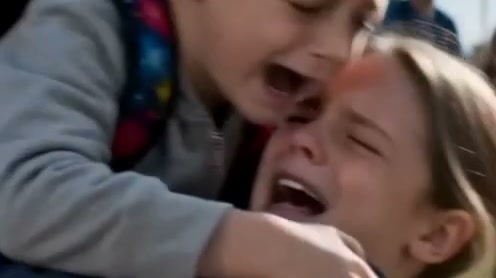
In the half-second before she hit the concrete, something happened in her body that wasn’t a decision — it was faster than a decision. She rotated. She pulled Caleb in and turned so her right knee and her left palm took the ground instead of him. Caleb landed on top of her chest, pressed against her, unhurt.
Her knee opened up on the concrete. She felt it.
Caleb started screaming. Not hurt — terrified. He didn’t understand what the ground had done.
“Shh,” Maya said immediately, arms tight around him. “Shh, I got you. I got you, bug. You’re okay.”
Brandon kept walking. Didn’t look back. One of his friends laughed at something he said.
Thirty feet back on the sidewalk, David stopped walking.
He had seen all of it. The shove. The fall. His daughter twisting her own body in midair to make herself the landing pad. His son crying on top of her on the concrete. The boy in the letter jacket walking away.
He stood there for three full seconds.
The lunch box was still in his left hand.
Then he walked forward, and his walk was not the same walk it had been.
He reached Maya first. He crouched, touched her face, looked at her knee — already bleeding through her jeans. “Can you stand?”
“Yeah.” She was already pushing up. “I’m fine, Dad. Caleb’s fine.”
“I know he’s fine.” His voice was quiet. Controlled. “You made sure of that.”
He stood, handed Maya the lunch box, and picked Caleb up, and Caleb buried his face in David’s neck and went quiet the way kids do when they reach the person they trust most.
David looked up.
Brandon was twenty feet away, still moving toward the gate, still not looking back.
“Hey.” David said it at a normal volume. Not a shout. Just a word with enough weight behind it that two parents and a crossing guard turned around.
Brandon turned around too.
He looked at the man holding the crying four-year-old. He looked at the girl with the bleeding knee. His expression went through three things quickly — confusion, then the beginning of a smirk, then something else when he got a better look at David’s face.
David walked toward him. Calm steps. Each one landing.
“You pushed my daughter.”
“I didn’t—” Brandon started.
“She was carrying a four-year-old.” David’s voice didn’t rise. “She was carrying her little brother and you put your shoulder into her and you walked away.”
“It was an accident.”
“No it wasn’t.” David looked at him for a long moment. “An accident is when you apologize.”
By now a circle had formed the way circles always form. Parents. Students. The crossing guard had stopped directing traffic. The vice principal, Mr. Holt, was moving through the crowd from the gate, having caught enough of it to know he needed to be involved.
“What’s going on?” Holt said.
“This student shoved my daughter to the ground while she was carrying her brother,” David said. He didn’t look at Holt. He kept his eyes on Brandon. “She protected the boy. Took the concrete herself. He kept walking.”
Holt looked at Brandon. “Is that true?”
Brandon looked at his friends. They had gone very still. The letter jacket suddenly looked enormous, like he was a child wearing something that belonged to someone else.
“It was crowded,” Brandon said. “I didn’t mean—”
“Six people saw it,” a woman said from the circle. A mother. Arms crossed. “He looked right at her after. He didn’t stop.”
Holt pulled out his radio. “Brandon, front office. Now.”
Brandon’s face went red. He looked at David like he was expecting something — an argument, a negotiation, some version of this that didn’t end with him walking through the school gate alone with a vice principal behind him.
David just looked back at him.
Brandon walked.
Holt touched David’s arm briefly. “I’ll call you this afternoon. This gets documented.”
“I know it does,” David said. “Thank you.”
The circle dissolved. Parents moved their kids forward. The crossing guard went back to work. The morning reassembled itself the way mornings do, around the thing that had just happened in it.
David turned back to Maya.
She had Caleb again — he’d reached for her and she’d taken him back, the way they always did, passing him between them like he belonged to both of them equally. She was standing on the leg that didn’t hurt, her weight shifted, her jaw set.
David looked at her knee. “We need to get that cleaned up inside.”
“It’s not bad.”
“Maya.”
“It’s really not, Dad.”
He looked at her for a moment. This girl who had turned in midair. Who had put herself between a four-year-old and concrete and then sat on the ground saying *shh, I got you* while she was bleeding.
“You know what you did,” he said.
“I just fell.”
“No.” He put his hand on her shoulder. “You didn’t just fall.”
She looked away toward the gate, the way teenagers do when emotion is happening to them and they haven’t decided yet if they’ll allow it. Her jaw worked. She pressed her lips together.
“He’s fine,” she said quietly.
“He’s fine,” David agreed. “Because of you.”
Caleb, from her arms, turned his head and looked at his father with wet eyes. “Maya falled,” he announced gravely, as though reporting news.
“I know, buddy.”
“She’s okay though.”
“She is,” David said. “She’s really okay.”
He picked up his lunch box from where Maya had set it on a low wall. He would be late to the warehouse. He had never been late before and he would be late today and he did not care at all.
He walked both of them inside, got Maya’s knee cleaned and bandaged in the nurse’s office, and sat with her until the bell rang and she handed Caleb to the pre-K aide and shouldered her backpack and turned to go.
“Hey,” David said.
She looked back.
“I saw you,” he said. “The whole thing. I was right there and I saw every second of it.” He held her eyes. “I want you to know that.”
Something moved across Maya’s face. Not a child’s expression — something older than that, something that had been waiting a long time to be seen.
“Okay,” she said.
“Okay,” he said back.
She walked to class.
David walked out through the school gate and onto the sidewalk toward the bus stop, lunch box in hand, the same route he walked every morning, and the morning was different now, and he was not sorry about any part of it.
That afternoon, Holt called. Brandon Sykes received a three-day suspension and a mandatory meeting with a counselor. The incident was placed in his permanent record. Two weeks later, at a parent review board meeting he hadn’t expected to face, three witnesses — including the mother who had spoken from the circle — gave accounts. Brandon lost his position as team captain. His letter jacket didn’t mean the same thing after that.
He never shoved anyone at that gate again.
Maya never mentioned the morning to anyone at school. She didn’t need to. The kids who had been there remembered what they had seen — a girl who had turned her body in midair, who had held her brother on the ground and called him *bug*, who had sat bleeding and said *I got you* before she’d checked on herself.
That reputation spread the way real ones do. Without her doing anything to spread it.
Caleb, for his part, told the story to every adult he encountered for the next two weeks.
“Maya falled,” he would begin, very seriously. “But she didn’t let me fall.”
He had it exactly right.