Senior Slapped A Girl In The Hallway – Her Brother Walked Off The Field
A senior boy slapped a quiet girl in a crowded hallway after the game… But the locker room door swung open, and every student who recognized jersey number 12 took one silent step back.
The game had ended twenty minutes ago. The hallway outside the gymnasium still smelled like popcorn and cold air, students streaming past in their Friday night clothes, voices loud, energy high.
Maya was at her locker. Fifteen years old, small, quiet, the kind of girl who kept her head down and her grades up. She was just trying to get her jacket.
That’s when Derek found her.
Derek Holloway was a senior. Letterman jacket, wide shoulders, the kind of boy who had learned early that his size was a social currency he could spend anywhere. He stopped in front of Maya’s locker with two of his friends flanking him like parentheses.
“Move,” he said. “You’re in front of my locker.”
Maya looked up. “This is my locker. Mine’s 214. Yours is—”
“I said move.”
She didn’t move fast enough.
The slap was open-handed and hard. It snapped her head sideways and she hit the lockers with her shoulder, then her knees buckled and she went down. The metal rang out like a bell.
The hallway went sharp and still for exactly one second.
Then the phones came up.
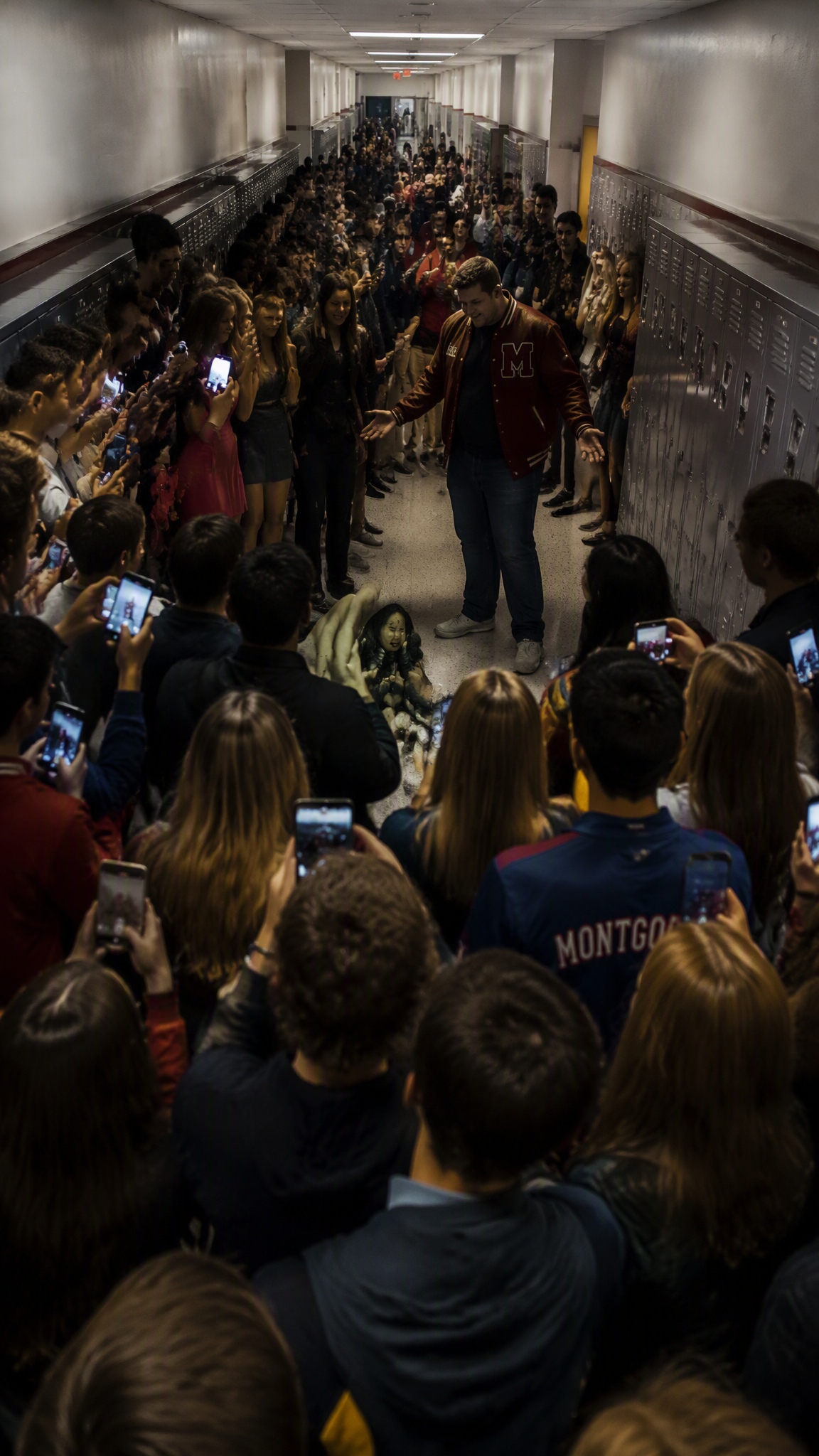
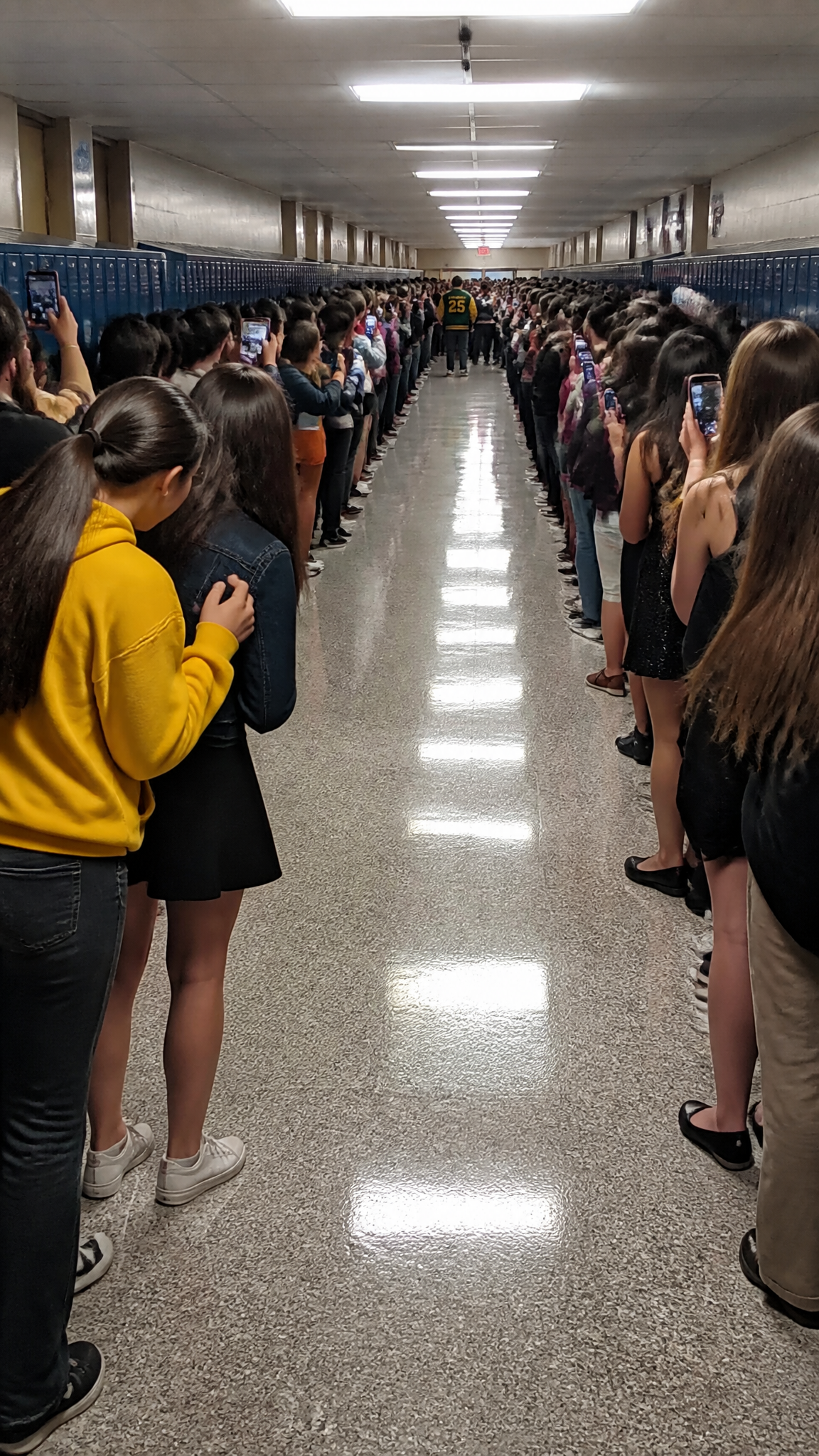
Thirty, forty phones rising in a single motion, screens lighting up, recording. The crowd formed a loose ring — close enough to watch, far enough to say later they hadn’t been involved. Nobody stepped forward.
Derek stood over her. He was laughing. Not nervous laughing. Performing laughing. He turned to his friends with his arms out like he’d just scored.
“Told you,” he said. “Told you she’d just sit there.”
His friends laughed, but it was the kind of laugh that checks the room first.
Maya sat against the locker with her hand pressed to her cheek, eyes wet, not crying yet, just stunned. She looked at the crowd. The crowd looked at their phones.
“Somebody help her,” a girl said from somewhere in the back.
Nobody moved.
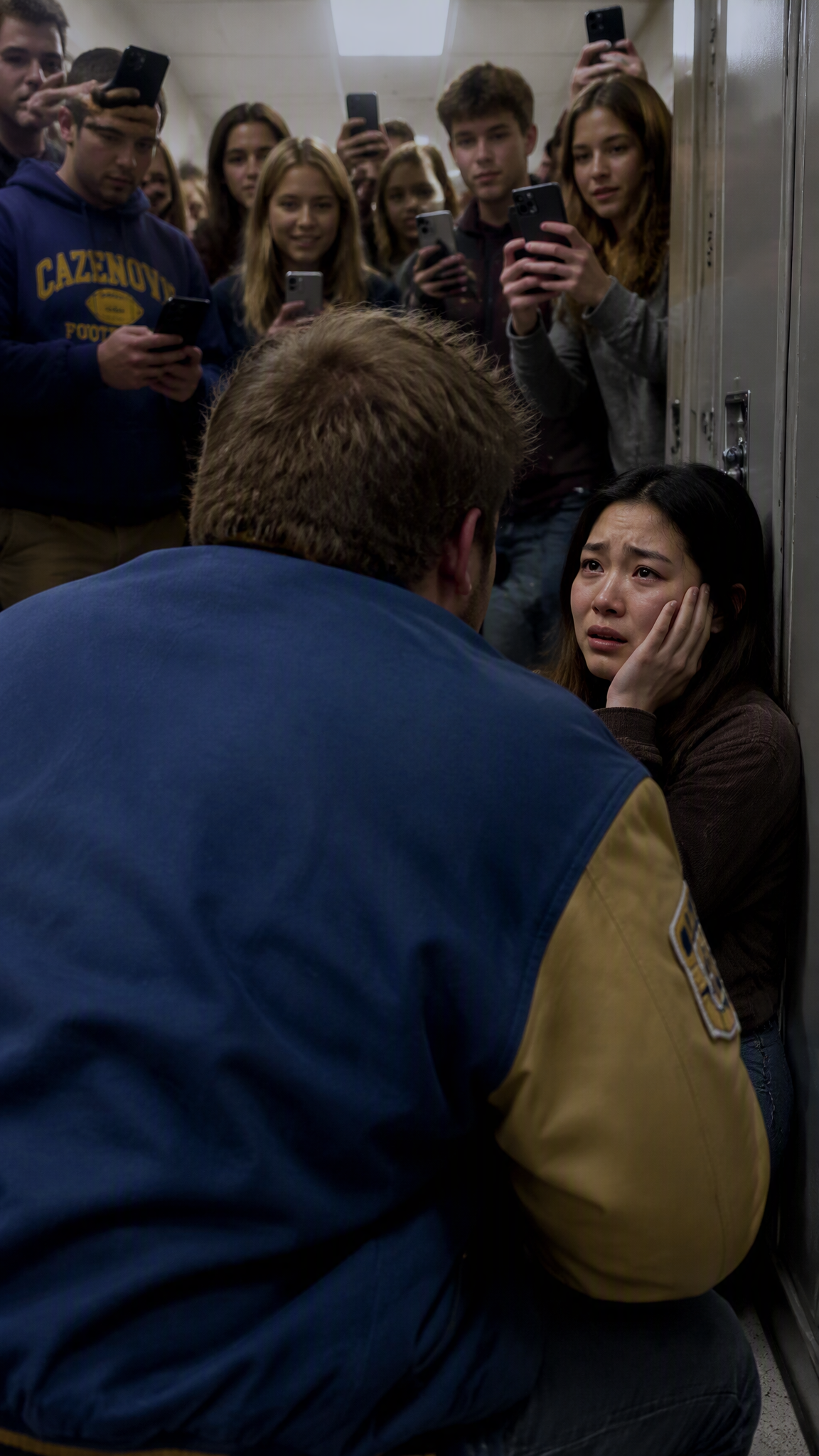
Derek crouched down in front of Maya, still grinning. “You gonna cry? Go ahead. Film it.” He looked up at the phones. “Get her face.”
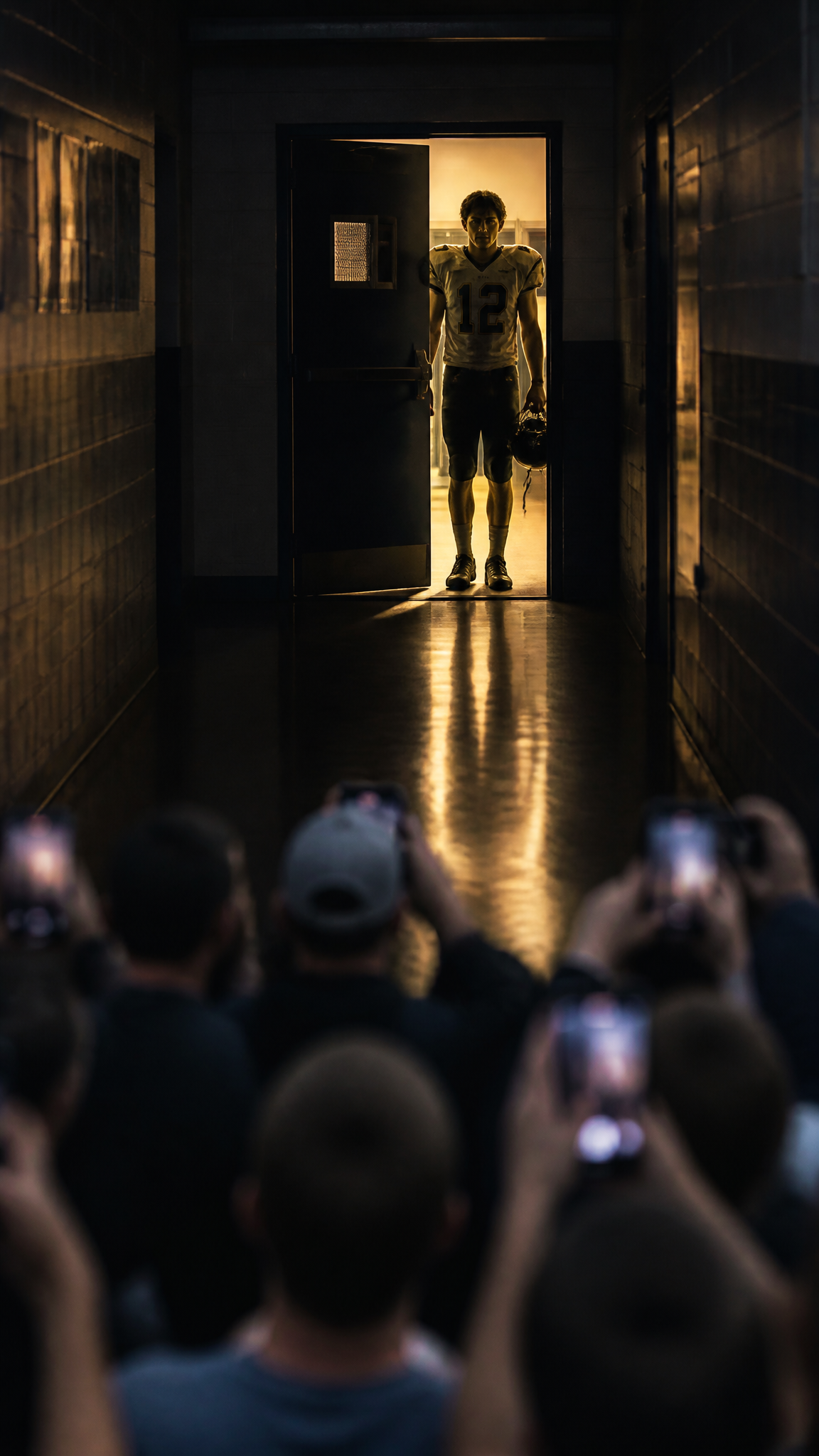
That’s when the locker room door at the far end of the hallway opened.
It didn’t slam. It didn’t burst. It just swung open the way it always did after a game, slow on its hinge, and a rectangle of light fell across the hallway floor.
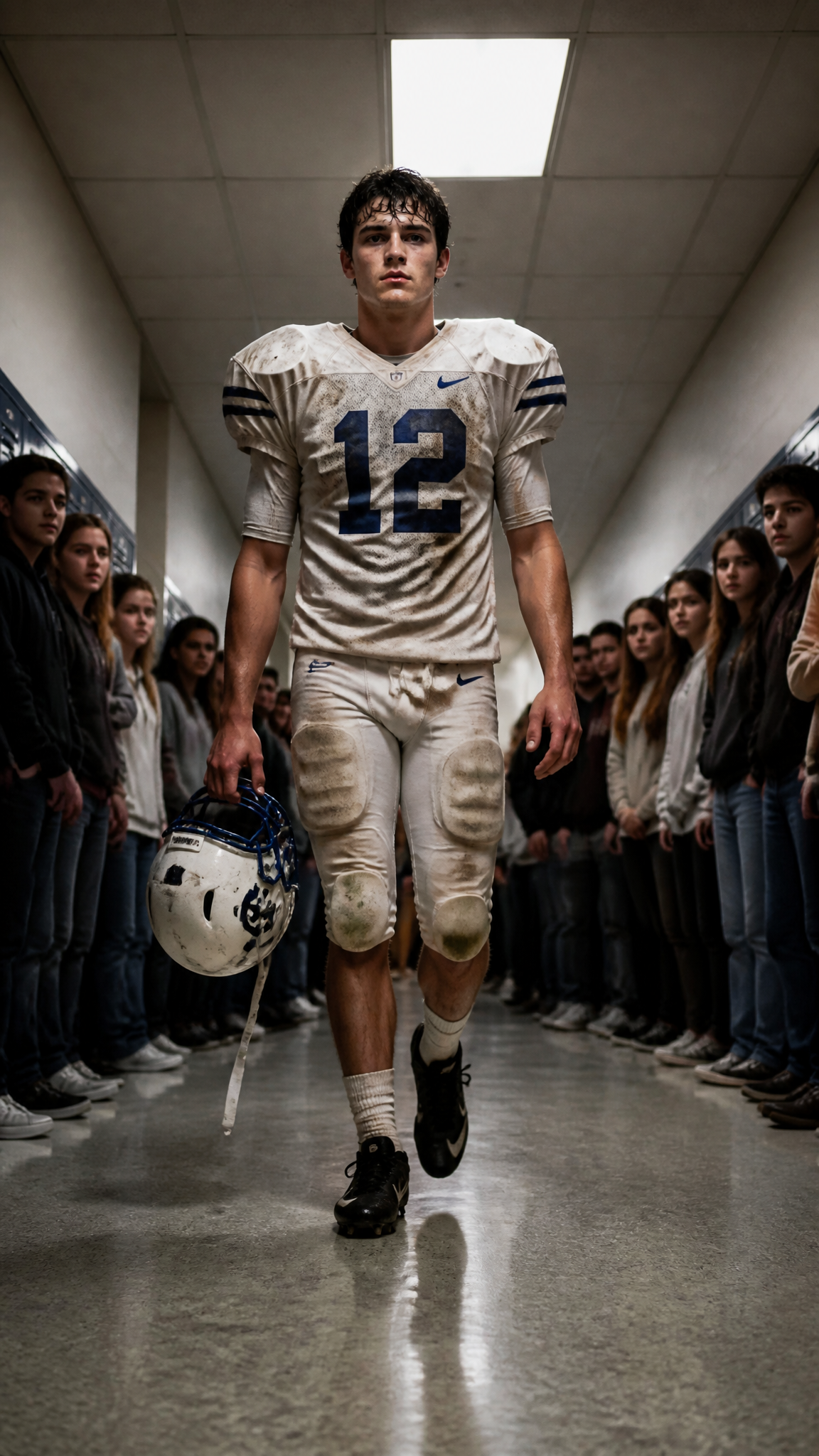
The boy in the doorway was still in full uniform. Shoulder pads. Dirty white jersey. Grass stains on both knees. Cleats on his feet and a helmet hanging from his right hand, the chin strap swinging once and going still.
Number 12.
He stood in the doorway for two seconds. Just long enough for his eyes to move down the hallway and find his sister on the floor.
His name was Caleb. He was eighteen. He had just played forty-eight minutes of football and his jersey showed every minute of it. He was the starting quarterback and had been since sophomore year, and there was not a single student in that hallway who did not know his number.
He didn’t run.
He walked.
The cleats hit the hallway floor and the sound traveled. Click. Click. Click. Even, steady, unhurried. Each step deliberate. The sound bounced off the lockers and the ceiling and filled the hallway the way a drumbeat fills a room before the music starts.
The students nearest the locker room door saw the number first.
A girl in a yellow hoodie grabbed her friend’s arm without saying anything. A sophomore boy took one step back, then another, then the people next to him stepped back too, and it moved through the crowd like a slow wave, everyone creating a path without being asked, without discussion, without a word spoken.
The path opened all the way down the hallway.
Derek’s friends saw it first.
Marcus, on Derek’s left, stopped laughing at second three of Caleb’s walk. Jordan, on Derek’s right, stopped at second five. They both looked at each other. Then they looked at the path forming behind Derek’s back.
Marcus said, very quietly, “Derek.”
Derek was still crouched in front of Maya, still performing. “What?”
“Derek.”
The click of the cleats was loud now. Close.
Derek heard it. He heard the silence that had replaced every other sound in the hallway. He heard the way his own friends had stopped breathing.
He stood up slowly. He turned around.
Caleb stopped three feet behind him.
They stood there in the hallway with Maya on the floor between them, looking up at her brother’s number on his chest. The dirty white jersey. The shoulder pads making his frame enormous. The helmet hanging from his right hand, swinging once, going still.
Caleb looked at his sister’s face. The red mark across her cheek. Her hand still pressed to it.
He looked at Derek.
Derek opened his mouth. “Look, man, she was in my—”
“Don’t.” Caleb’s voice was quiet. Not loud. Not shaking. Quiet the way a room goes quiet before something breaks. “Don’t say anything to me.”
Derek’s mouth closed.
Caleb crouched down. Not toward Derek. Toward Maya. He set his helmet on the floor, held out his hand, and waited.
Maya took it. He pulled her up gently, one arm going around her shoulders, his hand covering the back of her head for a moment the way you’d protect something fragile from a fall.
“You okay?” he said, low, just for her.
She shook her head once. Honest.
“Okay,” he said. “Okay. I got you.”
He straightened up. Maya stayed tucked against his side, her face turned into the shoulder pad, one fist wrapped in the fabric of his jersey.
Caleb looked at Derek again. Not with rage. Rage would have been easier. He looked at him with something worse — the specific calm of someone who has already decided what happens next and is not in any hurry.
“You put your hand on my little sister,” he said.
It wasn’t a question. It didn’t need to be.
Derek looked at the crowd. The crowd looked back at him. Every phone was still up, still recording. Marcus and Jordan had each taken another step back, putting distance between themselves and what was coming.
“I didn’t—” Derek started.
“Forty phones,” Caleb said. “Forty phones just filmed it.”
Derek looked at the phones. He looked at the faces behind them. He looked at the path that had opened through the crowd — the path that was still open, still pointing directly at him, every student who’d made space still standing at their distance, watching.
“I want you to walk to Coach Briggs’ office right now,” Caleb said. “Walk. Don’t run. Don’t go home first. Don’t text anybody. Walk there and sit down and wait, because in about four minutes I’m going to call my mother, and in about ten minutes she’s going to call the school, and in about twenty minutes every one of those videos is going to be in the principal’s inbox.”
Derek didn’t move.
“Walk,” Caleb said.
Derek walked.
He went through the crowd, which did not part for him the way it had parted for Caleb. They moved, but slowly, and they watched him go with their phones still up, and not one person said a word to him as he passed.
Marcus and Jordan went with him, not because they were loyal, but because standing there felt worse.
The hallway let out a long breath.
A junior girl came forward with a water bottle and held it out to Maya. “Here.”
Maya took it. “Thank you.”
Caleb kept his arm around her. He picked up his helmet from the floor with his free hand. He looked at the crowd — not angry at them, not performing for them, just acknowledging that they were there and that they had seen it.
“Somebody text me those videos,” he said. “Please.”
Six phones lit up immediately.
Coach Briggs was still in his office at 10:47 PM when Derek sat down in the chair across from his desk. Briggs looked at him for a long moment without speaking.
“Start talking,” Briggs said.
Derek talked.
By 11:15, the principal had been called at home. By 11:30, Derek’s parents were in the building. By midnight, the school’s student conduct coordinator had received forty-one video files from forty-one different students, every angle, every second, the slap and the fall and the crowd and the cleats and all of it.
Derek Holloway was suspended the following Monday. Not for three days. For the remainder of the semester.
His appeal was denied.
He did not return to the school for the spring semester. His family enrolled him elsewhere, in a district two towns over, and on his first day at the new school he was nobody — no letterman jacket that meant anything, no friends who owed him anything, no hallway he owned.
He was just a boy who had to start over.
Maya went back to school on Tuesday.
She walked down the hallway with her backpack on and her chin level and her hand not pressed to her cheek anymore. The mark was gone. The locker was still hers.
A girl she barely knew stopped her near the gymnasium doors.
“Hey,” the girl said. “Are you okay?”
“Yeah,” Maya said. And she meant it.
She opened her locker. Got her books. Went to first period.
In the gym, behind the trophy case near the main entrance, someone had taped a piece of paper to the wall. It wasn’t official. It wasn’t signed. It just said:
*Nobody walks through that door alone.*
Below it, in different handwriting, someone had written a number.
12.