Britain’s Got Talent’s Strangest Auditions: Goldfish Gags, Titanic Chaos
A stage that still surprises
It opens like a dare to our jaded eyes. A voice declares, “We’ve explored almost every part of the planet… but there’s still much to discover,” and the Britain’s Got Talent stage proceeds to prove it. What follows is a parade of the outlandish and the oddly moving: a human sound machine, a caped crusader, a beauty-pageant tutor turned ringmaster, a surreal costume you may spend days trying to name, and an act that remakes a famous ocean liner with the help of life jackets and panic. It is a love letter to the unpredictable, stitched together by the gasp of a thousand “Oh, my god” exclamations and the kind of laughter that arrives late, then refuses to leave.
From the first moments, the house feels twitchy with nerves. Someone backstage whispers, “I’m scared.” Out front, a judge leans forward, half-amused, half-braced, and offers a kind of series motto: two minutes, and a life can change. That needle swings between euphoria and chaos, sometimes both at once.
A human sound machine turns heads
First comes a performer who doesn’t so much sing as sculpt the air. A judge’s whispered question becomes a challenge to reality: “Is she doing the noise?” She is. Vowels become engines; consonants ricochet like pebbles in a tin. Another judge blurts, “She’s bloody great,” and the audience whoops as the stage blooms into something more than music, less than language, and somehow more satisfying than either.
“That’s unbelievable.”
“Never seen anything like this in my life.”
We’ve watched a thousand auditions; this one leaves a different residue. It’s not just talent; it’s the conjuring trick of making you doubt your own ears.
Capes, showtunes, and a judge side-eye
Then, a shadow: a cape, a rasp of vinyl, the slow walk of someone who has spent a lifetime practicing an entrance. “I love Batman,” a judge deadpans. “He’s impressive in real life, ain’t he? What’s your name?” The reply is pure, solemn camp: “It’s Batman.”
He stands, he smolders, he sings. Not the hero’s theme, but a slice of musical theatre. A line slips out, simple, yearning, and disarming:
“Something has changed within me.”
Is it parody? Tribute? Performance art? That turns out to be the show’s favorite question tonight. A judge, half-kind, half-baffled, sets the tone for the segment: “We’re not sure what you’re going to do, but we wish you the best of luck. Go for it.”
When performance art meets security
Soon, we’re in a different world—part runway class, part pep talk, part fuse about to blow. Commands hum from the wings like a coach pacing a catwalk: “Take it down. Take it down.” The words “Beautiful. Beautiful” float across the stage, and the performer tries to comply, modeling mood the way a mannequin models fabric.
But it won’t stay tidy. The beat lurches, the volume spikes, and from nowhere, there’s a skirmish in the aisle. One judge barks the line of the night:
“Where did he come from? He’s a fighter. Get him out of here. Security.”
Laughter collapses into the seats. This is the variety show as a living organism—unruly, generous, unable to keep a straight face for long.
Enter Bobby Goldfin, the fish who won’t quit
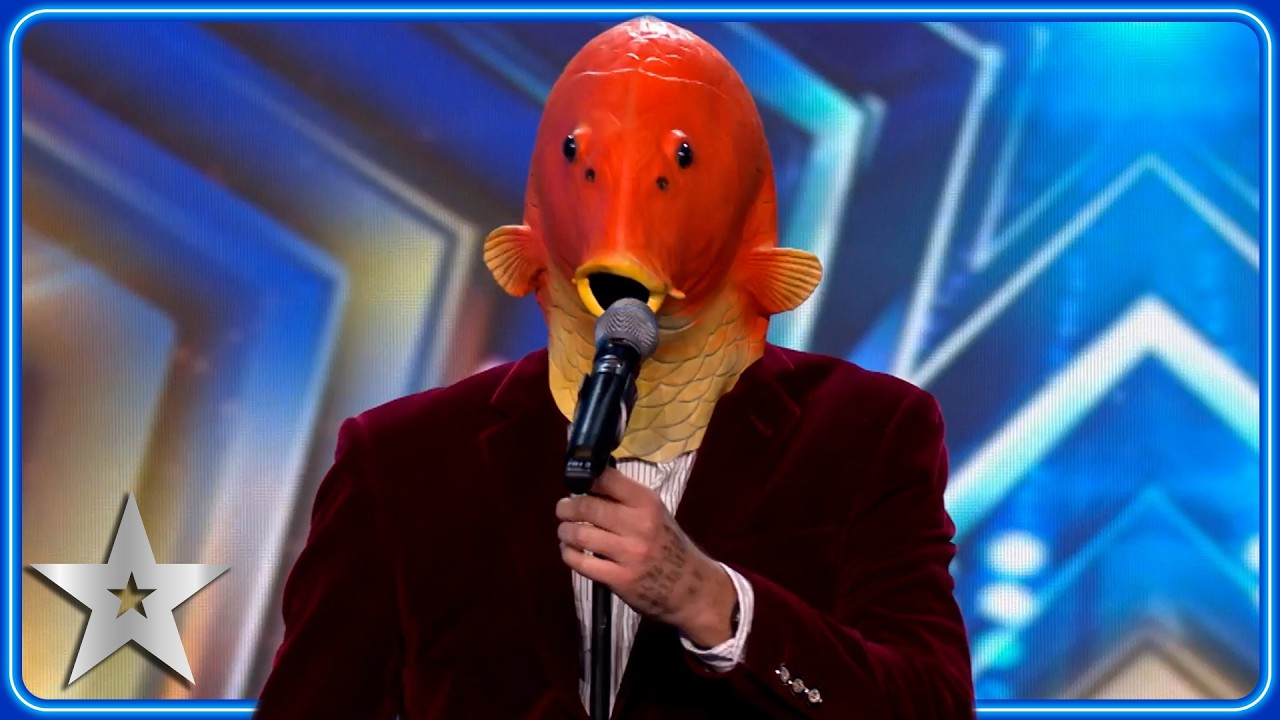
And then, with the show on a playful tilt, in swims a legend-in-the-making: a goldfish comedian in a bowl-shaped helmet, pebble-dry delivery intact. He introduces himself the way only a legend would.
“Hello. How are you? My name is Bobby Goldfin… I’m the only goldfish on a UK comedy scene.”
The judges light up. The audience leans in. The first joke starts the old-fashioned way:
“I’m Bobby Goldfin. I got some jokes… Knock knock.”
He waits. He blinks. Silence expands like rubber. “Who’s there?” a judge prompts, kindly, twice. He stares down the void again. The punchline swims past and escapes. Bobby flounders through another start—two fish, a bar, a promise of impact—and clips the setup into a “barn.” A judge finally puts a hand on the bowl and says what everyone is thinking:
“One of the good thing is you’re gonna forget this ever happened.”
They say no. He drifts off. And then, with the shameless logic of sketch comedy and the stubbornness of a folk hero, he returns. Again. A judge throws up their hands:
“Just so the audience know, this goldfish got four nos and for some reason is back.”
Another judge, clutching at hope and common sense at once, tries a reset:
“You were here before, and you were terrible. So maybe you’ll be better now. Good luck.”
The lights find him. He clears his throat. “Knock knock.” The room giggles like a child told the same bedtime story for the fifth night running. Comedy isn’t always in the punchline; sometimes it’s in the ritual, and the shared right to keep trying.
A creature from the wings and a two-minute ultimatum
Midway through, the show’s curiosity deepens into bewilderment. Something lumbers into view, and a judge blurts what we’re all thinking:
“What is that?”
“That is freaking—”
It’s unclassifiable and, somehow, polite. “Thank you for coming,” someone says, as if to usher a well-meaning alien toward the exits. Another judge sharpens the moment:
“Do you think you can win Britain’s Got Talent?”
The reply is hardly a reply. “Okay.” And then the stage manager’s creed, thrown like a life ring:
“Two minutes to change your life. Good luck.”
On this night, two minutes is enough to ask a dozen questions and answer none. That is the fun.
Titanic ambitions, inflatable realities
Of course, no parade of the bizarre is complete without slapstick history. A troupe hauls in props that any cinephile would recognize on sight. A judge whispers, delighted and aghast, “Oh, it’s the Titanic. Titanic.” Life jackets bulge, alarms squeal, timing misfires, and the performers wrestle their way through the kind of calamity that only rehearsal can produce.
“Again, wasn’t a two man job. One of us put it in the court. One of us should have done the life jacket.”
It is both confession and punchline. The crowd roars. If grace is the art of making difficulty look easy, this act flips the theorem: they make bedlam look like design, and it works.
An impressionist vs. Alexa
Then a rapid-fire voice factory barges in and commandeers the speaker system like a mischievous DJ. The performer summons songs, shutters them, throws commands, and wrestles with invisible tech. The show’s most modern argument plays out in shouts and shrugs:
“It’s impression showtime… Let music come on. Come on. Come on.”
“Alexa. Alexa.”
The machine and the mimic butt heads; chaos becomes the groove. Every false start is its own joke. Requests stack and scatter:
“Next… music. Come on.”
“Keva. Okay. Okay.”
“Thank you very much. Next.”
In lesser hands, it’s noise. Here, it’s evidence that the best impressions are not of people but of the frantic world the rest of us are trying to keep up with.
The verdicts, the echoes, the point
Across the night, the judges become a Greek chorus of disbelief. One stares at the wreckage and sighs:
“Honestly, I just don’t know what to say anymore on this show.”
Another taps the buzzer in spirit, if not in fact:
“What a load of rubbish.”
And then, in the glow after an unlikely success, a line that sums up the strange democracy of the stage:
“This is the one.”
These swings matter because the show treats absurdity with the same earnestness it grants a perfect high note. Even the pop juggernaut moments—yes, there’s a familiar icy anthem belted with more heart than pitch—are less about vocal polish than about daring to claim a corner of the roar. The stage is large enough for precision and pratfalls alike.
Which brings us back to Bobby Goldfin. Near the end, as if pulled by tide and duty, he edges forward one more time. He takes the mic, and delight ripples through the room before he speaks. He doesn’t have to be good; he only has to be Bobby. He delivers the line like a greeting to old friends:
“Thanks, guys. It’s swell to be here. I’m Bobby Goldfin.”
He pauses. He dares. He knocks.
“Knock knock.”
There it is—the punchline that never lands, the setup that becomes the joke. It’s a small miracle of shared patience. Comedy, this segment argues, can be a door you keep tapping on together. Some nights, the door never opens. The laughter still does.
Why it’s worth watching
What this montage captures isn’t just the shock of the new; it’s the relief of not knowing what shape joy will take. A human soundscape makes a judge blurt a compliment before the mind can catch up. A caped crooner reframes fandom as theater. A runway whisperer calls in security and proves that poise and panic can share a spotlight. A rubbery sea epic sinks with style. An impressionist duels with a smart speaker and finds music in misfire. And a goldfish turns failure into a running gag that unites a room.
It’s less a checklist of acts than a case study in why variety still matters on TV: you come for the prodigy, you stay for the surprise, and you leave with the sense that risk itself is entertaining. If you crave order, this isn’t for you. But if you want to see what happens when a stage invites our strangest dreams to try their luck—well, there’s a seat with your name on it.
Dive in. Let the judges’ groans and gasps be your guide. Somewhere between “What is that?” and “This is the one,” you’ll find the reason this show keeps pulling us back: two minutes may not always change a life, but they can change your mood, your evening, and your faith that somewhere out there, even a goldfish can bring down the house.