Inside AGT’s Most Daring Night: Drones, World‑Changing Dance, and Real Magic
America’s Got Talent has always promised surprise. But every so often, a lineup arrives that feels less like a talent show and more like a field guide to the future. This showcase delivers exactly that: precision dance that becomes a living sculpture, magicians who paint with light and reality, quick-change at the speed of a blink, and a comeback so risky you can feel your pulse in your ears. Across it all runs a simple through line: audacity.
A stage that feels like another planet
The night opens with a shimmer of light and a hush of anticipation. Eleven performers step forward from Japan with an idea that fuses choreography and code. They call themselves 11 Play, and their goal is almost guileless in its simplicity: “+To share our performance with all of America.+” Then the music rises, drones bloom overhead like fireflies, and the dancers move through a changing architecture of light.
“I think this is really, really smart,” Simon said, adding, “this is so current… this could be incredible going forward.”
Heidi admitted, “I just thought I was on a different planet… I’ve never seen anything like this before.”
Another judge grinned through happy tears at the troupe’s emotion, marveling that, for once, the “geeky techno guys” and graceful dancers had become one idea. Three emphatic yeses followed, and the room felt newly awake.
Sixty-five dancers, one vision
Scale arrived next in a rush. “My name is Gabriel Mayo… we bring 65 dancer on stage,” the French performer announced, representing the work of his brother, Sadek. What followed was not merely a crowd; it was a city in motion—waves of bodies folding into one another with the tempi of commuting and dreaming. In a sly technological wink, the stage spoke too: Please select your destination. Forest… Please select your avatar. Wolf. Loading. A target appeared, an arrow loosed, and the choice felt like an entrance into a narrative world where stagecraft and story merged.
Later in the night, two more innovators, Constantin and Yuri, compressed an entire cinematic universe into minutes. A judge captured the feeling most clearly:
“What you’re able to do with the technology and the amount of creativity that goes into that, that was amazing.”
Heidi followed: “One of the most amazing things I’ve ever seen. I really, really enjoyed it.”
Four yeses sent them forward, and the show’s thesis sharpened: imagination here wasn’t an accessory; it was the engine.
When risk is the point
Then came a hush you can’t fake. Christine, Marco, and Eve—“the Russian Bar Trio”—rolled a narrow flexible beam onto the stage, the same device that had nearly ended Christine’s career eight years earlier. She said it without drama: “+About eight years ago, I actually fell off the stage, and I got hurt really bad.+” No wires. No net. Just trust, flight, and a thin line between triumph and gravity.
The trio’s routine built cleanly—press, launch, land—until you realized how high the arc had grown and how hard the floor would feel. When it ended, relief was part of the applause.
“You could have broken your neck,” Simon said, pausing, “but it was more than a comeback… it was a triumph.”
Four yeses, and a little collective breath returned to the room.
Wheels, wobbles, and why it matters
Unicircle Flow turned the stage into a kinetic sketchbook, tracing rings through the air on sleek unicycles as if drawing treble clefs in motion. There was a slip—brief, human—and then a regrouping so smooth it became part of the story.
“Wow for what you do,” Howie said. “I love the choreography. I love the strength… There were a couple of foibles, but you were able to get back on the bike and ride.”
Heidi added, “You all move with such grace that half of the time I even forgot that you all were on unicycles.”
Simon kept it simple: “We’ve never seen an act like this before… the fact that someone fell over made it even more exciting… This is what AGT, what Vegas, what the Luxor show is gonna be all about. You’ve given yourselves a real shot.”
It was a reminder that perfection is persuasive, but resilience is unforgettable.
The night the room forgot to breathe
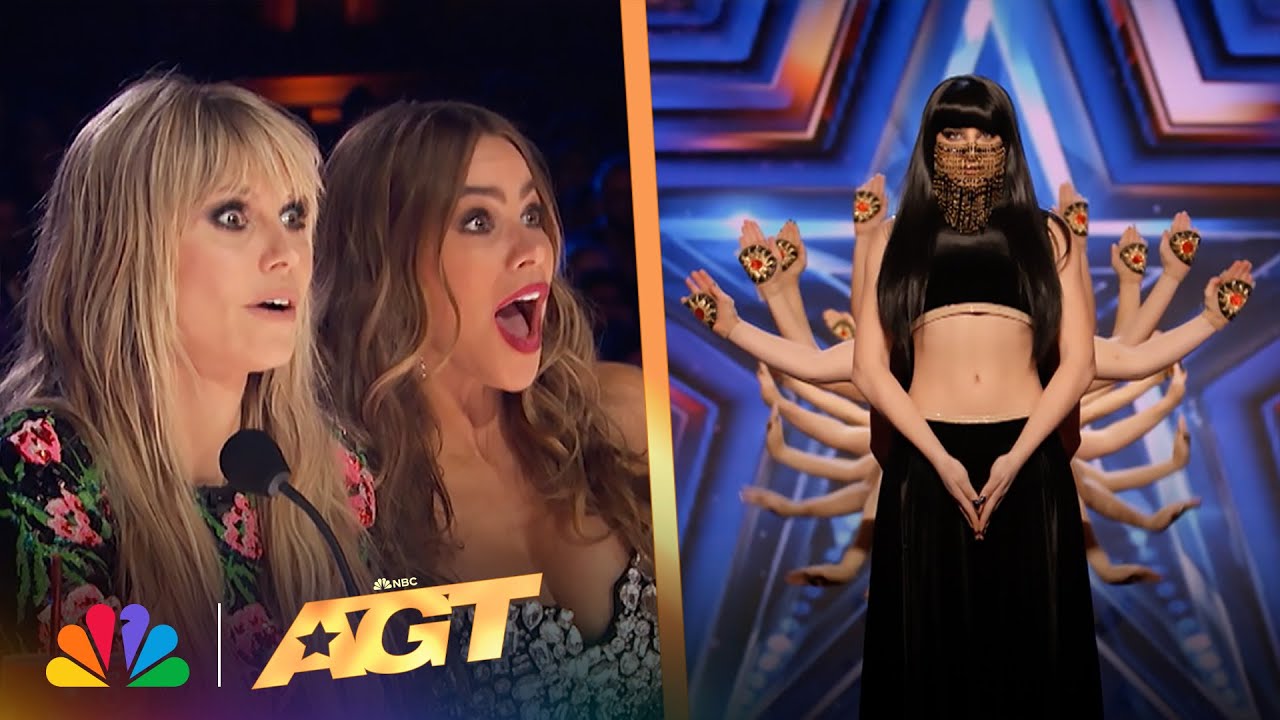
Not every dance act is a group; some are an organism. A precision collective arrived and, within seconds, erased the spaces between individuals. Arms became wings, bodies became facets, and the stage glowed with a geometry that felt alive. The judges didn’t hold back.
“Every single one of us in this room… are gonna remember this moment,” Simon said. “This is a performance that changes the world.”
Howie tried to name what he saw: “You create one of the most beautiful… powerful… Creature. You are all together. You become one creature… the best moment I have seen in AGT.”
Heidi sealed it with a destination: “I really think that you are Vegas ready. You don’t to do anything else. You are ready for Vegas.”
In a season defined by invention, this was the sequence that made invention feel inevitable.
Magic finds new edges
Magic, too, refused to sit still. A young woman spoke about her father: “+My dad, he was performing a lot of magic in France… I told him that the best show in the world is America’s Got Talent, and he had to audition… My dad always told me to follow my dreams, so I told him the same thing.+” Onstage, a host obliged the ritual. “+Pick a card. Any card… Sign it… I put your card in the middle of the deck slowly. Take it, and take it safe.+” It was classic structure wrapped in the tenderness of a family dare to dream.
Then Nicolas Ribs reset the definition of a card trick. Pages, pixels, and props passed back and forth until it was hard to know where the hand ended and the screen began.
“Wow. I mean, wow. Wow. Wow,” Heidi said. “The combo of technology and reality is so mind blowing. It’s insane.”
Sofía added, “I think you have brought a new style of magic to AGT… It’s fantastic. It’s visually amazing.”
Simon was blunt: “I forgot about you… again, a magician has made me look really stupid in the live shows because that was… in terms of a live performance… magic, one of the best we’ve ever seen.”
It wasn’t just new; it was necessary—the kind of modern magic that makes you question your definition of cause and effect.
The village magician who became a pigeon
Hara, from a “+very, very tiny village… Totsukawa Village in Japan,+” bowed shyly and announced that performing “+in front of you and you and you was biggest dream.+” In two minutes of delicacy and delight, he made good on it—flowers, folds, and a finale so gently impossible the judges just laughed.
“Now I believe in magic,” one judge told him. “It was stunning.”
Another marveled, “The fact that you just turned into a pigeon in front of our eyes, that is unbelievable… for those two minutes, it was like being in the happiest place… I just didn’t want it to end.”
It’s one thing to shock; it’s another to charm the room into stillness. Hara did both.
Blink and she’s wearing something new
Quick-change has a storied AGT history, and Sos and Victoria honored it with craft and speed. Married nearly twenty years, they brought a couture workshop to the stage: “+All the costumes you gonna see, it’s made by us.+” In a kaleidoscope of color and cut, Victoria stepped forward, swirled, and—pop—she became someone else entirely. Again and again.
“You really blew my mind. It was fabulous… You managed to pop color in there… design, patterns. It was so entertaining. It was brilliant,” a judge raved.
Simon, ever frank, teased that the dancing was “a bit corny,” but conceded, “one of the best we’ve seen. Congratulations.”
It was quick. It was slick. And it reminded everyone that craft at speed is its own kind of poetry.
The juggler in leopard print
Victor strode out in a leopard-patterned suit that earned the first question: “+What are you wearing? Are you wearing something?+” He deadpanned, “+It’s actually clothes, so don’t be tricked, especially the last rows.+” Born in Ukraine and a proud American for two decades, he turned the stage into a synchronized cascade as balls rained from the ceiling into impossibly smooth patterns.
Heidi stood to salute: “It was really, really special… I have no idea who is in our ceiling up there, but it was fantastic how these balls were just coming down. I loved it.”
Mel called it “intense” and “absolutely flawless.”
It was a master class in timing, a reminder that elegance often hides in repetition done right.
Why this night matters
If there’s a single idea that holds this showcase together, it’s the courage to reimagine the familiar. Dancers became a single body. Unicyclists chased grace, not just balance. A trio dared a second chance without a net. Magicians pulled us across the membrane between analog and digital. Even the quick-change artists reframed fashion as instant storytelling—and the juggler turned a costume joke into a study in precision.
Along the way, the judges found new language to match the scale onstage: “Vegas ready,” “best moment,” even a claim that a performance could “change the world.” It sounds grand until you watch—and then it just sounds accurate. That’s the quiet power of nights like this: they widen the room for what’s possible, not just on a stage, but in the imaginations watching from home.
Set aside some time and press play. Whether you come for the drones, the daring, the creature-like chorus lines, or the magic that turns pixels into real-life gasp, you’ll leave with your own favorite moment—and a sense that the bar just moved higher.