The Bank Sent Someone To Change His Locks — He Came Up The Driveway In Uniform
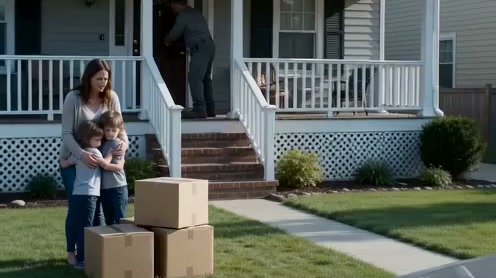
A bank contractor was changing the locks on a deployed soldier’s house while his wife and kids stood on the lawn with their boxes… But the soldier had just walked up his own driveway — still in uniform — carrying federal law folded in his breast pocket for six weeks.
Staff Sergeant James Reeves had been carrying the paperwork for six weeks.
It sat in the breast pocket of his deployment bag — printed, folded, notarized — a specific weight he knew the location of the way soldiers know the location of everything that matters.
Maya had called on a Tuesday.
He’d stepped out of a briefing to answer. Heard her voice doing the thing it did when she was trying not to cry in front of the kids. The bank had sent a notice. Thirty days.
He went straight to the JAG office that afternoon.
Captain Morrison looked at the notice. Looked at James. Pulled out a legal pad.
“Servicemembers Civil Relief Act,” Morrison said. “Prohibits foreclosure on an active duty servicemember’s primary residence without a court order. They cannot touch your house while you’re deployed. Full stop.”
“They sent a thirty-day notice,” James said.
“They can send whatever they want,” Morrison said. “Doesn’t make it legal.”
Morrison printed the relevant SCRA sections. Had James sign an affidavit. Had everything notarized through the base legal office. Slid the packet across the desk.
“Give them this,” Morrison said. “They’ll stop.”
James folded the paperwork into his breast pocket.
He’d been meaning to mail it.
Then his leave came through.
Fourteen months in, the compassionate leave request he’d filed in February finally cleared. Two weeks. He booked the flight the same day. He started a message to Maya three times and deleted it every time. She was carrying enough — the notices, the kids, the second job. He wanted to give her something she wasn’t bracing for.
He wanted to walk up the driveway.
He landed at O’Hare at six AM. Took a cab to the neighborhood. Had the driver stop at the corner.
Walked the last block.
He saw the contractor’s van first. White. Bank logo on the side. Parked directly in front of his house.
Then he saw Maya on the lawn. Ellie, seven, stood beside her in her school clothes. Marcus, four, held a stuffed bear with both hands, completely still the way small children go still when something is wrong and they don’t have the language for it yet.
Three boxes on the grass.
The contractor was on the porch, back to the street, changing the lock on James’s front door.
James stopped at the end of the driveway.
He looked at the contractor. At the boxes. At Marcus and his bear. At Maya’s face, which moved through three expressions in two seconds — the specific sequence of someone carrying something very heavy who has just been offered somewhere to set it down.
He reached into his breast pocket.
Took out the paperwork.
Unfolded it once.
Walked up the driveway.
The contractor heard the footsteps and turned. He read the uniform first. Then the face. Then he looked past James at the woman on the lawn, at the two children, and something shifted in his expression.
James set the paperwork on the porch railing between them.
“Servicemembers Civil Relief Act,” James said. His voice was level. Briefing voice. “Active duty servicemember. Primary residence. You need a court order to foreclose. You don’t have one.”
The contractor looked at the document. Looked at James. Looked at the bank logo on his own van like it had just become a problem.
He picked up his phone.
Called someone. Talked for forty-five seconds. Listened. Hung up.
He picked up his tools.
Then he picked up the original lock — the one he’d removed — and set it on the railing beside the paperwork.
“I’ll need you to reinstall that,” James said.
The contractor reinstalled it.
Four minutes. Tools back in the bag. He walked down the porch steps, got in the van, and drove away without another word.
James watched the van turn the corner.
Then he turned around.
Maya was standing at the bottom of the steps. She’d crossed the lawn without him noticing. Ellie was beside her, gripping her sleeve. Marcus was three feet away, still holding the bear, still processing.
“You didn’t tell me,” Maya said.
“I wanted to surprise you,” James said.
She looked at the porch. At the lock. At the paperwork on the railing. When she looked back at him her jaw was tight the way it got when she was deciding whether to be angry or relieved and relief was winning.
“You came home for this,” she said.
“I came home for you,” he said. “This was just the first thing.”
Marcus had been staring up at him since he turned around.
“Dad?” he said.
“Yeah,” James said. “It’s me.”
Marcus held the bear out toward him.
James crouched down. Took the bear with one hand. Picked his son up with the other arm. Ellie grabbed his sleeve. Maya put her hand flat on his shoulder — not a hug yet, just a hand, the specific contact of someone confirming that something real is standing in front of them.
“Come inside,” she said.
“Yeah,” he said.
He picked up the paperwork from the railing with his free hand. Folded it once. Put it back in his breast pocket. Where it had been for six weeks. Where it had done its job.
They went inside.
The door locked behind them with the original lock.
The one that had always been theirs.
Three weeks later, the bank’s legal department sent a formal letter acknowledging the SCRA violation and waiving all foreclosure proceedings. Captain Morrison had referred the case to a military legal advocacy organization, which filed a federal complaint the same week. The bank settled within thirty days. James used part of the settlement to clear fourteen months of missed payments. The rest went into savings.
Marcus named the bear James.
James didn’t find out until Christmas — when Marcus introduced them, very seriously, one to the other.
James shook the bear’s paw.
“Good to meet you,” he said.
Marcus nodded like that was exactly the right response.