She Slapped a Little Girl at School — Her Big Sister Just Got Off the Train
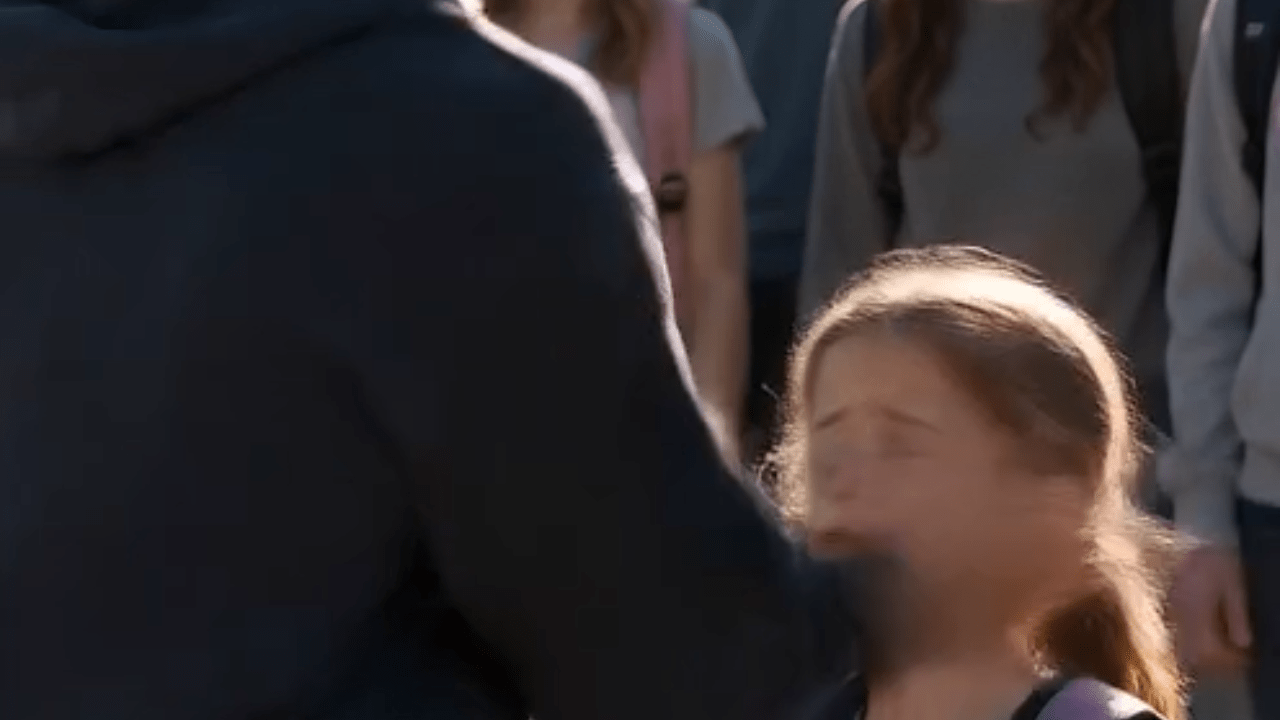
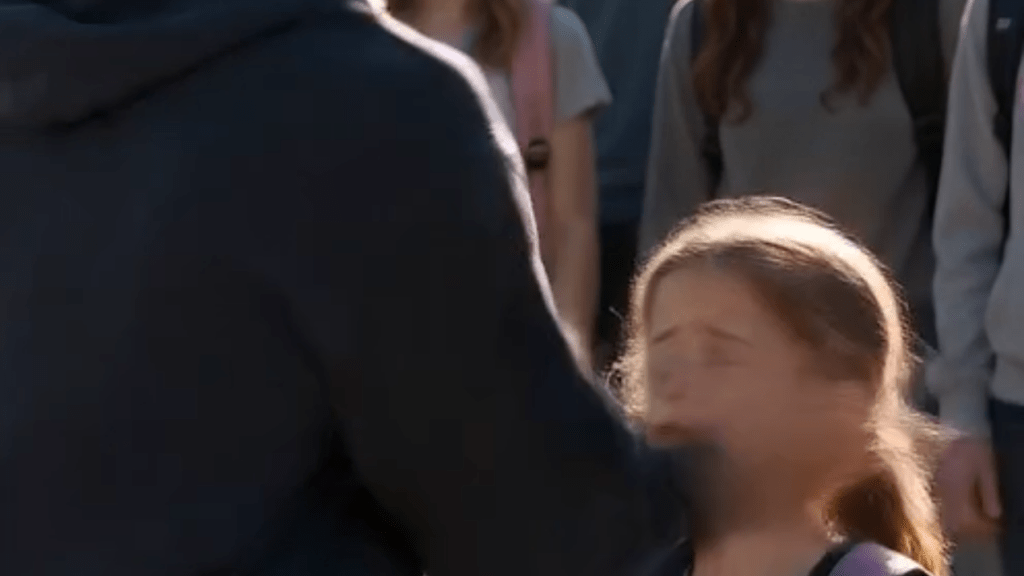
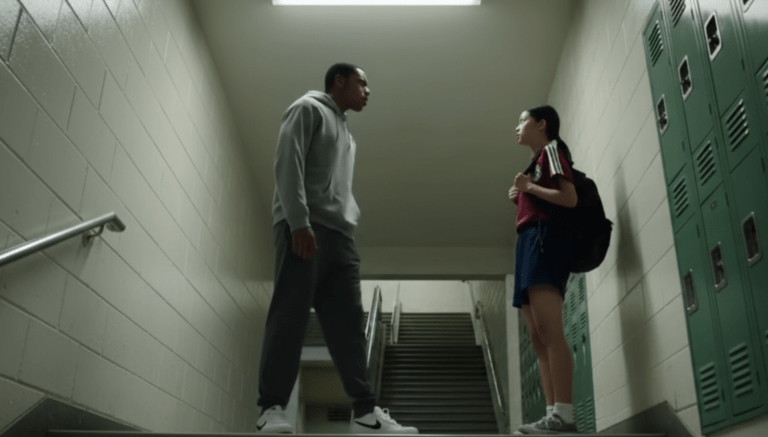
A senior boy slapped a ten-year-old girl at the school entrance in front of everyone… But her big sister had just stepped off the morning train — seven months deployed — still carrying the secret bookmark her little sister had slipped into her bag the night before she left.
Corporal Jamie Reyes had been on the 7:40 train from Union Station.
Seven months. Two weeks of leave. The specific arithmetic of a deployment that started in February and was ending in September, and had contained within it every kind of difficult thing that deployments contained — the specifics of which she kept to herself, because that was how she was built.
Her sister Nora was ten years old.
When Jamie deployed, Nora had been nine. That one-year gap felt larger than it should — a whole collection of things Jamie hadn’t seen, hadn’t heard, hadn’t known about until they arrived in letters written in the careful handwriting of a child learning that the people you loved sometimes went far away, and you had to find ways to reach them across the distance.
Nora had written every week.
Jamie had written back every week.
Forty-two letters, both directions. They were in her duffel bag on the overhead rack of the 7:40, and she was going to carry them home and put them somewhere that meant something.
She’d found the bookmark on the first day.
Not in a letter. In her book — the paperback she’d shoved into her bag in the specific hurry of a departure that always had too much to do and not enough time to do it. She’d opened it on the transport and the bookmark had fallen out onto her lap.
Cardstock. Colored pencils. Two figures — one tall, one small — standing in front of a house rendered with the confident inaccuracy of a child who knew what the house meant even if the proportions were wrong. A sun in the corner. Their names at the bottom in careful block letters: *Jamie. Nora.*
And at the very top, in smaller writing, clearly added as an afterthought: *so you don’t lose your place.*
Jamie had sat with it in her lap for a long time.
She hadn’t known Nora had put it there. Nora hadn’t said a word. Had just — done it. Probably the night before, while Jamie was finishing her packing, Nora had found cardstock and colored pencils and made something and slipped it into her bag in the dark without saying anything.
*So you don’t lose your place.*
Jamie had used it every single day for seven months.
She had it in her jacket pocket when she stepped off the 7:40 train.
The school was four blocks from the station. She’d planned this walk before she left — had pictured it specifically, the four blocks in September morning air, the feeling of approaching something that had been waiting for her.
She’d taken the bookmark out on the train, actually. While the city was still blurring past the windows, she’d held it in both hands and thought about Nora’s face when she saw it. *I carried this. Every single day. So I wouldn’t lose my place.*
She was still holding it when she came around the corner.
She saw Nora’s hand go to her face before she understood what she was seeing.
Then she understood.
The bookmark went back into her pocket.
Both hands free.
She crossed the street.
The entrance to Jefferson Middle-High was wide concrete steps, a metal railing, students arriving in the organized chaos of a school morning. She went up those steps the way she’d crossed tarmacs and gone through doors that were harder than this — steady, at the pace that covered ground without announcing itself.
Students moved out of her way.
She didn’t notice.
She reached Nora first.
Both hands on her sister’s face — not checking the mark specifically, but checking Nora underneath the mark. Whether she was actually okay. Whether the thing that needed to be okay still was.
Nora looked up at her.
“Jamie.” The word contained seven months and forty-two letters and a bookmark slipped into a bag at ten PM without a word.
“I know,” Jamie said. “You okay?”
“He does it a lot,” Nora said quietly. “Not just to me.”
“I know.” Jamie’s hands were still on her sister’s face. “I’m going to go talk to him.”
She stood up.
Turned.
The senior boy was still there — tall, seventeen, wearing the specific expression of someone who had made a calculation and was now rapidly revising it. He was bigger than most of the students around him. He’d been counting on that.
He looked at Jamie.
Jamie looked at him.
She didn’t raise her voice. She didn’t have to.
“She’s ten years old,” Jamie said. “What’s your reason.”
Not a question. A door she was holding open exactly long enough for him to understand there was no answer behind it.
He had nothing.
His mouth opened. Closed. He looked at the students around him — forty witnesses, all of them watching, none of them moving to help him.
“That’s what I thought,” Jamie said.
She turned back to Nora, took her hand, and walked her inside.
What happened after was the school’s business.
The principal called his parents within the hour. The assistant principal reviewed the security footage — all of it, not just that morning, because Nora had been right: it wasn’t the first time. Three other students came forward by noon. The suspension was three weeks, with a mandatory review before reinstatement. The school resource officer filed a report. Jamie filed one too, without drama, because that was what you did when someone hit a ten-year-old in front of forty witnesses.
She let the school handle it.
Then she sat in the principal’s office and made sure they actually did.
“I want the other families notified,” she said. “The ones whose kids he’s done this to. They deserve to know what the footage shows.”
The principal nodded. “We’ll reach out today.”
“Not tomorrow,” Jamie said. “Today.”
“Today,” the principal agreed.
She stood, shook his hand, and walked out.
By afternoon, the suspension was confirmed, the other families had been called, and the boy’s parents had sat in that same office looking at footage they couldn’t explain away. His father had tried, briefly. The principal had pressed play a second time.
That was the end of the trying.
That evening, Jamie sat on the edge of Nora’s bed.
Their mother was downstairs — something with garlic, the smell of every homecoming Jamie had ever imagined on the bad nights when imagining helped. The house was warm and quiet and exactly the size it had always been.
Nora was cross-legged on the bed, watching her with the focused attention of a child who had been waiting a long time and was now making up for every minute of it.
Jamie reached into her jacket pocket.
Took out the bookmark.
Held it out.
Nora went still. She looked at the cardstock. The colored pencils. The two figures in front of the lopsided house. The sun in the corner. Their names at the bottom. The small careful words at the top.
*So you don’t lose your place.*
“You kept it,” Nora said.
“Every day,” Jamie said.
Nora looked up. “I didn’t think you’d find it. I put it in when you weren’t looking.”
“I found it on the transport,” Jamie said. “First day. It fell out when I opened the book.”
Nora stared at the bookmark in her own hands now, turning it over slowly like she was seeing it differently — not as something she’d made, but as something that had traveled.
“I was going to give it back the second I stepped off the train,” Jamie said. “I had it out. In my hand. And then I looked up and saw you.”
Nora looked at her. “You put it back in your pocket.”
“I needed both hands.”
The room was quiet for a moment.
Then Nora laughed — the real one, the full one, the laugh Jamie had been carrying in her memory for seven months like a sound she was afraid she’d start to misremember. She’d gotten it exactly right. It was the same laugh.
“You needed both hands,” Nora repeated, like it was the best thing she’d ever heard.
“I did,” Jamie said.
Nora smoothed the bookmark carefully against her knee. She looked at it for a long moment — the lopsided sun, the wrong-proportioned house, the names, the words at the top that a nine-year-old had written at ten PM without telling anyone.
Then she leaned over and set it against her lamp on the nightstand, facing out, where the light caught it.
“I’m keeping it here,” Nora said. “So you can see it when you’re home.”
Jamie looked at the bookmark against the lamp. The small careful letters. *So you don’t lose your place.*
Seven months. Forty-two letters. Four blocks in September morning air. Both hands when she needed them.
“Deal,” she said.
She reached over and put her arm around her sister, and Nora leaned into her the way she had since she was small, and the house smelled like garlic and September and home, and neither of them said anything else for a long time, because they didn’t need to.
They hadn’t lost their place.