A Senior Girl Slapped The Wrong Kid — His Sister Walked In Straight From Her Night Shift
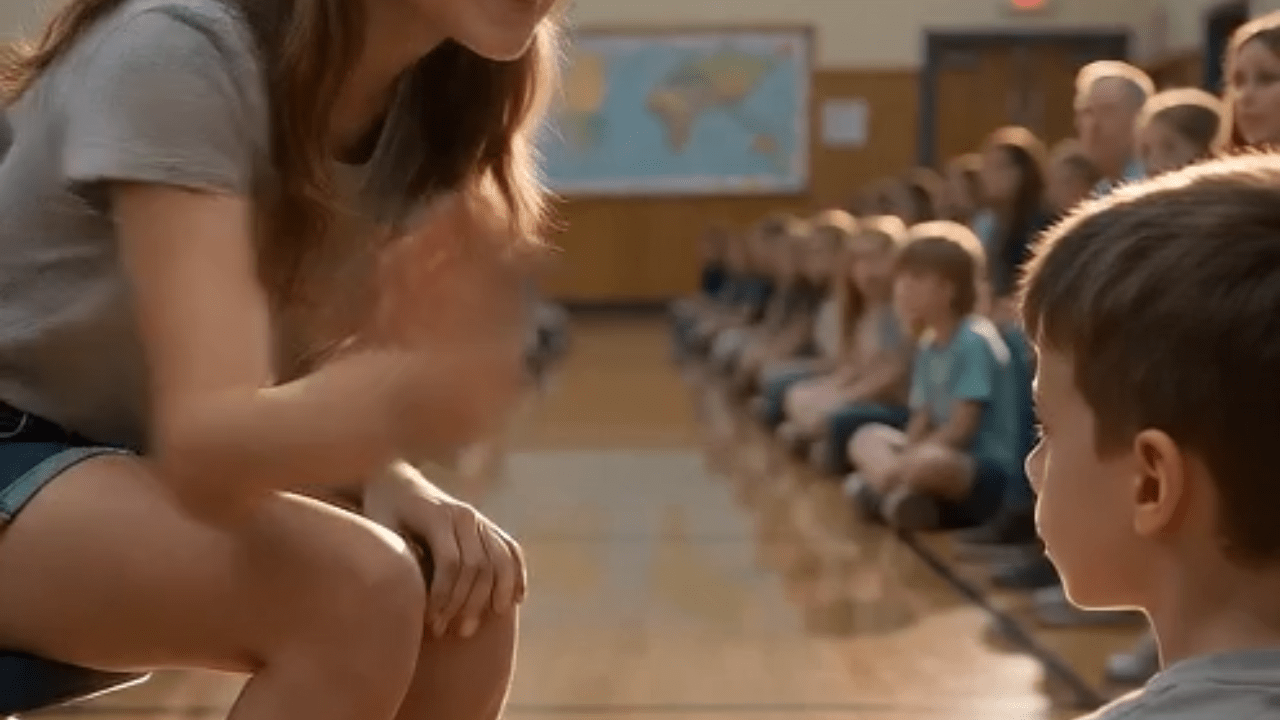
A senior girl slapped a quiet little boy at the school morning assembly in front of every parent and student… But his big sister was already rising from the parent section — still in her night shift scrubs, hospital badge catching the auditorium light.
Caleb had been talking about this assembly for two weeks.
“You’re coming, right?” he’d asked every single morning, standing at the kitchen counter in his dinosaur backpack, cereal spoon in hand. “You promised.”
“I promised,” his sister Maya had said every time. Every single time.
She’d worked twelve hours straight. Pediatric ward, third floor, two codes and a kid who reminded her of Caleb the whole shift. She clocked out at seven forty-two, drove straight to Riverside Elementary still in her scrubs, badge clipped to her chest, coffee she hadn’t finished sitting cold in the cupholder.
She found a seat in the parent section along the side wall and spotted Caleb immediately.
He was cross-legged in the third row of students, fidgeting with his shoelace, scanning the parent chairs. When he found her face, he lit up like she’d handed him something. She gave him a small wave. He gave her a huge one back.
She hadn’t slept. She didn’t care.
The senior students filed in last, taking the rows behind the younger grades. Maya noticed the girl immediately — not because of anything specific, just the way some people carry themselves in a room like the room owes them something.
Seventeen, maybe. Expensive sneakers. The kind of laugh that’s meant to be heard.
She sat directly behind Caleb’s row.
Maya watched her lean over to the girl beside her and say something. They both looked at Caleb. The girl beside her covered her mouth, laughing.
Maya sat forward slightly.
The principal was three sentences into the morning announcements when it happened.
Open hand. Back of Caleb’s head. Hard enough that he lurched forward, both palms hitting the floor to catch himself.
The sound carried.
The senior girl was already laughing, turning back to her friend like she’d done something clever.
Caleb’s hand went to the back of his head. He didn’t cry. He just sat very still, the way kids do when they’re deciding whether crying will make it worse.
Maya was standing before she’d made the decision to stand.
She stepped out of the parent chair row into the aisle. The badge caught the overhead light as she moved — blue lanyard, hospital logo, her photo, her name, her department. She hadn’t even thought about it. She’d come straight from work. She was still all of it.
Every parent in the row turned to watch her.
Every student in the nearest rows tracked the scrubs, the badge, the face that had been awake for going on nineteen hours.
She walked to her brother first.
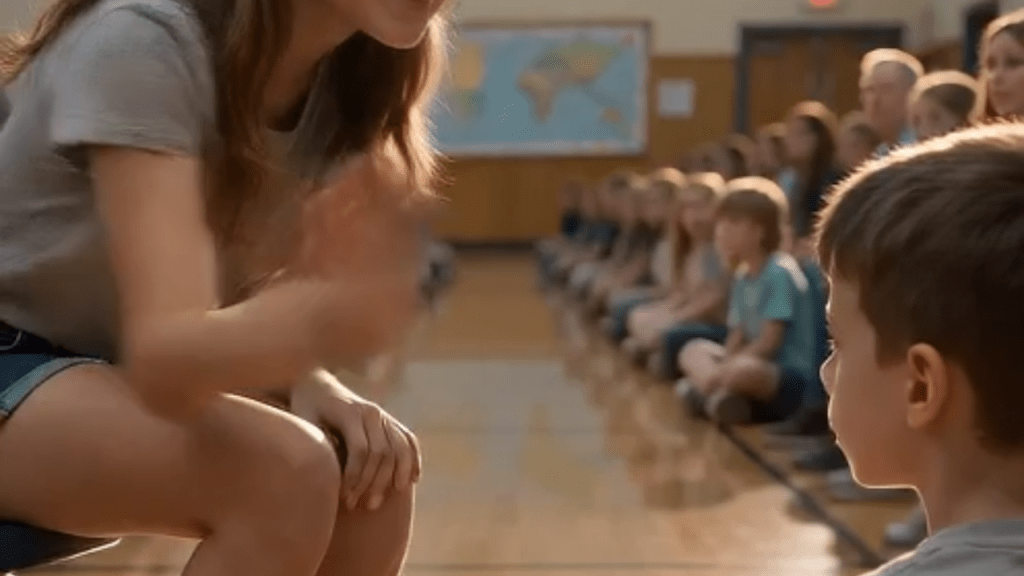
She crouched down in front of him, both hands cupping his face, tilting his head gently, checking his eyes the way she checked patients — pupils, tracking, responsiveness. Professional and fast and completely focused.
“Hey,” she said quietly. “Look at me. You okay?”
Caleb nodded, eyes a little wet. “She just hit me.”
“I know.” She checked the back of his head with two fingers. No swelling. “I saw.”
She held his face one more second. Then she stood up.
She turned to the senior girl.
The girl had stopped laughing. She was looking at Maya the way people look at something they didn’t expect to materialize — a little uncertain, performing confidence she wasn’t fully feeling.
“What?” the girl said. “He was being annoying.”
Maya didn’t raise her voice. She didn’t need to. The auditorium had gone the specific quiet that happens when everyone present understands something real is occurring.
“You hit a nine-year-old,” Maya said.
“It was a tap.”
“I watched it from twenty feet away.” Maya’s voice was flat and even. “It was not a tap.”
The girl looked at her friends, then back. “Who even are you?”
“I’m his sister.” Maya let that sit for exactly one second. “I’m also the person who just checked his neurological response because you struck him hard enough that I needed to.”
That landed. The girl’s expression shifted slightly — not remorse, not yet, but the first crack of realizing this was not going the direction she’d planned.
One of the teachers was moving toward them now. The principal had stopped speaking entirely.
“Is everything alright?” the teacher asked, voice careful.
“No,” Maya said. She wasn’t unkind about it. She was just accurate. “A student struck my brother in the back of the head during the assembly. I’d like to know what the school’s protocol is for that.”
The teacher looked at the senior girl. “Brittany—”
“I barely touched him,” Brittany said, but her voice had lost some of its earlier certainty.
“I have about forty witnesses,” Maya said, “including every parent sitting in that section, who watched it happen.”
She didn’t gesture. She didn’t raise her voice. She just stated it, the way she stated things to attending physicians at three in the morning when she needed them to understand the facts.
The principal came down from the stage.
He was a tall man, fifties, the kind of administrator who’d seen enough to read a room. He read this one quickly — the scrubs, the badge, the quiet young woman who had clearly come from somewhere important and was not going to be managed.
“Ms.—”
“Reyes,” Maya said. “Maya Reyes. I’m Caleb’s legal guardian. I’m also a registered nurse, and I’m telling you that the strike was significant enough that I performed a basic neurological check on my brother in the middle of your auditorium. That’s what just happened.”
The principal looked at Brittany.
Brittany looked at the floor.
“Brittany,” he said. “Come with me.”
“It was a joke,” she said.
“It wasn’t,” Caleb said quietly from the floor.
Everyone heard him. Small voice, very clear.
Brittany’s mother was called. She arrived twenty minutes later in workout clothes, already defensive before she’d heard a word.
“Brittany would never—” she started.
“There are fourteen parents who saw it,” the principal said. “We’ve already spoken to three of them.”
The mother looked at Maya — the scrubs, the badge, the exhaustion that had settled into something steady and immovable. “And who are you?”
“His sister,” Maya said. “His guardian. And the person who checked him for a concussion in front of your daughter because she thought hitting a nine-year-old was funny.”
Something shifted in the mother’s face. Not quite shame. Close to it.
Brittany received a three-day suspension and a mandatory conflict resolution program. The school called Maya that afternoon to confirm, and to tell her that two other families had come forward to report similar incidents involving Brittany over the past semester.
“We should have acted sooner,” the vice principal said on the phone. “I want you to know we take this seriously.”
“I know you do now,” Maya said.
She wasn’t cruel about it. She just said it.
She’d taken Caleb home after the assembly, stopped at the diner two blocks from their apartment — his choice, always his choice — and let him order the pancakes with the face made out of blueberries.
He was quiet for a while, pushing a blueberry around with his fork.
“Were you scared?” he asked.
“No,” she said.
“Were you mad?”
She thought about it honestly. “Yes.”
He nodded like that was the right answer. Then: “You still had your badge on.”
“I came straight from work.”
“I know.” He looked up. “I saw you sit down. I saw your badge. I thought—” He stopped.
“What?”
“I thought, she actually came.” He said it simply, without drama. The way kids say the truest things. “You actually came.”
Maya reached across the table and put her hand over his.
She’d worked nineteen hours. She’d driven straight from the hospital. She’d walked into that auditorium in her scrubs with her badge still clipped to her chest because she had made a promise to a nine-year-old boy who saved her a seat in his mind every morning at breakfast.
“I always come,” she said.
He believed her. He’d always believed her.
He picked up his fork and ate his pancakes, and she sat across from him in her hospital scrubs in a diner booth, badge still on, and for the first time in nineteen hours, she felt completely still.
Brittany returned from her suspension to a school that remembered what happened. Not cruelly — kids aren’t always cruel — but with the specific social recalibration that occurs when a room full of people watched someone get exactly what they earned.
She didn’t sit behind younger students again.
She didn’t lean over to laugh at anyone again.
And somewhere in the pediatric ward on the third floor, Maya Reyes clocked in for her next shift, badge clipped, and got back to work — because the shift after the hard one is still a shift, and someone always needs her there.
She’d learned that from a nine-year-old who saved her a seat.