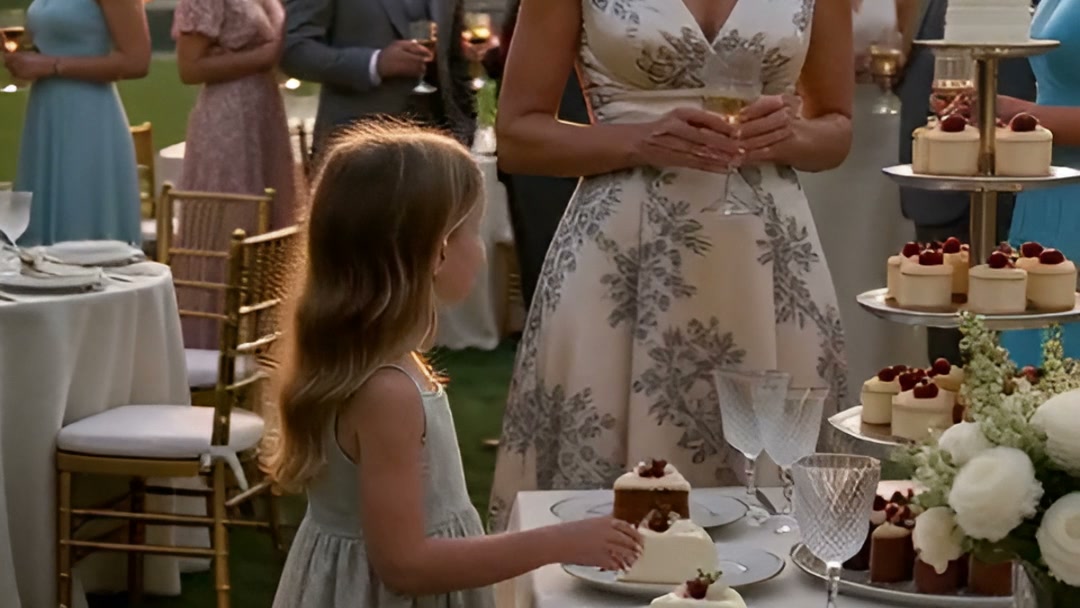
A wealthy woman slapped a hungry child’s hand away at a garden party… But the little girl’s father was already watching from the crowd.
The garden party was the kind of event that cost more to cater than most people earned in a year. White linen caught the late afternoon light. Crystal glasses clinked. Women in silk dresses laughed at things that weren’t funny.
Maya stood at the edge of the dessert table and stared at the cake.
She was six years old, small for her age, wearing a faded yellow dress that had been washed so many times the sunflowers on it had nearly disappeared. Her shoes were too tight. Her hair needed brushing. She didn’t belong here, and she knew it, and she didn’t care, because the cake had strawberries on top.
She reached out one thin hand toward a slice on a low plate.
The slap came so fast she didn’t see it.
The sound cracked across the garden like a snapped branch. Maya stumbled backward, clutching her hand to her chest, and every conversation in a thirty-foot radius went silent.
“Get your filthy hands off that.”
The woman’s name was Diane Hargrove. Late forties, cream-colored Valentino dress, diamond earrings that caught the light like two small fires. She stood over Maya with the particular fury of someone whose world had just been contaminated.
“Who brought this child here?” Diane’s voice carried across the whole lawn. “Someone remove her. Now.”
Maya didn’t cry out. She pressed her hand against her chest and looked up at Diane with wide, dry eyes. Her lip was trembling. That was the worst part — she was trying so hard not to cry in front of all these strangers.
A woman near the rosebushes took a step back. A man in a seersucker jacket looked away. Nobody moved. Nobody spoke.
Diane reached out and adjusted the cake plate, as if that was the end of it.
“Did someone just let a street child wander in off the road?” She looked around at her guests with a small, incredulous laugh. “Security should be handling the gate better. This is embarrassing.”
“She wasn’t wandering.”
The voice came from the back of the crowd.
The guests parted, not dramatically, but the way people instinctively clear space for someone who sounds certain. A man in a charcoal suit walked through the gap. Mid-fifties, broad shoulders, silver at his temples. He’d been standing near the bar a minute ago, holding a drink. He wasn’t holding it anymore. He’d set it down somewhere and now both hands were free.
He walked straight to Maya.
He crouched down in front of her, right there on the grass, without looking at anyone else. He took her small hand gently and turned it over to look at the red mark across her palm. His jaw tightened. He exhaled slowly through his nose.
“Hey,” he said quietly. “You okay?”
Maya nodded, just barely. “It stings.”
“I know.” He kept his voice low, just for her. “I’m here. It’s okay.”
Then he stood up.
He was taller standing than he’d seemed walking. Diane took one involuntary step backward.
He looked at her. Not with rage — that would have been easier. His face was completely flat. The way a room goes quiet before a storm, not during it.
“She’s my daughter,” he said.
The garden went so still you could hear the fountain.
Diane’s smile didn’t collapse all at once. It went in stages. The certainty first, then the color in her face, then something around her eyes that might have been the beginning of understanding exactly what she’d done.
“I — ” she started.
“Don’t.” He didn’t raise his voice. “There’s nothing you can say right now that helps you.”
“I didn’t know — she wasn’t — there was no way to know she was — “
“You didn’t need to know whose child she was,” he said. “She was six years old reaching for a piece of cake. That was enough information.”
Someone near the fountain cleared their throat. A woman in a blue dress set her glass down on the nearest table and didn’t pick it up again.
“Richard, I — ” Diane tried a different angle. “You know I didn’t mean — “
“You screamed at her in front of two hundred people and told someone to have her removed.” He bent down and picked Maya up, settling her against his side. She wrapped her arms around his neck and buried her face against his collar. “I watched that happen. So did everyone here.”
He looked at the crowd. Familiar faces — business partners, clients, people he’d known for fifteen years. Some of them were looking at the ground. Some of them were looking at Diane.
“Richard, please,” Diane said, and now the composure was completely gone. Her voice had gone thin and strange. “This is my home. This is my event. I didn’t — I never would have — “
“The Hargrove Foundation gala,” he said quietly. “The one my firm sponsors. The one I was going to write the check for Monday morning.” He paused. “I’ll have my assistant redirect that gift.”
He didn’t announce a number. He didn’t need to. Diane knew the number. Everyone in Diane’s inner circle knew the number, because she’d mentioned it, casually and strategically, at every opportunity for three months.
“The mark on her hand will be gone by tomorrow,” he said. “But she’ll remember today for a long time.” He looked at Diane one last time. “So will everyone here.”
He carried Maya through the crowd toward the estate’s side gate. She still had her face pressed against his neck. As they passed the dessert table, he reached out with his free hand, plucked a strawberry from the top of the nearest plate, and placed it in Maya’s hand.
“There you go,” he said quietly.
She looked at it. Then she looked at him.
“Daddy,” she whispered, “that lady was really mean.”
“Yes,” he said. “She was.”
“Are you mad?”
“Yes,” he said again. “But not at you. Never at you.”
They walked out through the side gate into the late afternoon gold, and the latch clicked shut behind them.
Back on the lawn, nobody spoke for a long moment.
Then the woman in the blue dress picked up her bag. “I think I need to get going,” she said to no one in particular. Her husband nodded and followed her. Someone else began folding a napkin very carefully, not eating anymore.
Diane stood at the dessert table alone, surrounded by crystal and white linen and a tiered cake with strawberries on top, and no one moved to stand beside her.
The fountain kept running. The golden light held. Everything looked exactly the same as it had an hour ago.
But the check would not be coming Monday. And every person in that garden had seen her slap a child’s hand for reaching toward a piece of cake, and then watched the girl’s father carry her away, and they would not forget it, no matter how many parties Diane Hargrove hosted, no matter how perfectly the linen was pressed or how brightly the crystal caught the light.
She had humiliated a six-year-old girl in front of her entire world.
And her entire world had watched.