He Slapped Her At Dinner — Their Seven-Year-Old Said Four Words
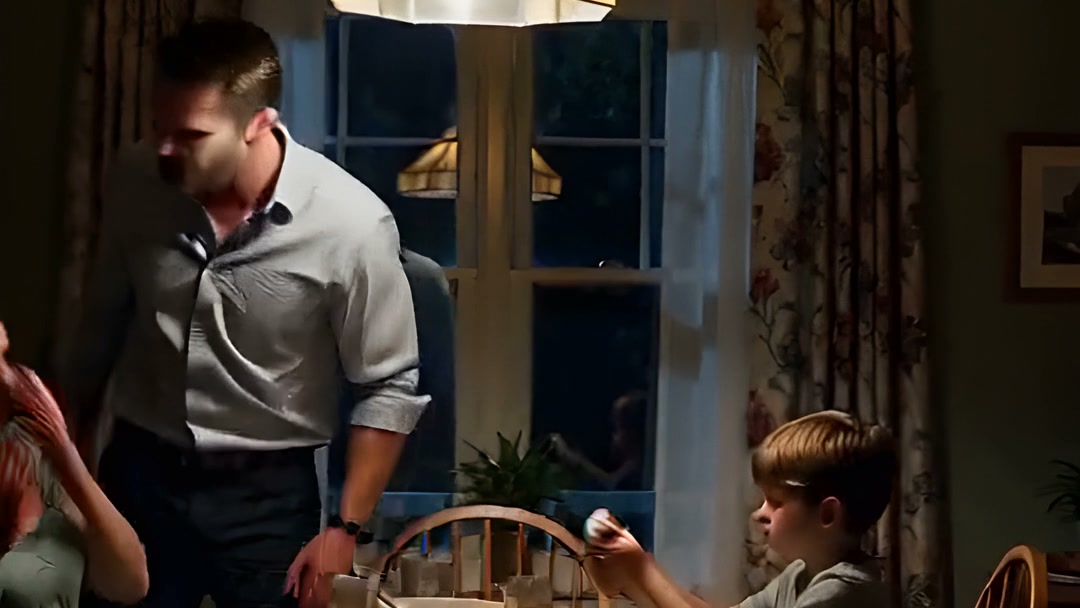
Her husband slapped her across the face at the dinner table… But their seven-year-old son set down his fork and said the four words that made a grown man afraid.
The kitchen smelled like spaghetti and dish soap. Three plates. A half-eaten dinner. The overhead light buzzed low.
Marcus was seven. He’d learned to read the air before the yelling started — the way his dad’s jaw set, the way his mom’s shoulders went up toward her ears. He watched it now from across the table, fork halfway to his mouth.
“I asked you one thing,” his father said. His voice was quiet. That was worse than loud.
His mother, Claire, kept her eyes on her plate. “I forgot to pick it up. I’m sorry — I had Marcus’s appointment, and then the traffic on Route 9 was —”
The slap was flat and fast.
Her head turned with it. Her hand went to her cheek. The room went silent in the way a room does when something crosses a line it has never crossed before.
Marcus set his fork down on the plate.
Small sound. Metal on ceramic.
He didn’t look away.
“Marcus,” his father said, a warning folded inside the name. “Eat your dinner.”
Marcus looked at his father. “Dad.”
“I said eat.”
“I’m telling my teacher.”
The words were small. They landed like a stone dropped in still water.
His father blinked. Something behind his eyes shifted — the anger pulling back, making room for something Marcus had never seen on that face before. Something that looked like fear.
“You’re not going to do that,” his father said. But his voice had changed. The hardness was gone. In its place was something careful, something that was almost a question.
“I’m telling her tomorrow,” Marcus said. He didn’t raise his voice. He didn’t need to.
His father took a step back from the table. “Marcus, what happens in this house —”
“Is wrong,” Marcus said.
Claire made a sound — not quite a word, not quite a cry.
Marcus turned to her. “Mom.” He waited. “Look at me.”
She lifted her head slowly, like it cost her something. Her eyes were wet, the left side of her face carrying the red shape of her husband’s hand. She looked at her son.
He held her gaze across the table. Seven years old. Fork set down. Completely still.
“You don’t have to say sorry to him,” Marcus said. “You didn’t do anything.”
She pressed her lips together. A tear ran the side of her face that didn’t hurt.
His father’s hand moved to the back of a chair. He gripped it. “You don’t understand what you’re doing, Marcus.”
“I understand,” Marcus said. “I’m not little.”
The refrigerator hummed. A car passed outside. The spaghetti went cold on three plates.
“If you walk into that school —” his father started.
“I’m going to walk in,” Marcus said. “You can’t drive me anymore.”
His father opened his mouth. Closed it.
Marcus looked back at his mother. “Can you call Grandma to pick me up in the morning?”
Claire stared at her son. Something was shifting inside her — she could feel it, slow and enormous, the way a wall finally cracks after years of pressure against it.
“Yes,” she said. Her voice was almost steady. “I can call her.”
“Good.” Marcus picked his fork back up.
His father pushed the chair aside and walked out of the kitchen. His footsteps hit the hallway. The bedroom door shut — not a slam, which was worse. A controlled click.
Marcus twirled spaghetti onto his fork.
“You okay?” he asked his mother.
She laughed. It surprised her. One short, wet sound — half cry, half something she hadn’t felt in so long she’d forgotten what to call it.
“No,” she said honestly.
“Me neither,” said Marcus. “But we’re going to be.”
He ate his bite of spaghetti.
She watched her son for a long moment. Then she reached across the table and put her hand over his small one. He turned his palm up and held it.
The next morning, Marcus walked into his second-grade classroom and asked to speak to his teacher privately before the bell.
Miss Calloway listened for eleven minutes, taking notes on a yellow legal pad.
By 10 a.m., she had called the school counselor.
By noon, a mandatory report had been filed.
By 3:15, when Claire came to pick Marcus up — in her mother’s car, a bag packed, her face still carrying a faint bruise — a social worker was already waiting in the principal’s office.
His father didn’t come home that night.
Or the night after.
Six weeks later, a judge signed a protective order in a courthouse twelve miles away. Claire sat in the hallway outside the courtroom and cried in a way she hadn’t let herself cry in four years — loudly, and without apologizing for it.
Marcus sat beside her on the bench. He handed her a folded paper towel from his pocket.
“I got it from the bathroom,” he said. “In case.”
She laughed again. The same sound — half cry, half something better.
“You planned ahead,” she said.
“Miss Calloway says that’s a good skill,” he said seriously.
She pulled him close, pressed her mouth to the top of his head.
“It is,” she said. “It really is.”
A seven-year-old boy had set down a fork and said four words. And everything that followed — the report, the order, the first safe night — had started exactly there, in a small kitchen, under a buzzing overhead light.
He hadn’t looked away.
And that had been enough.