Good day, puzzle friends, and welcome into the warmest little bakery in the village!
The shelves are stacked with fresh loaves, the counter is covered with cakes, and the lamps are glowing softly.
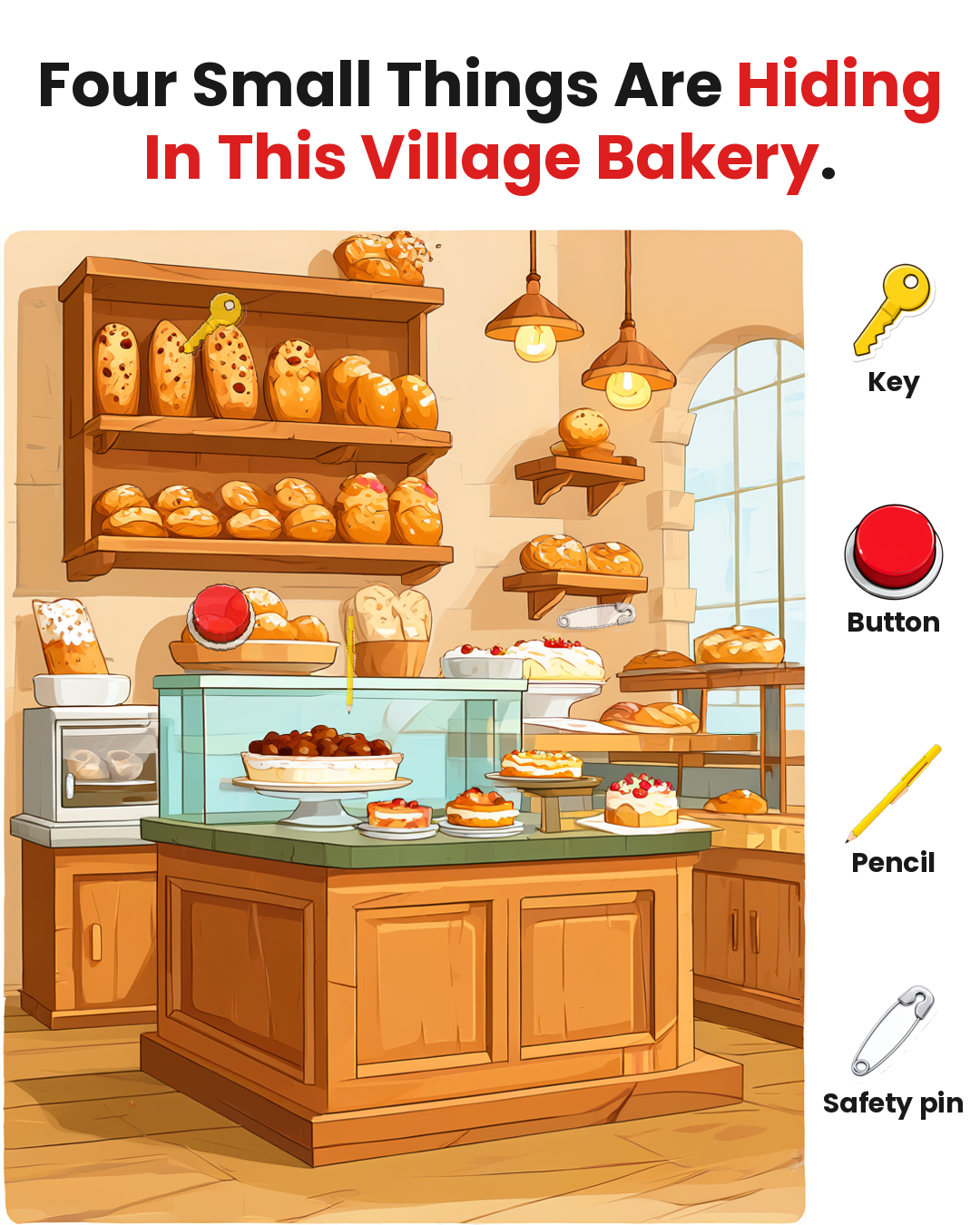
But somewhere in all that bread and cream, four small everyday objects have been left behind.
You are looking for a key, a button, a pencil and a safety pin, and all four are shown along the side of the picture.
Every one of them really is there, in plain view, with nothing on top of it.
The trick is that each one is sitting somewhere you would never think to look in a bakery.
A good tip: ignore the cakes completely and search the shelves, the edges and the empty corners first.
Find all four and you have sharper eyes than most of the people who will see this picture today.
Take your time and look closely before you scroll down!
Search The Edges, Not The Middle
When we look at a busy picture, our eyes go straight to the centre and to the brightest, biggest thing in it. In this bakery that means the glass display case and the beautiful cakes on the counter, and that is precisely where none of the four objects are hiding.
A much better method is to work around the outside first. Run your eyes along the top shelf from left to right, then down the right-hand wall, then along the floor, then up the left side. Only when you have been all the way around should you allow yourself to look at the middle of the picture.
This works because hidden-object pictures are almost always built the same way: the eye-catching part of the scene is the decoy, and the real answers sit quietly at the borders, on shelves, on edges and in the small gaps between things.
Know The Shape Before You Look
Here is a habit that makes an enormous difference, and hardly anybody uses it. Before you start searching, look carefully at the four small pictures along the side and fix each shape in your mind one at a time. Not all four together, just one.
The reason is that your brain can only hold one search target clearly at a time. If you go hunting for a key, a button, a pencil and a pin all at once, you are really hunting for nothing in particular, and your eyes slide over all four of them. Scientists who study this call it a search template: the clearer your template, the faster the object jumps out at you.
So do one full pass of the bakery looking only for a long thin yellow shape. Then do another pass looking only for a small red circle. Four slow passes will beat twenty frantic ones every single time.
The Oldest Game In The Picture Book
Hidden-object pictures are far older than most people imagine. Illustrators in the eighteen hundreds drew elaborate scenes with faces concealed in the leaves of trees and animals folded into the shapes of clouds, and families spent whole evenings around a single engraving.
The idea was never only entertainment. Art teachers used these pictures to train students to see shapes rather than objects, which is the first real skill of drawing. A beginner sees a loaf of bread, while a trained eye sees an oval with a line across it.
That is exactly the skill this puzzle asks for. The moment you stop seeing bread and cakes and start seeing shapes and colours, the four strangers in this bakery stand out as if someone had put a spotlight on them.
Can You Beat The Clock?
Most people find two of the four objects very quickly, then spend far longer on the remaining two. The average time for all four is around a minute, and anything under thirty seconds is genuinely impressive.
Here is a friendly challenge: find all four, then hand the picture to someone else without saying a word about where you looked. Watching another person search the cakes while the pencil stands right there behind the glass is a small, quiet pleasure.
And if one of the four refuses to appear, walk away for twenty seconds and come back. Fresh eyes find it almost instantly.
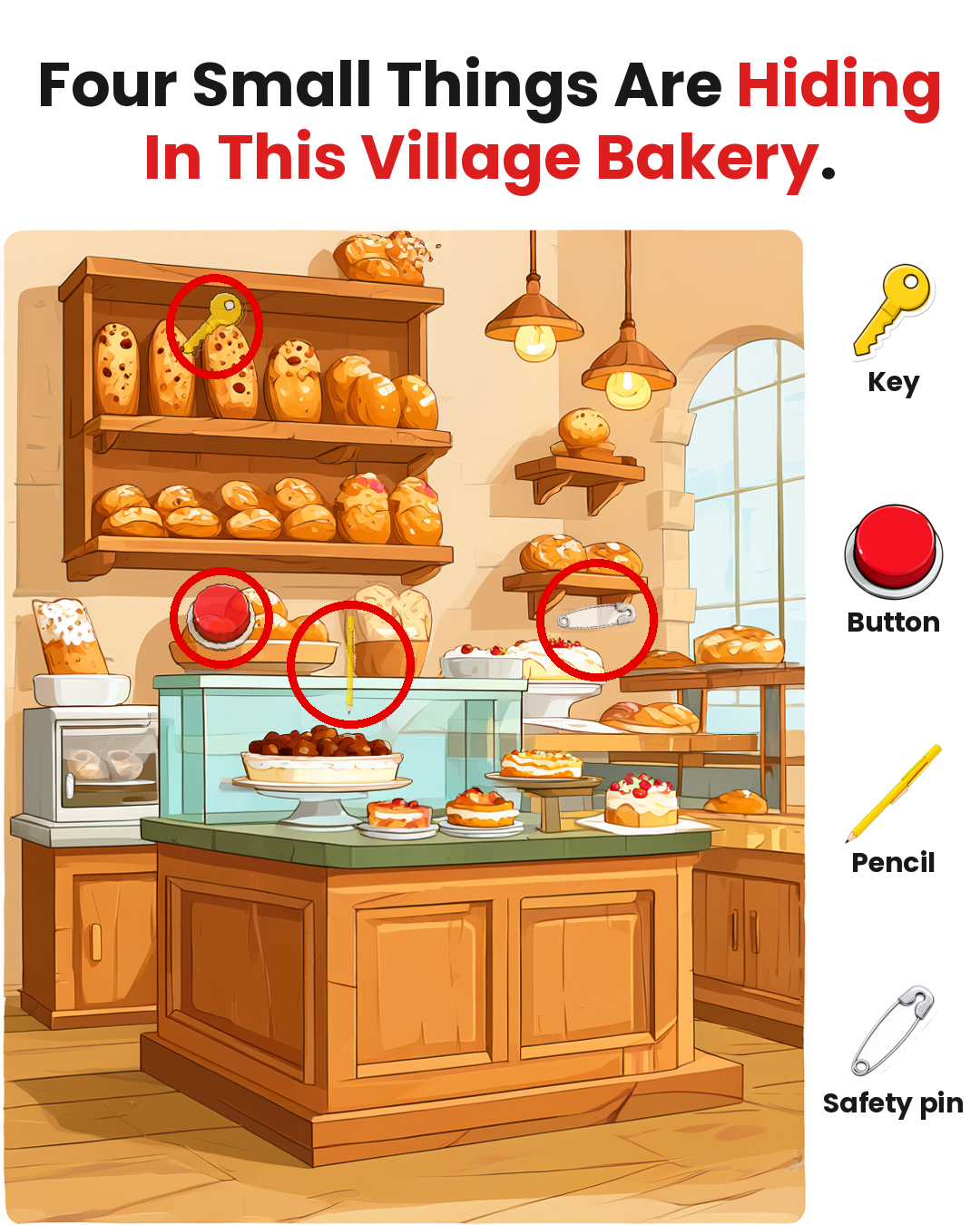
ANSWER: The key is on the top bread shelf, the red button is on the small cake stand to the left, the yellow pencil is standing behind the glass display case, and the safety pin is lying on the little wall shelf on the right
Exactly Where The Four Are
The golden key is on the very top shelf of bread, hanging between the second and third loaves on the left. It is roughly the same warm yellow as the crusty bread around it, which is why it stays invisible for so long.
The red button is sitting on the small white cake stand on the left side, just below the shelves, where it looks exactly like a round berry topping on a little cake. The yellow pencil is standing upright behind the left corner of the glass display case, half in front of the pale wall, so it reads as part of the shop fittings. The safety pin is lying flat on the narrow wooden wall shelf on the right, below the bread rolls, where its thin silver outline blends into the shelf’s edge.
Why They Are So Hard To See
Every one of these four objects was placed on a background of a similar colour or a similar shape, and that is the whole secret. The key is yellow on golden bread. The button is red and round among round red fruit decorations. The pencil is a thin vertical line against a vertical edge. The pin is thin, pale and silver on a light wooden shelf.
This is the same principle that animals use in nature. Camouflage does not mean being covered up. It means matching the pattern around you so completely that the eye never separates you from the background in the first place. Not one of these four objects is hidden behind anything at all, and yet most people need a full minute to find them.
How Did You Do?
All four in under 30 seconds: eagle eyes, and a rare gift for seeing shapes instead of things.
All four in under a minute: excellent work, and better than most people manage.
Three out of four: a very respectable score. The one you missed was almost certainly the safety pin.
Two or fewer: no cause for concern at all. Look once more, one object at a time, and watch how quickly the bakery gives up its secrets.