Hello, puzzle friends, and welcome to a sunny morning in the meadow!
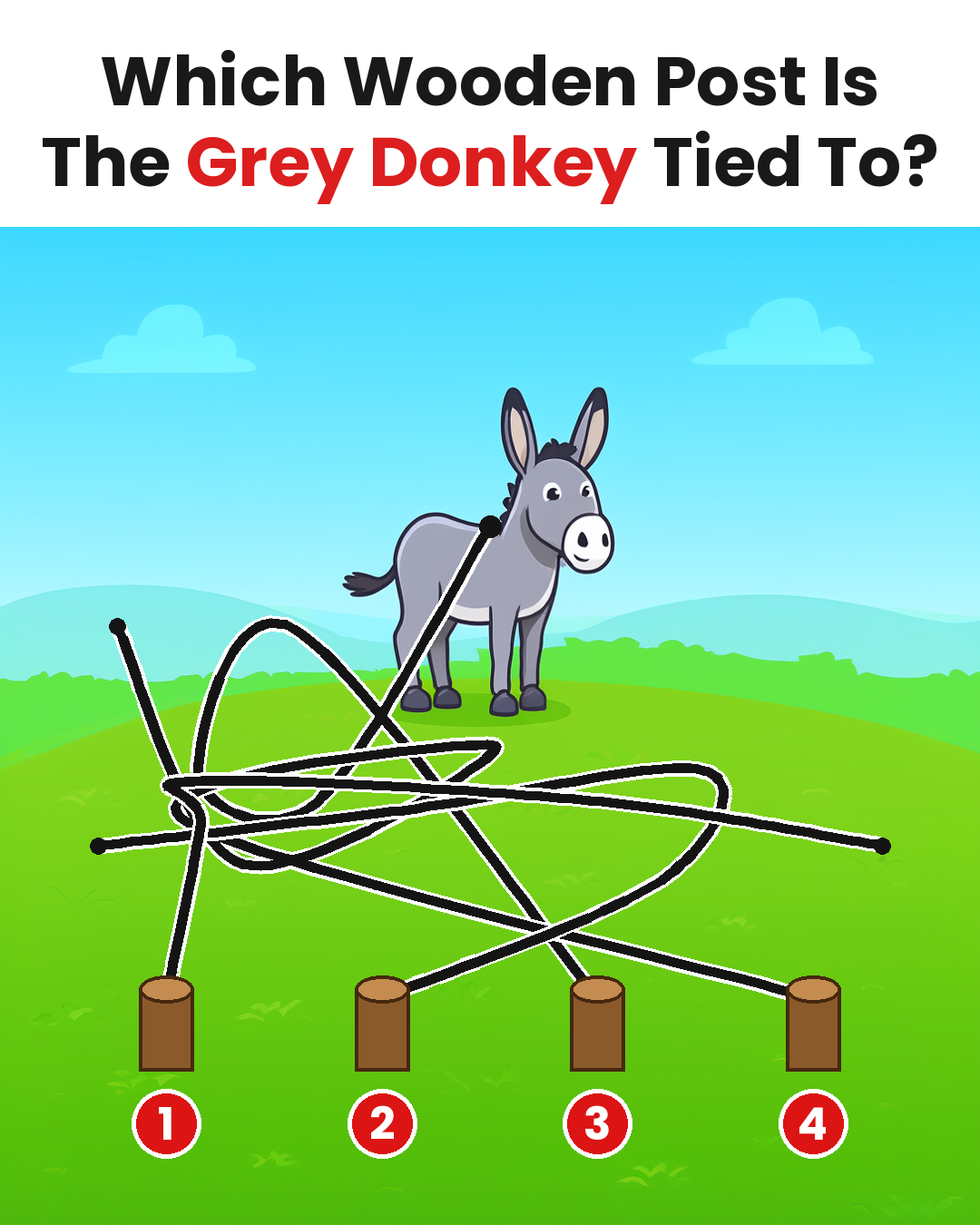
A friendly grey donkey is standing on the grass, happy as can be, with the hills behind him.
Someone has tied him to one of the four wooden posts at the bottom of the picture.
The trouble is that four long ropes are lying across the field, crossing over and under each other in a tangle.
Only one of those ropes actually runs from the donkey to a post. The other three are just there to confuse you.
Your job is to follow the right rope with your eyes and tell us the number of the post he is tied to: 1, 2, 3 or 4.
The tip is simple but important: start at the donkey, not at the posts.
Take it slowly, and try to do it without using your finger. That is the real test!
Take your time and look closely before you scroll down!
Always Start At The Animal
Nearly everyone begins this puzzle the wrong way round. They look at post number one, follow its rope upward, lose it in the middle of the tangle, and start again at post number two. By the time they reach the fourth post, their eyes are tired and the lines all look the same.
There is a much better way, and it costs nothing. Start where the rope is tied to the donkey. From there, there is only ever one line to follow, so you can never take a wrong turn. Every crossing you meet is just a line passing behind yours, and you simply keep going straight through it.
If you do lose the thread halfway down, go back to the donkey and begin again rather than guessing from where you stopped. It feels slower, but it is almost always faster in the end.
Why The Crossings Fool Us
Our eyes are brilliant at following a continuous line, which is how we read a page of writing. But at a crossing, the brain has to make a split-second choice about which line continues and which one passes underneath, and it does not always choose correctly.
When two lines cross at a shallow angle, the brain tends to follow the smoother path rather than the true one. It prefers gentle curves to sudden turns, so if a false rope offers an easier, flatter continuation at a crossing point, your eyes will happily slide onto it without telling you. That is exactly why these puzzles are drawn with so many shallow crossings in the middle of the picture.
There is also a simple matter of effort. Holding a single thin line in your attention for several seconds is real mental work, and the longer the rope, the more likely your focus is to drift. The puzzle is not testing your eyesight at all. It is testing your patience.
An Old Puzzle With A Long History
Tangled-line puzzles have been printed for well over a hundred years. In the old picture magazines they were usually drawn as kite strings, fishing lines or a bunch of balloons held by a group of children, and the question was always the same: who is holding which one?
The form survived because it needs no words at all. A child, a grandparent and somebody who speaks another language entirely can all look at the same picture and understand the question immediately. Very few puzzles can say that.
Today the same idea is used seriously in eye-tracking research and in tests of visual attention, because following one line through a crowd of others turns out to be a good measure of how well a person can hold their focus on one thing while ignoring everything else.
A Friendly Challenge
Most people need between fifteen and thirty seconds to trace the right rope from end to end without cheating. Under ten seconds is genuinely excellent.
Here is the harder version, if you are feeling brave: do it with your hands in your lap, using only your eyes. No finger on the screen, no pencil. That is how this puzzle was meant to be solved, and it is surprisingly difficult.
When you have your answer, send the picture to a friend and ask them for their post number before you tell them yours. Comparing answers is half the fun.
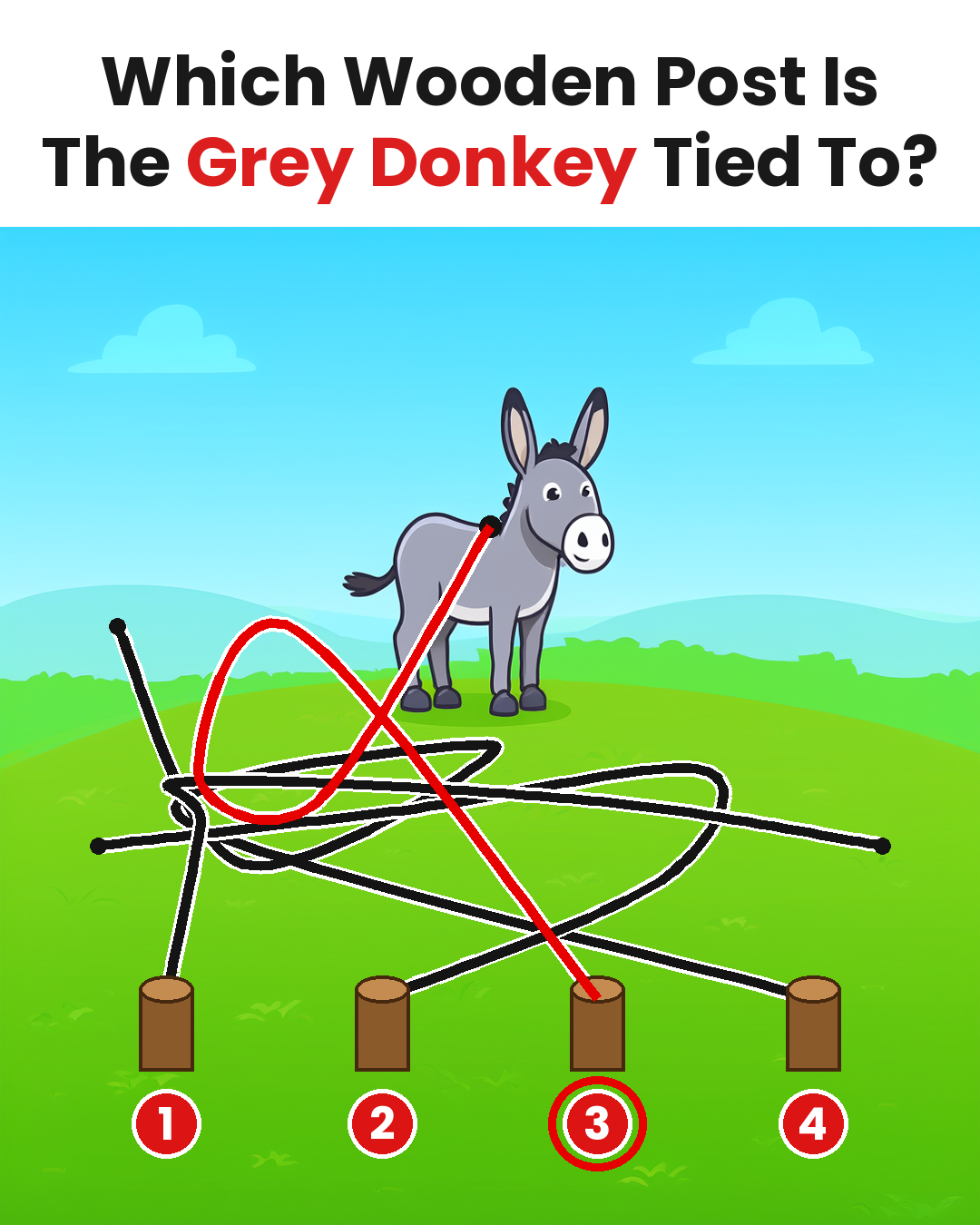
ANSWER: Post number 3
Following The Right Rope
The rope that matters is tied at the donkey’s neck, near his shoulder. From there it runs down and to the left into the tangle, loops around in a wide curve on the left side of the field, comes back across the middle of the picture, and then drops down in a long straight line to the post marked number 3.
In the answer picture that rope is drawn in red, and you can see it clearly: it is the only line that touches both the donkey and a post. The other three ropes simply run from one edge of the field to the other. Two of them end at posts 1 and 2 with no animal at the other end at all, and the fourth wanders across to post 4. None of them has anything to do with the donkey.
Why Post 4 Catches So Many People
Post number 4 is the most popular wrong answer, and there is a good reason for it. The rope that ends there crosses the donkey’s rope twice in the middle of the picture, at a very shallow angle both times, and it continues in almost exactly the same direction afterwards.
At that second crossing, the brain quietly swaps one line for the other because the new path is smoother and requires less effort to follow. You never notice the swap happening. You simply arrive at post 4 feeling perfectly confident, which is the most charming and most annoying part of this kind of puzzle.
The defence against it is to slow down at every crossing instead of speeding up. One extra second at each junction, and the tangle loses all of its power.
How Did You Do?
Under 10 seconds with your eyes alone: outstanding. You have the steady focus of a watchmaker.
10 to 25 seconds: very good indeed, and the usual result for someone who started at the donkey.
25 to 50 seconds: perfectly normal, especially if you began at the posts and had to start over.
If you answered 4, you are in excellent company. Look again at the long red line and you will see exactly where your eyes took the smoother road.